首页 BLOG Ice Cream Robot Vending Machine ROI: 5 Realistic Scenarios Based on Location & Traffic Volume
Ice Cream Robot Vending Machine ROI: 5 Realistic Scenarios Based on Location & Traffic Volume
Date:2025-12-06 Author:Huaxin
This article notes no one-size-fits-all ROI for ice cream vending robots, as profitability depends on location, foot traffic, and climate. It uses Huaxin’s robot data across 5 global scenarios (e.g., U.S. malls, SEA airports) to detail daily sales, monthly net profit, and payback periods (4.4–31.1 months). It also analyzes region-specific risks and offers deployment advice based on budget and goals, concluding the robots are a low-investment, high-return option.

There is no one-size-fits-all answer to the ROI of ice cream vending robots for entrepreneurs and operators. Profitability depends heavily on location strategy, foot traffic patterns, and local climate conditions—all of which collectively impact sales volume, costs, and ultimately profit margins.
Compared to traditional brick-and-mortar stores, these smart vending devices offer 24/7 unattended operation, low labor costs, and flexible deployment. Their value is maximized in optimal scenarios. This analysis leverages real operational data from markets including Europe, North America, and Southeast Asia to evaluate the ROI of ice cream vending robots across practical use cases.
Deployment Scenarios for Ice Cream Vending Robots
To ensure practicality, we categorize scenarios based on three core dimensions—foot traffic, deployment environment, and operational cycle (summer-only/year-round)—aligned with global market realities:High foot traffic: Areas with over 10,000 daily visitors (e.g., international airports, flagship shopping malls)
Medium foot traffic: Areas with 3,000–10,000 daily visitors (e.g., corporate parks, coastal beaches)
Low foot traffic: Areas with fewer than 3,000 daily visitors (e.g., community centers, suburban campuses)
Indoor deployment offers stable temperatures and consistent foot traffic, while outdoor deployment relies more on seasonal peaks and requires mitigating climate risks. Summer-only operation suits regions with distinct warm seasons, while year-round operation is ideal for subtropical climates.
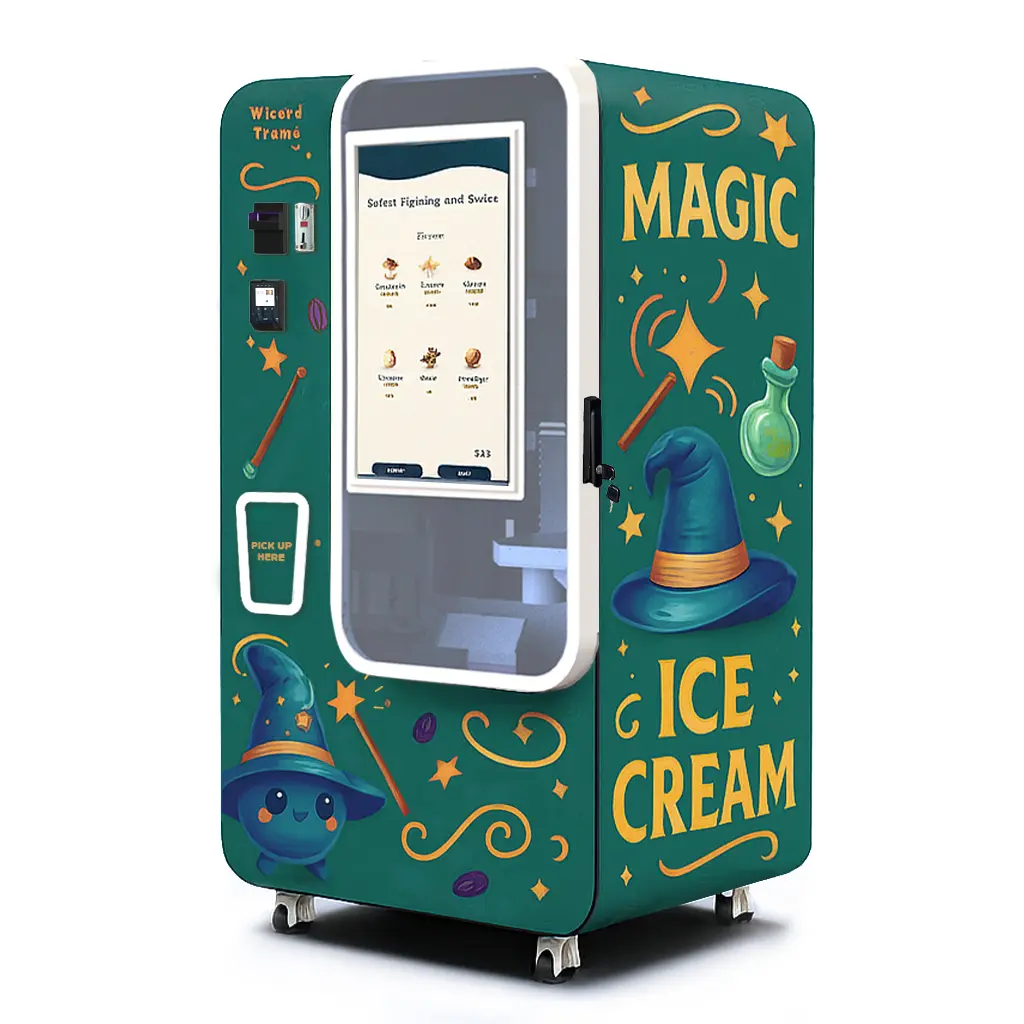
All scenarios use Huaxin's smart ice cream vending robot as the standard configuration, with core specifications:
Average price per serving: $4
Ingredient cost per serving: $0.80
Daily power consumption: 12 kWh
Equipment unit price: ~$7,000
Operating costs include location fees (market-differentiated), maintenance fees, and minimal labor costs for restocking.
ROI Breakdown Across 5 Real-World Scenarios
Combining on-site operational experience and financial projections, we analyze the ROI and payback periods for five real scenarios. Detailed comparisons are shown below:| Scenario | Daily Sales | Avg. Price | Monthly Net Profit | Payback Period |
| High-Traffic Indoor (Summer-Only) | 250 servings | $4 | $19200 | 4.4 months |
| High-Traffic Outdoor (Year-Round) | 180 servings | $4 | $12080 | 7 months |
| Medium-Traffic Indoor (Year-Round) | 80 servings | $4 | $5380 | 15.2 months |
| Medium-Traffic Outdoor (Summer-Only) | 120 servings | $4 | $8420 | 10 months |
| Low-Traffic Indoor (Year-Round) | 40 servings | $4 | $2640 | 31.1 months |
High-end malls in cities like Los Angeles and New York see over 15,000 daily visitors in summer, with families and shoppers as core customers. The vending robot's fast serving speed and customizable body stickers effectively capture impulse purchases, while the indoor environment eliminates climate risks. Restocking is required 2–3 times weekly, and cleaning every 5 days—resulting in low operational input. Monthly fixed costs are approximately $4,800, with a monthly gross profit of $24,000 ([$3.2 profit per serving] × 250 servings/day × 30 days). High sales volume is the key driver of rapid payback.
Scenario 2: International Airports in Southeast Asia
International airports in cities like Bangkok and Singapore handle over 20,000 daily visitors year-round, with stable demand from travelers waiting for flights or collecting luggage. Huaxin's vending robot supports over 20 languages, with a quickly switchable interface to accommodate international passengers. 24/7 operation ensures consistent sales, with remote monitoring and restocking via a mini-program. Monthly fixed costs are ~$5,200, and monthly gross profit reaches $17,280 ([$3.2 profit per serving] × 180 servings/day × 30 days). Stable year-round ice cream demand offsets high location costs and boosts monthly net profit.
Scenario 3: Corporate Parks in Europe
Corporate parks in Berlin and Paris attract 5,000–8,000 daily visitors, with ice cream demand concentrated during lunch and afternoon tea breaks. While demand dips slightly in winter, corporate events effectively compensate. Monthly fixed costs are ~$2,300, and monthly gross profit is $7,680 ([$3.2 profit per serving] × 80 servings/day × 30 days). Stable weekday foot traffic ensures no significant seasonal fluctuations in sales.
Scenario 4: Beaches in Australia
Beaches in Sydney and Melbourne welcome 8,000–10,000 daily visitors during the Southern Hemisphere summer. Huaxin's vending robot is designed to withstand temperatures up to 35°C, with a stainless steel body resistant to sea breeze corrosion. Weekends and holidays are peak sales periods, requiring daily restocking during busy times—remote inventory alerts prevent stockouts. Monthly fixed costs are $3,100, and monthly gross profit hits $11,520 ([$3.2 profit per serving] × 120 servings/day × 30 days). While summer-only operation (4 months) requires amortizing winter costs, overall profitability remains high.
Scenario 5: Community Centers in Canada
Community centers in Toronto and Vancouver serve 2,000–3,000 local residents weekly, with families and event participants as primary customers. Winter sports leagues and community workshops sustain off-peak sales. Restocking intervals can be extended to 5–6 days, with weekly cleaning. Monthly fixed costs are ~$1,200, and monthly gross profit is ~$3,840 ([$3.2 profit per serving] × 40 servings/day × 30 days). Low initial investment and operating costs make this a low-risk entry point for new operators.
Region-Specific Risk Analysis
While the above scenarios are based on real operational data, global operators must address region-specific risks:Seasonal fluctuation risk: Outdoor summer-only models in Europe and North America face 6–8 months of low sales. The robot's mobile wheels allow relocation to indoor malls or train stations during off-peak seasons to meet indoor demand.
Equipment idleness risk: Low-traffic locations may experience weekday lulls. Cloud-based dynamic pricing or combo promotions via the mini-program can attract customers.
Ingredient waste risk: Remote inventory monitoring and low-temperature preservation technology keep ingredient waste below 3%.
How to Choose Deployment Scenarios & Equipment Based on Budget & Goals
Operators can make data-driven decisions based on budget, risk tolerance, and long-term goals:Budget < $10,000
Prioritize low-traffic indoor (year-round) or medium-traffic outdoor (summer-only) scenarios. These options minimize financial pressure with no additional equipment investment, keeping initial capital outlay manageable. Both scenarios offer reasonable payback periods without long-term capital immobilization.
Pursuing Short Payback Period
Focus on high-traffic indoor (summer-only) or high-traffic outdoor (year-round) scenarios. The core logic is "high traffic for high turnover" to quickly amortize fixed costs. Indoor environments eliminate climate risks, while year-round operation avoids significant off-peak periods—both reduce revenue volatility and ensure rapid capital recovery. Funds can be reinvested in new locations post-payback to achieve economies of scale, making these high-traffic scenarios optimal.
Prioritizing Long-Term Stable Returns
Medium-traffic indoor (year-round) is the best choice. Corporate park customers (professionals) have stable demand and high repeat purchase rates, avoiding extreme sales fluctuations and off-peak revenue gaps. Indoor deployment reduces equipment wear from weather (wind, rain, extreme heat), ensuring stable long-term maintenance costs and minimizing downtime losses from unexpected failures.
The success of ice cream vending robots lies in precise alignment with global market dynamics. High-traffic summer locations enable rapid payback, while indoor year-round deployment ensures stable revenue. Based on the above analysis, we recommend two typical deployment combinations for new operators:
Balanced Growth Combo: High-traffic indoor (summer-only) + Medium-traffic indoor (year-round)
Leverages summer peak sales while maintaining year-round revenue
Combined payback period: ~6 months
Low-Risk Entry Combo: Medium-traffic outdoor (summer-only) + Low-traffic indoor (year-round)
Total initial investment: < $13,000
Flexible deployment adjustments based on market feedback
Success hinges on combining automation advantages with strategic planning. Weekly restocking, remote monitoring, and minimal maintenance ensure efficient operation. With global adaptability and high ROI potential across scenarios, Huaxin's ice cream vending robots emerge as a low-investment, high-return opportunity in the global self-service catering market.