首页 BLOG Soft Serve Ice Cream Vending Machine vs Traditional Ice Cream Shop: Profit & Cost Comparison
Soft Serve Ice Cream Vending Machine vs Traditional Ice Cream Shop: Profit & Cost Comparison
Date:2025-12-03 Author:Huaxin
This article compares soft-serve ice cream vending machines and traditional shops across costs, revenue, cash flow, and risks. Vending machines have negligible rent/labor costs, 24/7 operation, 30-second serving, 65%+ gross profit, 3–4-month payback, and $1.5k–$3k monthly net profit. They outperform traditional shops (high fixed costs, 12–24-month payback) by solving "high rent/labor, low efficiency, high risk" pain points, fitting impulsive consumer needs and entrepreneurs’ "low-investment, quick-return" goals.

The core consumption scenarios for ice cream are high-traffic areas such as shopping malls, scenic spots, and office buildings. Consumer decisions are mostly impulsive, and they pay great attention to the visibility of food preparation hygiene. For entrepreneurs, especially small and medium-sized investors, their core demands are to avoid the heavy rent burden and staffing difficulties of traditional stores, while achieving the entrepreneurial goals of "low investment, quick return, and stable profitability".
New entrepreneurs seek entry points with low thresholds and low risks, while existing practitioners hope to optimize profitability and achieve efficient expansion. Comparing soft-serve ice cream vending machines with traditional ice cream shops can effectively help both new and experienced operators make appropriate choices.
Traditional Ice Cream Shops vs. Soft-Serve Ice Cream Vending Machines
Traditional stores rely on continuous high fixed costs, while the main cost of vending machines is the purchase of equipment, with extremely low subsequent operating costs. The fundamental difference between these two models lies in their cost structures.The cost core of traditional ice cream shops lies in continuous high fixed expenses:
In terms of rent, it is necessary to occupy prime locations such as shopping malls and commercial streets. The floor area is usually no less than 15 square meters, with a monthly rent of 1,500–5,000 US dollars. An additional 3–6 months of rent is required as a deposit.
Labor costs remain high. It is necessary to employ 2–3 full-time employees responsible for cash register operations, production, and cleaning. The average monthly salary per person is 800–1,200 US dollars, resulting in a total monthly labor cost of 1,600–3,600 US dollars.
The initial decoration requires an investment of 5,000–15,000 US dollars, and annual maintenance costs must also be borne.
In terms of equipment procurement, the total investment for traditional ice cream machines, freezers, cash registers, etc., reaches 10,000–20,000 US dollars. Coupled with additional monthly expenses such as 300–500 US dollars for utilities, inventory management, employee training, and hygiene testing, the overall operating cost pressure is significant.
Soft-serve ice cream vending machines focus on one-time equipment investment, with extremely low subsequent operating costs:
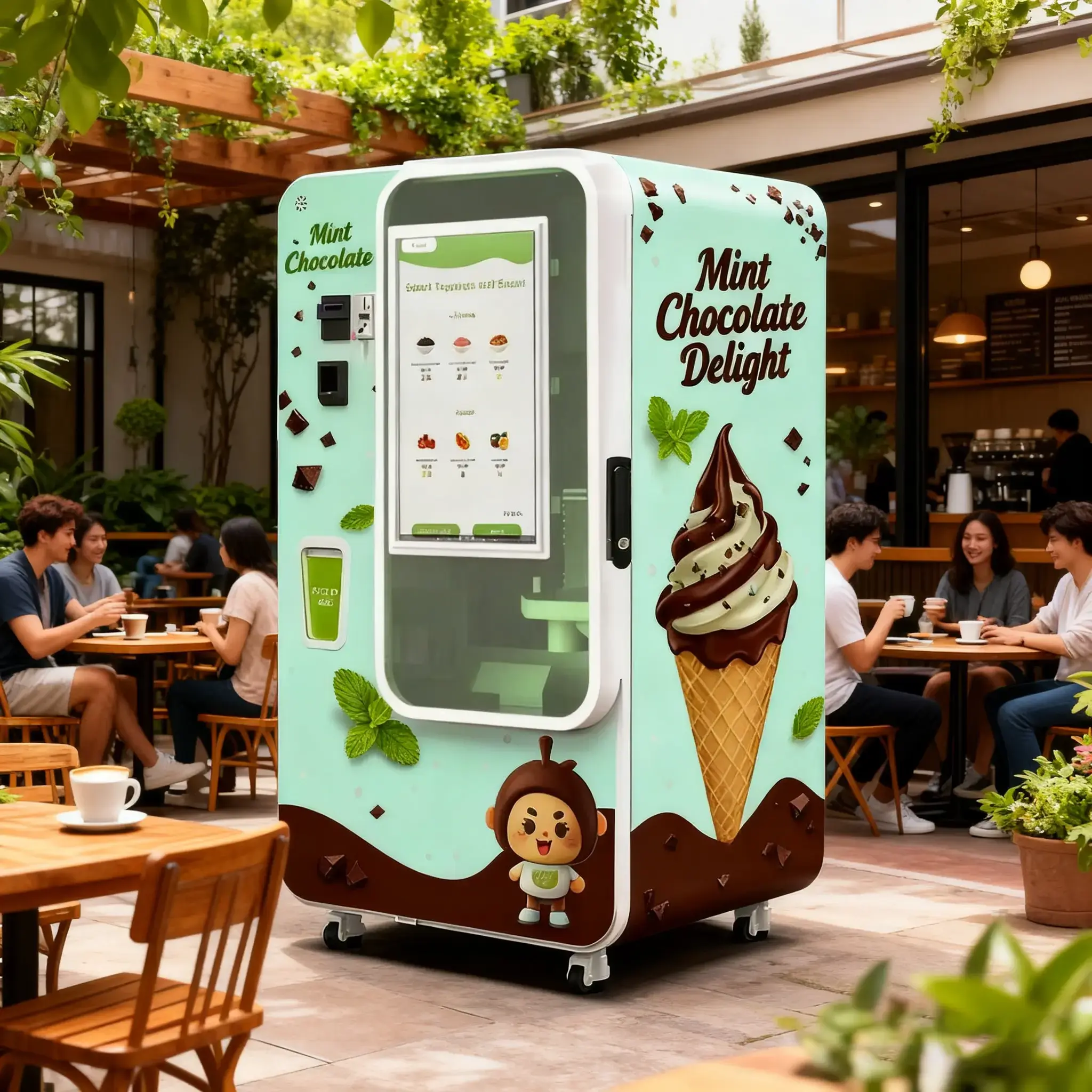
Rent costs are almost negligible. The equipment occupies only 0.85–0.95 square meters and can be flexibly placed in narrow spaces such as beside escalators and in office building pantries. The average monthly site fee is approximately 160 US dollars, and no additional expenses are required for self-owned venues.
Labor costs are almost zero. One person can easily manage 10 machines. It only takes 5 minutes to refill materials for a single machine, and it is equipped with a one-click automatic cleaning function. A single machine can save 7,200 US dollars in labor costs annually.
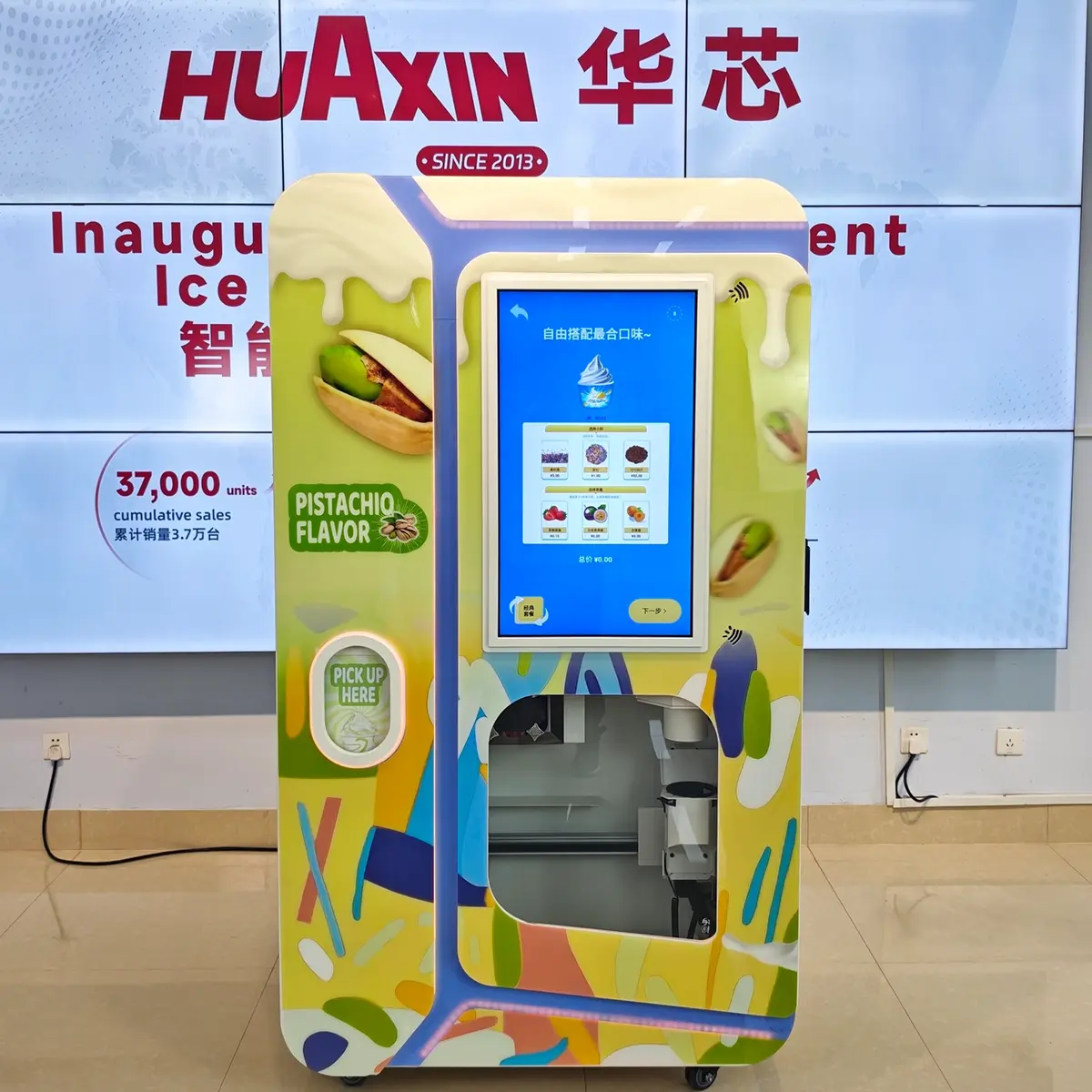
A single machine requires a one-time investment of 6,500–10,000 US dollars, integrating full functions such as refrigeration, discharge, and payment, with no need for additional configuration.
Among other operating costs, the daily power consumption is only 10–12 kWh, with an annual electricity cost of 432 US dollars. Combined with 24-hour remote monitoring and free system upgrades, inventory waste and training costs are further reduced.
Revenue Comparison Between Ice Cream Vending Machines and Traditional Stores
Revenue performance depends on operational efficiency, customer conversion rate, and profit margin. The following mainly compares the revenue of soft-serve ice cream vending machines and traditional stores from three calculable data aspects: turnover, gross profit margin, and net profit.1. Turnover
Traditional ice cream shops are limited by labor efficiency and space. It takes 2 minutes to make one ice cream, and 30% of impulsive consumers will give up purchasing due to long queues. Their monthly turnover is approximately 1,200–1,800 US dollars (200–300 cups per month, with each cup priced at 6–10 US dollars).
Soft-serve ice cream vending machines take 15–30 seconds to make a serving, which can effectively reduce customer loss. The average daily sales volume at high-traffic locations is about 200 cups, and the monthly turnover can reach 3,600–6,000 US dollars.
2. Gross Profit Margin
Although the raw material costs are similar, the high fixed costs of traditional ice cream shops will significantly compress the profit margin, with a gross profit margin of 40–50%.
The gross profit margin of soft-serve ice cream vending machines exceeds 65%. The raw material cost per cup is 1.5–2 US dollars, and the selling price is 6–10 US dollars (which can be adjusted at any time). Unique ice cream flavors can drive an increase in repurchase rate, further expanding the gross profit advantage.
3. Net Profit
The monthly net profit of traditional ice cream shops is 300–800 US dollars (after deducting rent, labor, and other costs). Many small shops struggle to make profits due to high fixed costs.
The monthly net profit of soft-serve ice cream vending machines is 1,500–3,000 US dollars (for shopping mall locations). It can also generate additional invisible revenue (such as screen advertising fees and cup advertising fees). Moreover, 80% of users will share their purchases on social platforms, driving 3–5 secondary purchases. The annual net profit of 10 machines exceeds 180,000 US dollars.
Cash Flow and Payback Period Comparison
For entrepreneurs and small and medium-sized investors with limited funds, cash flow and payback period directly determine whether a project can survive.The early cash flow of traditional ice cream shops is negative. The total initial investment is approximately 20,000–40,000 US dollars, and monthly fixed costs will continue to occupy funds. Cash flow pressure is more likely to occur during low-traffic periods.
Soft-serve ice cream vending machines can achieve positive cash flow within a few months. A single machine requires a one-time investment of 5,500–10,000 US dollars, with extremely low subsequent operating costs. It supports 24-hour unattended sales and real-time revenue monitoring on mobile phones, ensuring stable cash flow.
The payback period of traditional ice cream shops is approximately 12–24 months. High fixed costs and low-efficiency turnover lead to slow returns.
The payback period of soft-serve ice cream vending machines is approximately 3–4 months (for shopping mall locations). Customer data shows that shopping mall locations with an average daily sales volume of 200 cups can recover costs within 3 months. Our customers in the UK placed machines in scenic spots and recovered costs within 4 months.
Risk and Operational Complexity Comparison
Risk control and operational convenience determine the long-term feasibility of a business model.| Risk/Complexity Dimension | Traditional Ice Cream Shops | Soft-Serve Ice Cream Vending Machines |
| Initial Investment Risk | High: Insufficient customer flow will lead to significant capital losses. | Low: Even if a single location performs poorly, it will not affect the overall capital chain. |
| Operational Complexity | High: Requires management of employees, inventory, hygiene, and customer service, and is prone to human errors. | Low: The entire process is automated. A mobile app supports remote monitoring, one-click fault diagnosis, and parameter adjustment. 98% of problems can be solved remotely through video guidance. |
| Market Adaptability | Low: Fixed locations limit customer coverage, and it is difficult to relocate quickly when traffic declines. | High: Equipped with adjustable casters, allowing one person to move the equipment. It can be flexibly deployed according to changes in traffic. |
| Hygiene Compliance Risk | High: Manual operations increase the risk of cross-contamination. Continuous employee hygiene training is required to pass strict random inspections. | Low: Closed production process + dual sterilization with ultraviolet rays and ozone. It has obtained global certifications such as ETL, CE, and ETL, complying with the compliance requirements of various countries. |
| Business Interruption Risk | High: Factors such as staff shortages and equipment failures may lead to business suspension. | Low:24-houruninterrupted operation, with no risk of cylinder freezing. It has a global after-sales service team. |
Target User Groups
Soft-serve ice cream vending machines: Suitable for new entrepreneurs with no experience and low funds, investors seeking diversified income, and enterprises with high-traffic venues hoping to add new profit channels. They are also suitable for international operators and people pursuing passive income.Traditional ice cream shops: Suitable for experienced entrepreneurs with sufficient funds, team management capabilities, and a focus on brand building, especially for long-term locations with stable customer flow.
Soft-serve ice cream vending machines outperform traditional ice cream shops in all core indicators. They accurately address the four core pain points of traditional ice cream shops: "high rent, expensive labor, low efficiency, and high risk". At the same time, they perfectly match the core needs of contemporary consumers in high-traffic scenarios: "1-minute decision-making, 30-second meal pickup, visible hygiene, and sharing and dissemination". They not only enable entrepreneurs to achieve a "light-asset, low-risk" profit model but also allow consumers to obtain an experience that better conforms to instant consumption habits.