The Future of Retail: Why Smart Vending Machines Are Replacing Traditional Kiosks
Date:2026-03-30 Author:Huaxin
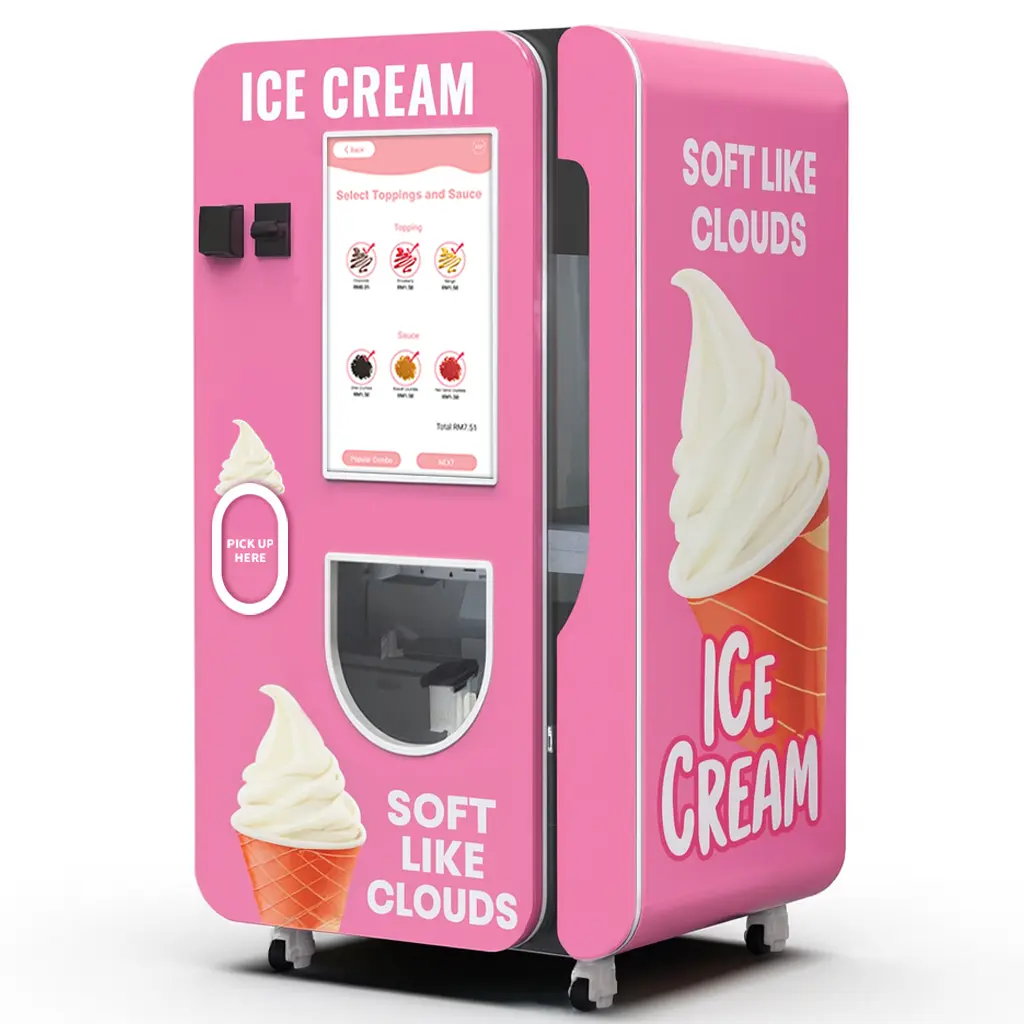
As labor costs continue to rise and consumers increasingly expect 24/7 instant satisfaction, the retail industry is undergoing a fundamental transformation. Smart ice cream vending machines are no longer just “machines that dispense ice cream,” but have evolved into new retail terminals integrating IoT, AI-driven decision-making, and remote management.

As labor costs continue to rise and consumers increasingly expect 24/7 instant satisfaction, the retail industry is undergoing a fundamental transformation. Smart ice cream vending machines are no longer just “machines that dispense ice cream,” but have evolved into new retail terminals integrating IoT, AI-driven decision-making, and remote management.
A truth that is already unfolding: retail is experiencing a profound shift—from “staffed” to “unmanned,” from “passive” to “proactive,” and from “standardized” to “personalized.” Ice cream vending machines are one of the most representative examples of this transformation.
1. Generational Shift in Consumer Behavior: They No Longer “Wait for Service”
If you still believe that “service must involve people to feel warm,” you may have missed the dramatic shift in consumer psychology over the past five years.
Data doesn’t lie: according to market research, more than 65% of consumers prefer contactless transactions in vending scenarios. In the United States, over 70% of smart vending machine users favor contactless payment. This is not a short-term habit, but a permanent shift in how a generation consumes.
My own observation supports this. Last year, in a shopping mall in Los Angeles, I stood next to a Huaxin ice cream machine for half an hour. Out of 10 buyers, 8 were young people aged 20–35. They walked up to the machine, scanned a code, selected a flavor, and received their ice cream within 15 seconds. The entire process was smooth. Not a single word was exchanged, yet they left with satisfied smiles.
What does this generation want?
| Consumer Needs | Traditional Kiosk | Smart Vending Machine |
| Immediacy | Queue and wait for staff | Ice cream ready in 15 seconds, instant purchase |
| Sense of Control | Passively receive service | Self-selection, full control of pace |
| Information Transparency | Ask staff for details | Nutrition and ingredients displayed on screen |
| Payment Methods | Cash, card | Mobile wallet, QR code, contactless |
| Operating Hours | 10–12 hours | 24 hours |
2. The Rise of Contactless Transactions: From Optional to Essential
Before 2020, contactless payment was a “bonus feature.” Today, it is a “must-have.”
The global smart vending machine market is expanding at an astonishing pace: it was valued at approximately $10.68 billion in 2025 and is expected to reach $24.54 billion by 2034, with a compound annual growth rate of 9.69%. More importantly, over 65% of smart vending transactions are already conducted via digital payment.
Huaxin Master.OS 2.0 smart cloud control system fully supports multiple payment methods, including credit cards, cash (banknotes and coins), and QR codes. More importantly, payment is not the endpoint—it is the entry point for data. Every transaction tells you who bought what, when they made the purchase, and how much they are willing to spend.
For operators, this is not just convenience—it is insight.
3. Digital Inventory Management: Machines Know Better What to Restock
What is the biggest pain point of traditional kiosks? Inventory.
You don’t know what sells well, when to restock, or which products should be removed. Ordering based on intuition often leads to either stock shortages or expired waste.
Smart vending machines completely solve this problem.
The combination of IoT and AI is reshaping inventory management. Through sensors and cloud platforms, smart machines can monitor in real time the remaining levels of each ingredient container, the temperature of each machine, and the sales trends of each location.
Snacktime, a Finnish company operating hundreds of smart vending machines, has achieved the following through IoT-based remote management:
- Supply chain costs reduced by 15%
- Revenue increased by 5% (through inventory optimization and precise promotions)
- Significantly lower failure rates and improved maintenance efficiency
4. Brand Automation: Machines Become Your “Best Employee”
Have you ever thought about this question: if a brand had a life of its own, how would it appear in front of customers?
In traditional kiosks, brand image depends on staff mood. A good day means friendly service; a bad day means indifference. What customers remember is not the brand, but “that person with a bad attitude.”
Smart vending machines never have a bad mood. They operate 24/7, 365 days a year, serving every customer with consistent attitude and standardized production quality.
More importantly, they can become proactive promoters of your brand.
A 32-inch 4K touchscreen is not just an ordering interface—it is also a branding channel. You can:
- Play brand promotional videos
- Push new product tasting campaigns
- Display ingredient traceability information
- Show slow-motion close-ups of the production process
5. Real Case: From “Kiosk” to “Smart Retail Terminal”
In 2024, a convenience store near the University of Southern California (USC) conducted an experiment. They placed a Huaxin Easy7 fully automatic ice cream machine next to the checkout counter, occupying less than 1 square meter.
The results were surprising:
- Average daily sales: 45 cups (Monday–Thursday), 65 cups on weekends
- Average transaction value: $4.80
- Monthly net profit: $4,456
- Payback period: less than 3 months
First, students enjoy interacting with the machine. The robotic production process of the Easy7 is visually appealing. Many students initially purchased out of curiosity, and after enjoying the product, became repeat customers.
Second, late-night sales were unexpectedly strong. The convenience store operates 24 hours, and between 1–3 a.m., students buying snacks often add a cup of ice cream—something traditional kiosks cannot capture.
Third, it requires almost no effort to manage. The machine has a remote alert system: low inventory triggers mobile notifications, and faults can be diagnosed remotely. Restocking only takes a quick check, with minimal additional time required.
This machine not only created a new revenue stream, but also turned the store into a “talk-worthy” place. Customers take photos and share them, bringing additional traffic.
This is the value of smart vending machines: not just replacing labor, but creating new scenarios, new experiences, and new growth opportunities.
6. Cost Efficiency: Calculating ROI
Many people worry that smart vending machines are too expensive. Let’s look at a comparison:
| Comparison Dimension | Traditional Kiosk | Smart Vending Machine |
| Initial Investment | $30,000–$50,000 (renovation + equipment + inventory) | $8,000–$15,000 (equipment + initial materials) |
| Labor Cost | 3–4 staff shifts, $80,000+ annually | 0, one person manages 8–10 machines |
| Operating Hours | 10–12 hours/day | 24 hours/day |
| Inventory Management | Experience-based, 3–8% loss | AI prediction, <1% loss |
| Data Capability | None | Real-time sales & user preference analysis |
| Marketing Capability | Flyers, signage | Screen promotions, remote campaigns, targeted recommendations |
7. Actionable Guide
If you are considering upgrading your business with smart vending machines, here is a practical checklist:
Step 1: Define your objective
- Is it to reduce labor costs in existing stores?
- Or to expand into new locations and reach new customer segments?
- Or to collect data and optimize product strategy?
- Ensure core components (compressors, sensors) are from top-tier brands
- Ensure a mature remote management system (monitoring temperature, inventory, faults)
- Ensure support for contactless payment and multi-language interfaces
- Ensure compliance certifications for target markets (CE/UL/ETL, etc.)
- Select 1–2 representative locations
- Test for 3 months and collect complete data
- Optimize product mix and pricing strategy
- Manage multiple machines via remote systems
- Establish SOPs for restocking and maintenance
- Drive iteration with data
The Future of Retail Is Smart, Invisible, and 24/7
Every revolution in retail solves the same problem: enabling customers to achieve maximum satisfaction with minimal cost (time, money, effort).
From grocery stores to department stores, from e-commerce to instant retail, the essence has always been efficiency improvement. Smart vending machines are the latest step in this evolution.
They require no store renovation, no staff scheduling, and no employee training. All they need is a power source, an internet connection, and a good location.
As the founder of VenHub said:
“Smart cities are being built, smart buildings are being built, smart communities are being built—but there is no smart retail behind them. Large real estate developers are looking for ways to provide safe and convenient solutions for tenants and residents.”
This is exactly where the opportunity lies for smart ice cream vending machines—to become part of future urban infrastructure, as natural as streetlights and as essential as smartphones.

NEXT ARTRCE