The Rise of Automated Ice Cream Vending Machines in the Global Retail Industry
Date:2026-05-08 Author:Huaxin
Amidst rising global labor costs, automated ice cream vending machines are becoming a crucial tool for the transformation of the catering and entertainment industries. This article will provide a detailed analysis from four perspectives: cost structure, operating model, real-world case studies, and ROI calculation, to explore how unmanned retail can achieve 24/7 revenue generation and scalable expansion.

I. A Neglected Reality: Catering Profits Being Swallowed by Labor
From 2020 to 2025, we have observed a consistent trend in our client projects in Southeast Asia, Europe, and the Middle East: the proportion of labor costs is approaching, and will likely exceed, the critical point for catering gross profit.Typical Cost Structure (Taking a medium-sized ice cream shop as an example)
Cost Expenditures | Percentage (Middle East/Europe) | Percentage (Southeast Asia)
Rent | 20%–30% | 15%–25%
Labor | 30%–45% | 20%–35%
Raw Materials | 20%–30% | 25%–35%
Other | 5%–10% | 5%–10%
Key issues leading to increased labor costs:
1. Requires manual scheduling during peak periods, while staff are idle during off-peak periods (extremely low OEE);2. Increasing employee turnover (especially among young part-time workers);
3. Training and management costs for new employees are severely underestimated and ignored.
A client from Penang, Malaysia, shared their operational experience with us:
“Our soft serve ice cream shop sells an average of about 180 cups per day, and even more on weekends and holidays. However, because we operate from morning till night, we have to have three employees working in shifts, handling order taking, ice cream preparation, cashiering, and basic cleaning. While sales appear good on the surface, in reality, over half of our profits are covered by labor costs.”
This client further mentioned that during Malaysia's peak tourist season, the shop often experiences two extreme situations:
A: During peak hours (evenings and weekends), customers queue, and employees are overwhelmed;
B: During off-peak hours (afternoon lull), employees are idle, but their wages still need to be paid.
In addition, due to the high turnover rate of young part-time employees, the shop needs to retrain new staff almost every few months, including but not limited to:
1. Ice cream preparation process;
2. Cashier system operation;
3. Customer service standards;
4. Daily equipment cleaning and maintenance.
Over time, in addition to the explicit wage expenses, the hidden human resource management costs are also constantly increasing. Later, the client began experimenting with deploying ice cream vending machines in tourist areas, while retaining their existing stores for brand display. After several months of operation, they discovered:
1. Significantly increased nighttime sales;
2. No need to add extra staff;
3. More stable profit margin per cup compared to traditional stores;
4. One operator could manage multiple machines simultaneously.
The client ultimately realized:
For the ice cream industry, what truly limits profit growth is often not sales volume, but the over-reliance on manual operation in traditional stores.
This is not an isolated case, but a structural problem.
II. How can ice cream vending machines achieve 24/7 revenue generation?
The core value of achieving automation is not "saving manpower," but rather how to improve the output per unit of asset (sales per square meter + time utilization).1. Operational Efficiency Comparison
Indicators: Traditional Stores vs. Automated Ice Cream Vending MachinesOperating Hours: 8–12 hours vs. 24 hours
Labor Dependence: 100% vs. 0%
Dispensing Time: 30–60 seconds vs. 15–30 seconds
OEE (Overall Equipment Effectiveness): 40%–60% vs. 70%–90%
Actual Project Data:
Shopping Mall Locations: Daily Sales 80–150 cups
Scenic Spot Locations: Daily Sales 150–300 cups
Transportation Hubs: Peak Sales Up to 400+ cups/day
2. Simple ROI Calculation Model
Model: Automated Ice Cream Vending MachineSingle Cup Ice Cream Price: SGD 3.0
Single Cup Ice Cream Cost (Ice Cream Ingredients + Consumables): SGD 1.0
Single Cup Ice Cream Gross Profit: SGD 2.0
Payment Period for Different Locations:
| Location Type | Daily Sales | Monthly Profit | Payback Period |
| Shopping Mall | 100 cups | ~SGD 6,000 | 1-2 months |
| Scenic Area | 200 cups | ~SGD 12,000 | 1 month |
| School/Community | 60 cup | ~SGD 3,600 | 2-3 months |
Note: These figures typically do not include location commission (usually 10%–25%), and actual rates may vary depending on the location.
III. Changes in Consumer Behavior: Why are "Unmanned Ice Cream" Sales Higher?
After the pandemic, a consumer shift has been overlooked by many traditional restaurants: Many consumers are increasingly accustomed to a "self-service + contactless + quick decision-making" consumption model.User Experience Improvements:
1. Average ordering decision time reduced to 5–10 seconds;
2. Payment methods: Cash to 100% digital (credit card/NFC/QR);
3. No queue anxiety (especially saving waiting time in hot weather).
Customer test results in Singapore:
| Indicators | Traditional Stores | Vending Machines |
| Conversion Rate | 15%–25% | 30%–45% |
| Impulse Purchase Rate | 20% | 50%+ |
| Nighttime Sales Rate | <10% | 25%–35% |
Key Insight: The nighttime sales capability of ice cream vending machines is a profit source that traditional stores cannot replicate.
IV. From "Single Store Profitability" to "Machine Matrix": The Logic of Asset-Light Expansion
This is the core business value of ice cream vending machines:From "operating a single store" to "managing a distributed network."
1. Traditional Model vs. Ice Cream Vending Machine Matrix
| Different Dimensions | Store Model | Machine Matrix |
| Expansion Cost | High (Decoration + Rent) | Low (Equipment-Focused) |
| Management Complexity | High | Medium |
| Standardization | Difficult | High |
| Replicability | Low | Strong |
2. Actual Machine Operation Strategies (Summary of Customer Experience)
Phase 1: Model Validation Testing (1–3 units)Testing different location scenarios (shopping malls / schools / scenic spots)
Optimizing SKUs (typically 3–5 optimal combinations)
Phase 2: Regional Replication Model (5–20 units)
Establishing optimal replenishment routes (1 person can manage 10–15 units)
Data-driven site selection based on actual application (machine conversion rate > scene foot traffic)
Phase 3: Large-Scale Deployment of Machines (30+ units)
Introducing a remote monitoring system (real-time monitoring items: product sales, machine status)
Optimizing the supply chain (centralized raw material procurement, one-stop shopping recommended)
3. Real-world Case Study (European Client Example)
A European client initially opted for a small-scale investment, purchasing three B83Max ice cream vending machines for market testing.Initially, they deployed the machines in various locations, including:
* Shopping malls;
* Seaside tourist areas;
* Local family entertainment centers.
The client initially assumed shopping malls would have the highest foot traffic and sales, but after several months of operation, they discovered that tourist attractions and leisure and entertainment venues were actually driving high conversion rates.
The reason is simple: In tourist areas, consumers are more likely to engage in "instant consumption" and "impulse buying." Especially in hot weather and after long walks, ice cream is a high-demand product. In contrast, while many shopping malls appear to have high foot traffic, consumers spend less time there and have more choices, resulting in lower actual conversion rates for the machines.
The client later proactively closed several low-conversion mall locations and gradually concentrated the machines in:
* Seaside tourist areas;
* Near amusement parks;
* Pedestrian streets at night;
* Scenic area entrances and rest areas.
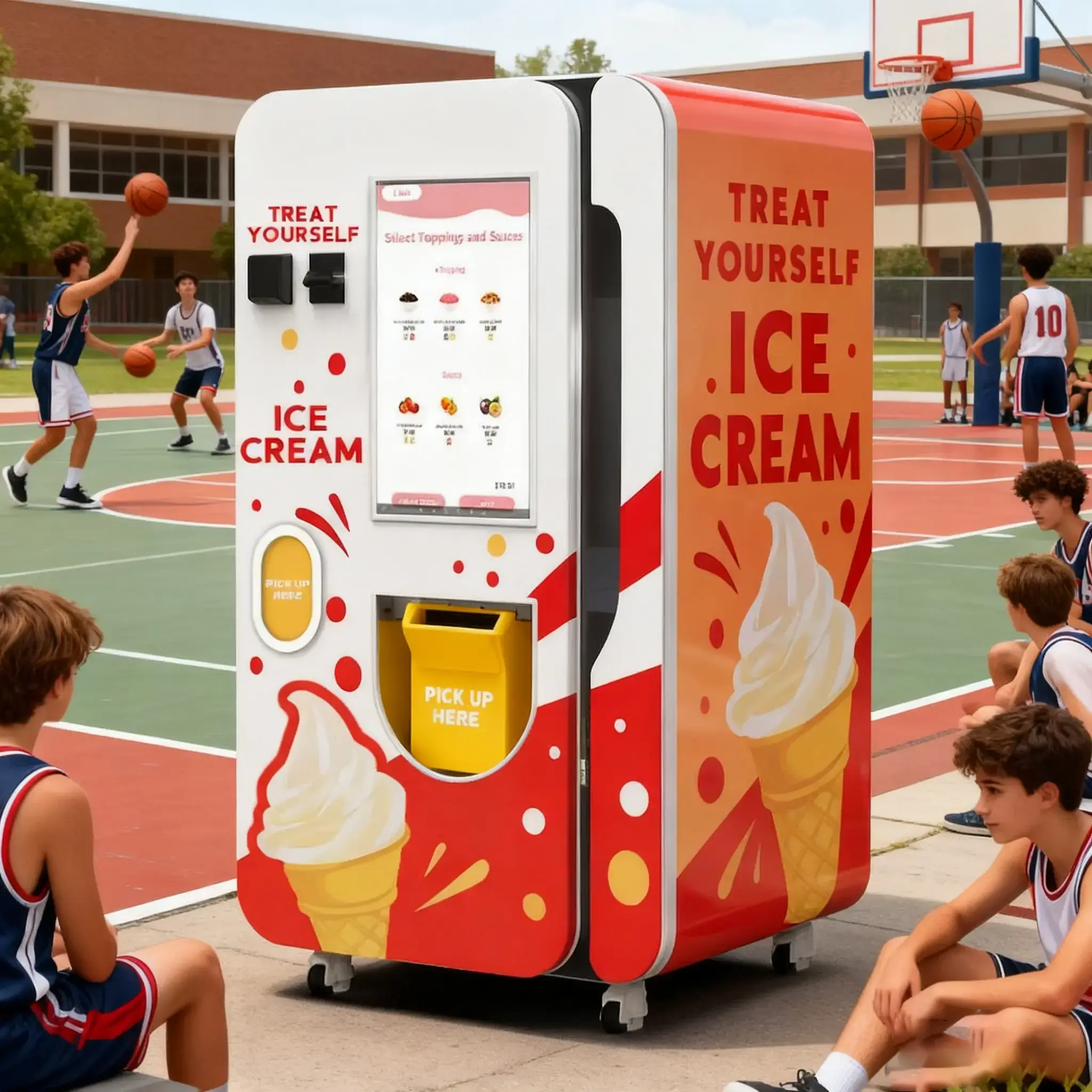
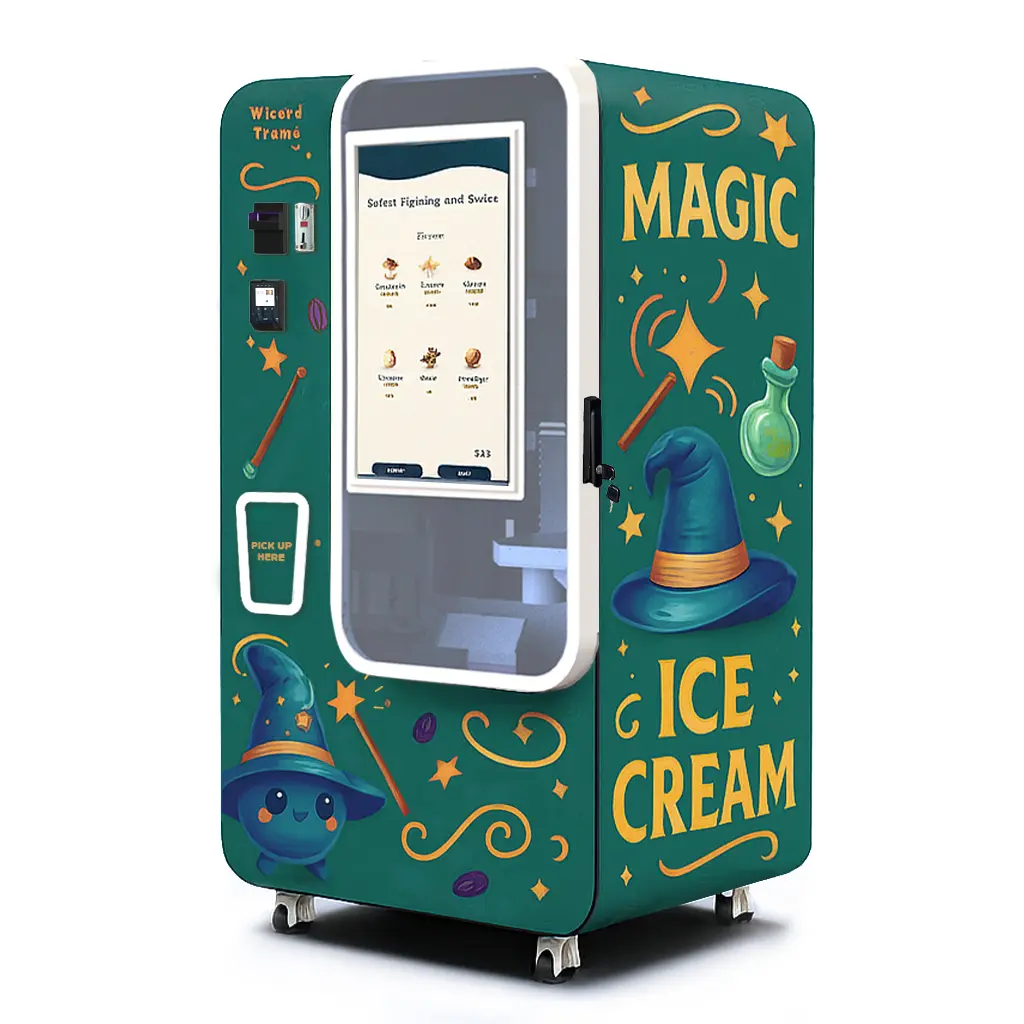
Meanwhile, they made a very interesting adjustment: Designing different appearance styles for the machines based on different scenarios.
For example:
· Adopting a more vibrant, summery visual design for seaside resorts;
· Incorporating cartoon elements for family entertainment centers;
· Adding lighting and social media check-in elements for areas frequented by young people.
Client feedback indicated that this "scenario-based appearance design" was more effective than they had anticipated. Many consumers even proactively took photos and uploaded them to social media platforms, inadvertently helping the machines gain additional exposure.
After six months of operation, this client eventually expanded the number of devices from the initial 3 to 18.
More importantly, they discovered that:
Compared to the traditional store model, the operational efficiency of vending machines was significantly higher.
Previously, a store required:
· Employee scheduling;
· Cashier management;
· Daily training;
· Store maintenance.
Now, one operations staff member can manage more than 10 devices simultaneously, including:
· Restocking;
· Cleaning;
· Basic inspections;
· Remotely viewing sales data. Ultimately, the average payback period for these machines stabilized at around 2-3 months.
The client later summarized it in one sentence:
"What truly convinced us to continue expanding wasn't just sales volume, but the replicability of this model. Compared to traditional stores, it's lighter, more flexible, and easier to quickly enter new markets."
V. Challenges that Ice Cream Vending Machines Must Face (Issues Often Overlooked by Operators)
This part is crucial for building genuine trust.1. Location Selection > Machine Performance
Misconception: Better equipment → Better businessReality: Stable, high-performance equipment + good location > High-end equipment + poor location
2. SKU Design Errors
Common problems for beginners:Too many SKUs → Increased difficulty for customers to make decisions → Decreased machine conversion rate
Ice cream flavors not localized, not catering to most people's taste preferences. (Example: Differences in preferences between Asia and Europe)
Recommendations:
Maintain 3–5 high-conversion SKUs
Regularly test different flavor combinations
3. Venue Revenue Sharing Negotiation
Realistic Range:Shopping Malls: 15%–25%
Tourist Areas: 10%–20%
Schools: 5%–15%
Tips: Use "No staff required + No renovations + Advertising and marketing" as negotiating advantages
VI. Ice Cream Vending Machines are "Efficiency Assets"
In our projects across multiple countries, a consensus is becoming increasingly clear: Ice cream vending machines are not merely a "equipment business," but a rapidly replicable retail infrastructure. Their true value lies not just in automatic dispensing or labor savings, but in helping operators build a business model with greater scalability, higher operational efficiency, lower labor and rental risks, and the ability to quickly adapt to different market environments.In the past, the traditional catering industry focused more on the product itself; however, in the coming years, the core of competition in the global retail industry is gradually shifting to competition in "operational efficiency." Especially for traditional restaurants, shopping malls, scenic spots, amusement parks, and chain brands, establishing a more asset-light, more efficient, and easier-to-replicate profit system in a market environment of continuously rising labor costs and rapidly changing consumer habits has become a problem that more and more operators must face.
The emergence of ice cream vending machines is also changing the understanding of "opening a store" for many traditional operators. Its value has gradually evolved from simply selling equipment to a new retail operation model. Compared to traditional stores, it not only achieves continuous revenue generation 24 hours a day, but more importantly, it reduces reliance on labor, decoration, and complex store management systems, making "small-scale testing + rapid replication + regional expansion" truly feasible.
Of course, unmanned retail is not a business where "simply deploying machines guarantees profits." What truly determines the final return is still the selection of locations, operational capabilities, SKU design, payment experience, and continuous data optimization capabilities. The final difference between many projects often lies not in the equipment itself, but in operational thinking and business strategy.
However, it's undeniable that with the increasing demand from consumers for self-service consumption, contactless shopping, and instant purchases, ice cream vending machines are becoming an important part of the global retail industry's upgrade. For many traditional operators, this is not just about upgrading equipment, but potentially a restructuring of their business model and a shift in the future growth logic of retail.
1. What is the minimum startup scale for ice cream vending machines?
It is recommended to start with 3 machines to validate the model, rather than making a large-scale investment all at once.2. How many people are needed to maintain one machine?
Typically, one person can manage 10-15 machines (including restocking and basic maintenance).3. Is it suitable for all national markets?
It is suitable for all national markets, but sales are better in high-temperature regions (Southeast Asia, the Middle East) due to their advantageous geographical locations. However, special attention needs to be paid to heat dissipation and power stability.4. Is the payback period stable?
Not entirely stable, but the profit margin is very substantial, averaging 70%-80%. The core variables are: Location + Traffic Conversion Rate + Revenue Sharing Ratio.5. What are the most common reasons for beginners to fail?
It's not equipment issues, but rather:① Incorrect location selection;
② Inadequate SKU design;
③ Overly optimistic ROI expectations.