Automated Ice Cream Vending Machines: A Scalable Growth Model for Chain Brands
Automated ice cream vending machines help chain brands add a standardized, low-labor dessert product line with remote management, consistent output, and scalable deployment.
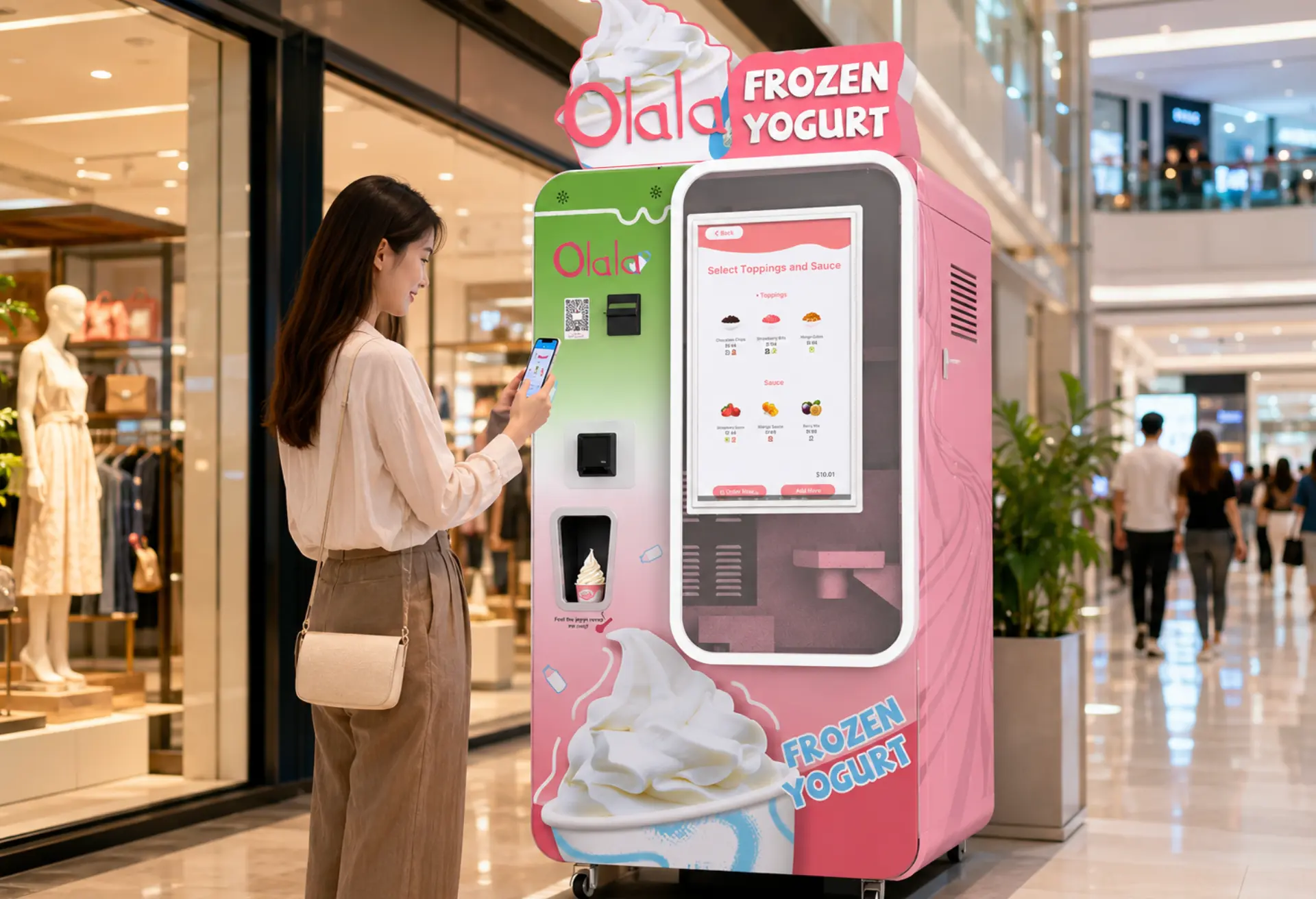
For many chain brands, growth does not always mean opening more stores. Sometimes, the bigger opportunity is to create a new revenue line inside locations that already have traffic.
A coffee chain may want to offer soft ice cream during the summer season. A convenience store brand may want to increase impulse purchases. A hotel group may want to add a dessert option in the lobby without extending kitchen hours. A cinema or shopping mall may want a retail unit that attracts attention, generates sales, and does not require another full-time operator.
The idea sounds simple. The execution is usually more complicated.
Who will operate the product? How will staff be trained? Can every location serve the same taste and portion? How will headquarters control pricing, hygiene, inventory, machine status, and sales performance across different cities?
This is where automated ice cream vending machines become more than just equipment. For chain brands, they can work as a standardized, low-labor, and repeatable growth tool.
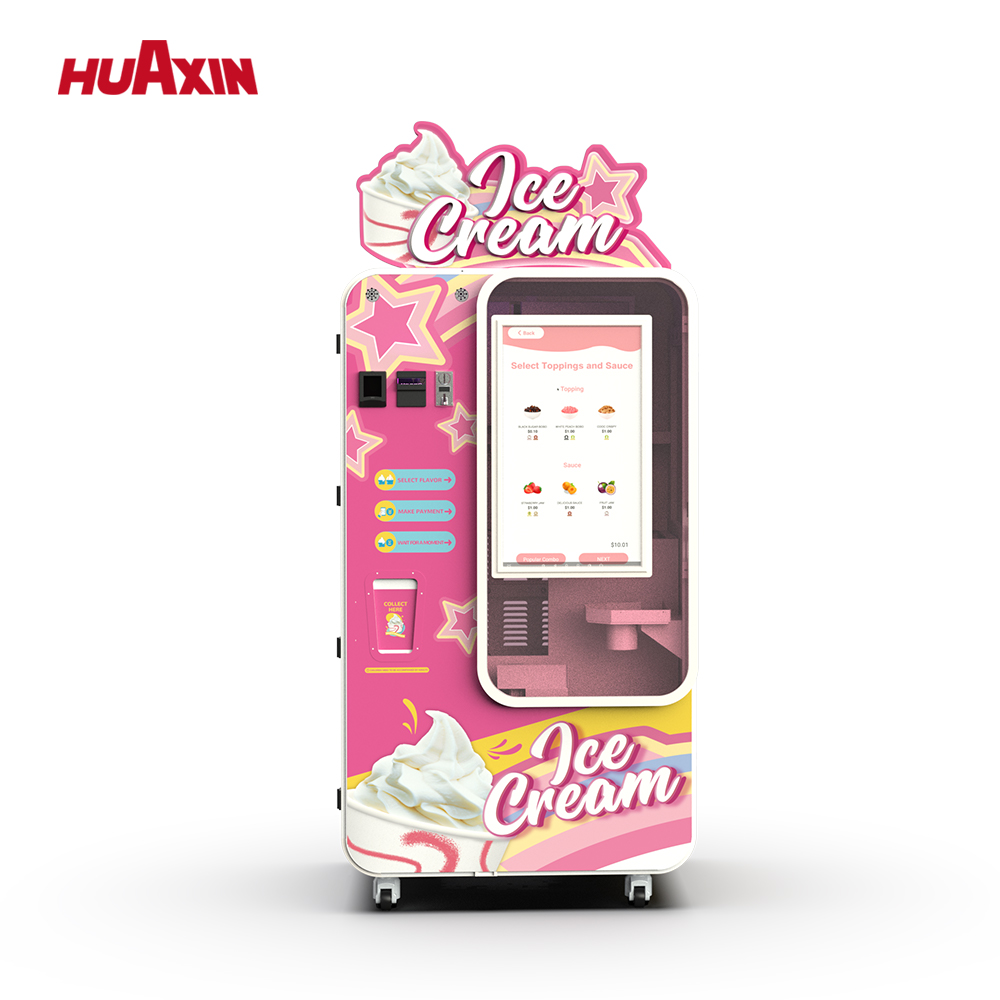
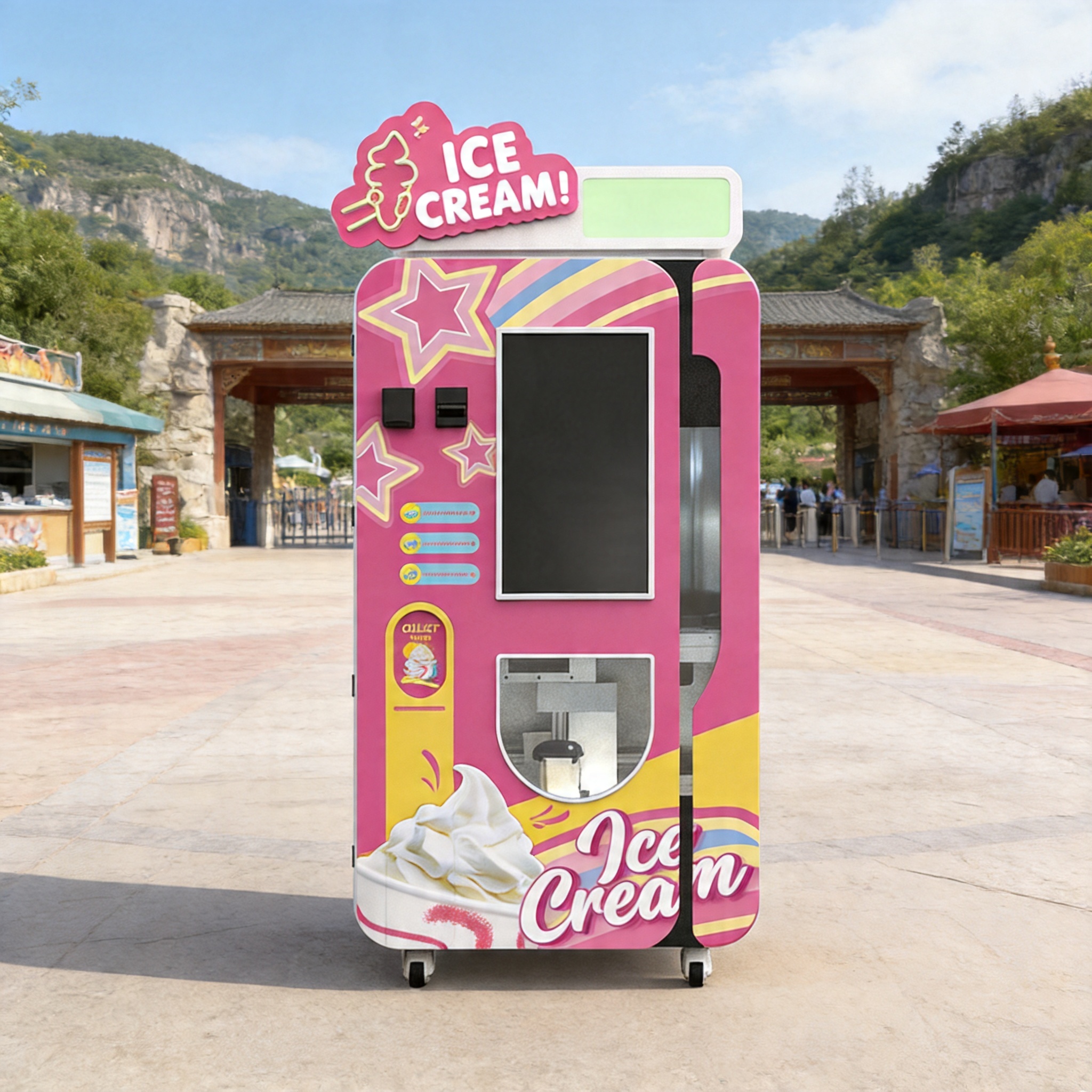
By deploying a solution such as the Huaxin B86max automated ice cream vending machine, brands can add an ice cream product line without building a full dessert counter in every location. A commercial machine of this type is designed for modern retail spaces, with a compact footprint, digital temperature control, automated production, cashless payment compatibility, and remote operation features. This makes it easier to place in stores, malls, hotels, cinemas, transportation hubs, and other high-traffic commercial environments.
The result is not simply a vending machine business. It is a lighter model for chain store growth, brand expansion, and low-labor retail.
Why Traditional Expansion Becomes Difficult
Many companies first evaluate a new product line by looking at equipment cost, ingredient cost, and gross margin. Those numbers matter, but in real chain operations, the bigger challenges are often labor, management, consistency, and speed.
Labor Constraints
In a traditional store model, adding ice cream usually requires employees to prepare products, clean equipment, control portions, serve customers, and manage peak-hour demand.
For one store, this may be manageable. Across 20, 50, or 100 stores, the pressure becomes much heavier. Brands must deal with wages, scheduling, staff turnover, retraining, and uneven service quality.
Even when the recipe is simple, the final product often depends on the person operating the machine. One employee may serve too much. Another may not follow cleaning procedures carefully. A third may not handle the equipment correctly during busy hours.
For chain brands, any product line that depends too much on store-level labor becomes harder to scale.
Management Constraints
Multi-location management is not just about selling more. It is about keeping every location under control.
A headquarters team may set standards, but execution can vary by store. One store may adjust the price. Another may use the wrong cleaning routine. Some may refill late, while others may not report machine issues quickly.
To control this, traditional models require training, store visits, inspections, quality checks, and constant communication with local managers. This increases management cost and slows down growth.
Expansion Speed Constraints
Traditional expansion often requires site planning, renovation, recruitment, staff training, new operating procedures, and management system setup.
This is too slow for many commercial opportunities. Summer sales, shopping mall openings, holiday seasons, cinema peak periods, and tourism traffic all have time windows. If a brand needs several months to prepare each location, it may miss the best timing.
Automated ice cream vending machines compress a complex product line into a standardized retail unit.
| Bottleneck | Traditional Model | Vending Machine Model |
|---|---|---|
| Labor | Dedicated staff per store | No dedicated ice cream staff |
| Management | Training and inspections | Remote cloud control |
| Expansion Speed | Long preparation cycle | Faster deployment after site confirmation |
| Quality Control | Human-dependent | Parameter-based consistency |
| Setup Cost | Renovation + hiring + equipment | Equipment + materials |
The Zero-Labor Replication Model
“Zero labor” does not mean nobody manages the machine. In real operations, a better way to describe it is low-labor replication.
An automated ice cream vending machine still needs restocking, cleaning, inspection, and maintenance support. But it does not require each store to assign a dedicated employee to make and sell ice cream.
The machine handles customer ordering, payment, production, and dispensing. Local staff only follow simple SOPs for refilling materials, checking supplies, and keeping the machine area clean.
A scalable zero-labor retail model usually includes:
- Centralized cloud management
- Automated sales and payment
- Unified recipe and parameter control
- Local restocking by existing staff
- Remote fault alerts and maintenance support
- Real-time sales and inventory data
This model is practical for coffee chains, restaurant chains, convenience stores, hotels, cinemas, shopping centers, retail chains, and franchise systems.
The real value is that headquarters can manage many locations through one system, instead of relying entirely on each store’s individual execution.
Brand Consistency: Every Cup the Same
For chain brands, consistency is not a small detail. It is the foundation of customer trust.
Customers expect the same taste, portion, temperature, and presentation whether they buy from a store in one city or another. Traditional manual service makes this difficult because the result depends heavily on staff skill and discipline.
A smart ice cream vending machine changes the control logic. Instead of depending mainly on human judgment, the machine uses preset parameters to control the production process.
| Dimension | Traditional Model | Vending Machine Model |
|---|---|---|
| Recipe | Human judgment | Precise parameter control |
| Temperature | Manual adjustment | Digital monitoring |
| Presentation | Skill-dependent | Automated replication |
| Portion | Inconsistent | Accurate portion control |
| Hygiene | Staff-dependent | Auto-cleaning + UV sterilization support |
Of course, machines do not replace all operational management. Ingredient quality, restocking discipline, cleaning routines, and maintenance still matter. But compared with a fully manual model, a commercial ice cream vending machine makes standardization easier to build and easier to repeat.
Brand consistency is also visual.
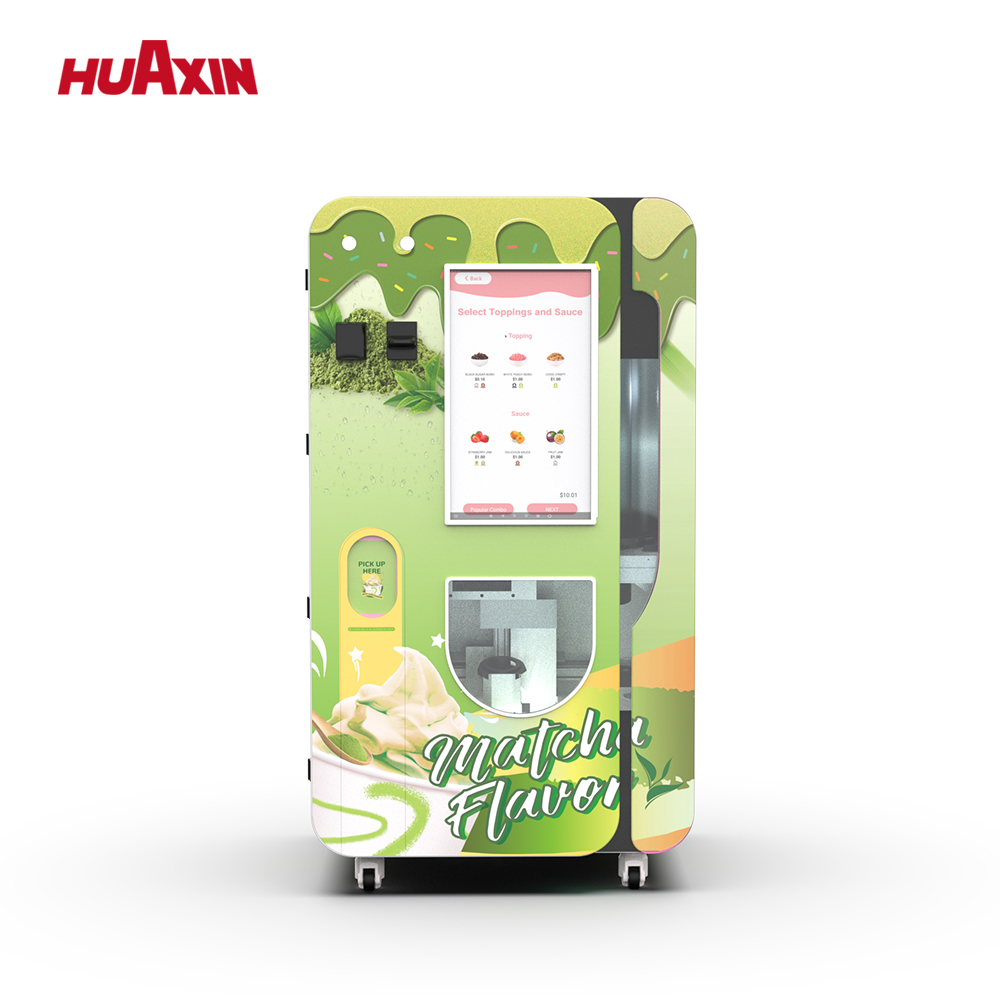
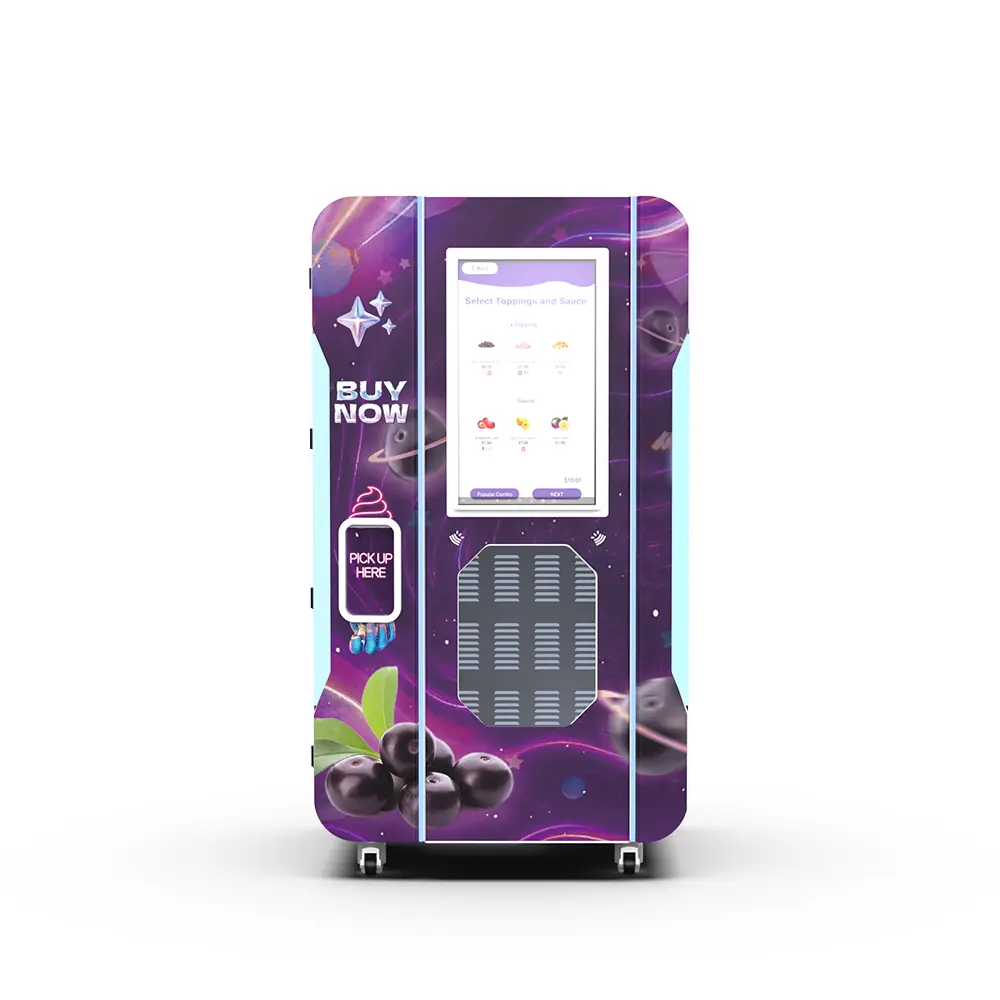
The machine exterior, lightbox, stickers, UI interface, startup screen, menu page, and logo display can all be customized. In a mall, hotel lobby, cinema, or convenience store entrance, the machine is not only a point of sale. It is also a visible brand touchpoint.
For chain brands, this matters. Every machine can become a small retail outlet and a brand exposure position at the same time.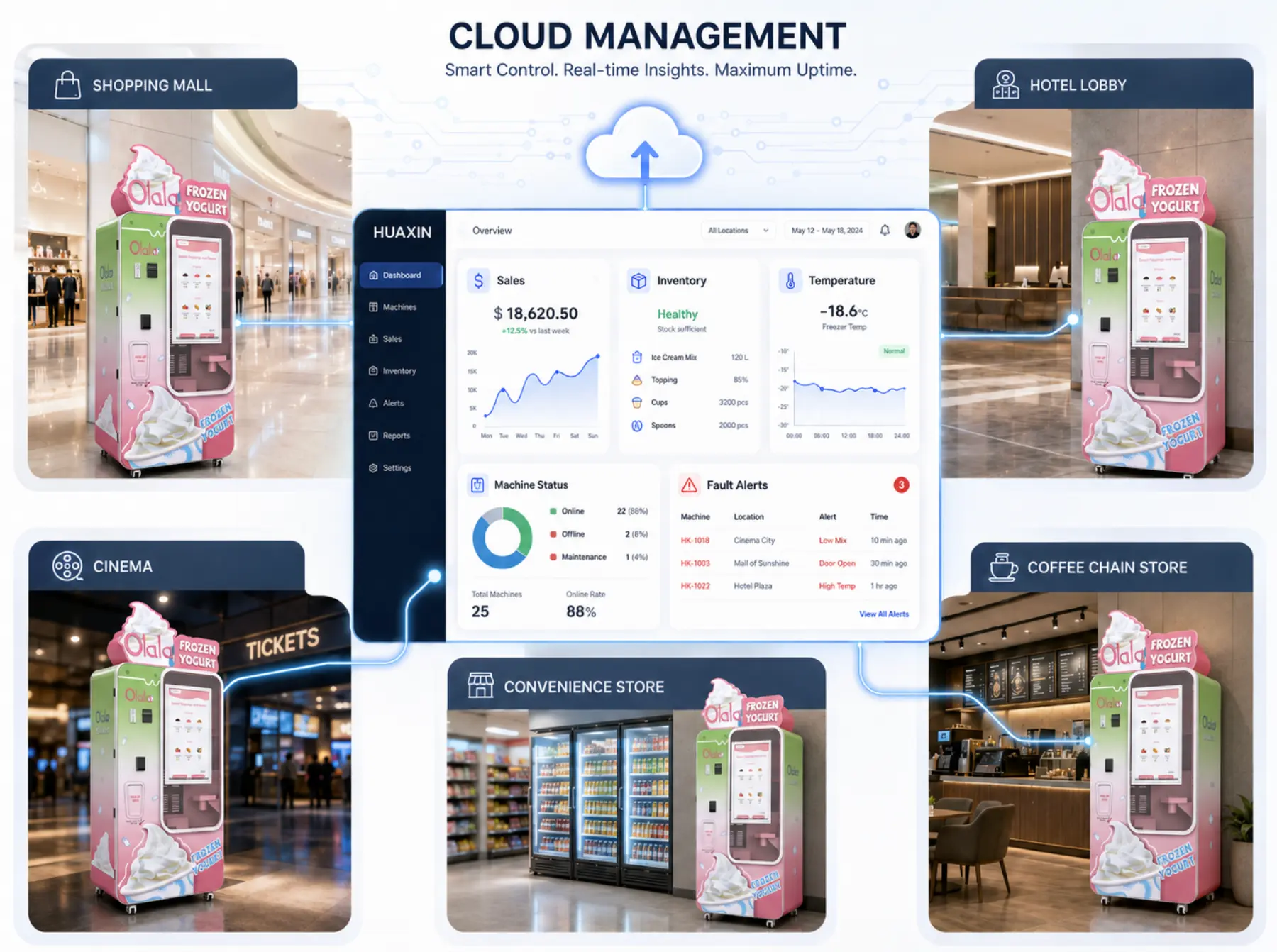
Remote Cloud Management at Scale
When a brand operates one or two machines, manual tracking may still work. When it operates 10, 50, or 100 machines, Excel sheets and phone calls are no longer enough.
At scale, remote cloud management becomes essential.
A smart ice cream vending machine should allow headquarters or regional operators to monitor machines, adjust settings, review data, and respond to issues remotely.
Key remote management functions include:
- Real-time machine status monitoring
- Temperature monitoring
- Inventory alerts
- Fault warnings
- Remote pricing adjustment
- Remote promotion settings
- Sales data analysis
- Revenue sharing and settlement records
- Role-based access control
These functions are not just technical features. They directly affect operating efficiency.
For example, a cinema location may sell more chocolate flavor, while a hotel lobby may perform better with vanilla or yogurt-style products. A mall location may sell more on weekends, while a convenience store may have more stable weekday traffic.
With sales data, headquarters can adjust menus, promotions, and restocking plans based on facts rather than guesswork.
If a machine shows low inventory, staff can refill before sales are affected. If a temperature warning appears, the service team can respond before product quality is damaged. If a fault occurs in a remote location, the operator can diagnose the issue faster and guide local staff through basic checks.
Payment compatibility is also important in commercial projects. Chain brands usually need machines that can support common cashless payment methods such as credit cards, mobile payments, and QR-code payments, depending on the local market. This reduces friction at the point of purchase and makes the vending model easier to integrate into modern retail environments.
This is the real value of remote management: scattered machines become a controllable retail network.
Energy Efficiency and Reduced Food Waste
For many chain brands, operational efficiency is no longer only about labor cost. Energy use, ingredient waste, and daily operating discipline are also becoming part of long-term business evaluation.
Automated ice cream vending machines can support a more controlled operating model. Digital temperature monitoring helps keep ingredients within a stable range, while parameter-based dispensing helps reduce portion variation and unnecessary material loss. Inventory alerts also make it easier for operators to restock based on real consumption instead of guesswork.
This does not mean waste disappears completely. Poor site management, inaccurate demand forecasting, or weak restocking discipline can still create losses. But compared with a fully manual model, a smart ice cream vending machine gives operators more data and control, which can help reduce avoidable waste over time.
For brands managing multiple locations, this matters. Less waste, more stable storage conditions, and better operational visibility can support both profitability and sustainability goals.
Headquarters, Stores, and Service Teams: Who Does What?
For chain brands, successful deployment depends on clear responsibility. A vending machine project should not be left entirely to store staff, and it should not rely only on headquarters either.
| Role | Main Responsibilities |
|---|---|
| Headquarters | Menu strategy, pricing, recipe parameters, brand standards, data review |
| Store Staff | Restocking, simple cleaning, daily visual checks, basic machine area management |
| Regional Manager | SOP inspection, performance review, site coordination |
| Service Team | Fault diagnosis, maintenance support, spare parts coordination |
| Franchisee or Partner | Local execution, site cooperation, revenue reporting |
This division of work is important. It helps the brand avoid a common mistake: buying machines first and building the operating system later.
For multi-location deployment, the operating system should be planned before expansion.
Site Selection: What to Check Before Deployment
Not every location is suitable for automated ice cream vending machines. A good site should have traffic, visibility, and operational support.
Before deployment, brands should evaluate the following factors:
| Location Factor | What to Check |
|---|---|
| Foot Traffic | Is there enough daily customer flow? |
| Dwell Time | Do customers stay long enough to make impulse purchases? |
| Visibility | Can the machine be placed in a high-exposure area? |
| Customer Profile | Are customers likely to buy desserts, snacks, or cold drinks? |
| Restocking Access | Can staff refill materials conveniently? |
| Power and Space | Is the site ready for machine installation? |
| Rental or Revenue Share | Does the cost structure support ROI? |
| Staff Cooperation | Is there someone on site to handle basic tasks? |
A high-traffic location is not always a good location if rent is too high or staff cannot support restocking. A smaller site may perform better if it has the right customer profile and lower operating cost.
This is why pilot testing is important before large-scale deployment.
Case Example: From 1 to 50 Machines
A chain brand should not start by placing 50 machines at once. A better path is to test, learn, and scale in stages.
Phase 1: Pilot
The brand places 3–5 automated ice cream vending machines in selected locations, such as high-traffic stores, shopping mall entrances, cinemas, hotels, or tourist areas.
During this phase, the team tests:
- Daily cup sales
- Best-selling flavors
- Price acceptance
- Restocking frequency
- Machine uptime
- Customer feedback
- Staff cooperation
- Cleaning and maintenance workload
The goal is not only to sell ice cream. The goal is to understand whether the model can be repeated.
Phase 2: Regional Expansion
After the pilot performs well, the brand expands to 20–25 locations within one region.
At this stage, the company should build a basic operating system, including restocking SOPs, machine inspection rules, remote monitoring procedures, maintenance response flow, and store cooperation standards.
The brand may also start using unified machine design, menu structure, pricing logic, and promotional campaigns.
Phase 3: Full Deployment
Once the regional model is stable, the brand can expand to 50 machines or more.
At this stage, the vending machine project becomes more than a trial. It becomes a new product line and a repeatable revenue channel.
Possible results include:
- Faster product line expansion
- Lower dependence on store-level labor
- Better brand visibility in commercial locations
- More data-driven menu decisions
- Additional revenue from existing traffic
The final result depends on site quality, pricing, ingredient cost, machine uptime, rental terms, and daily execution. The machine is important, but the operating model is what determines long-term success.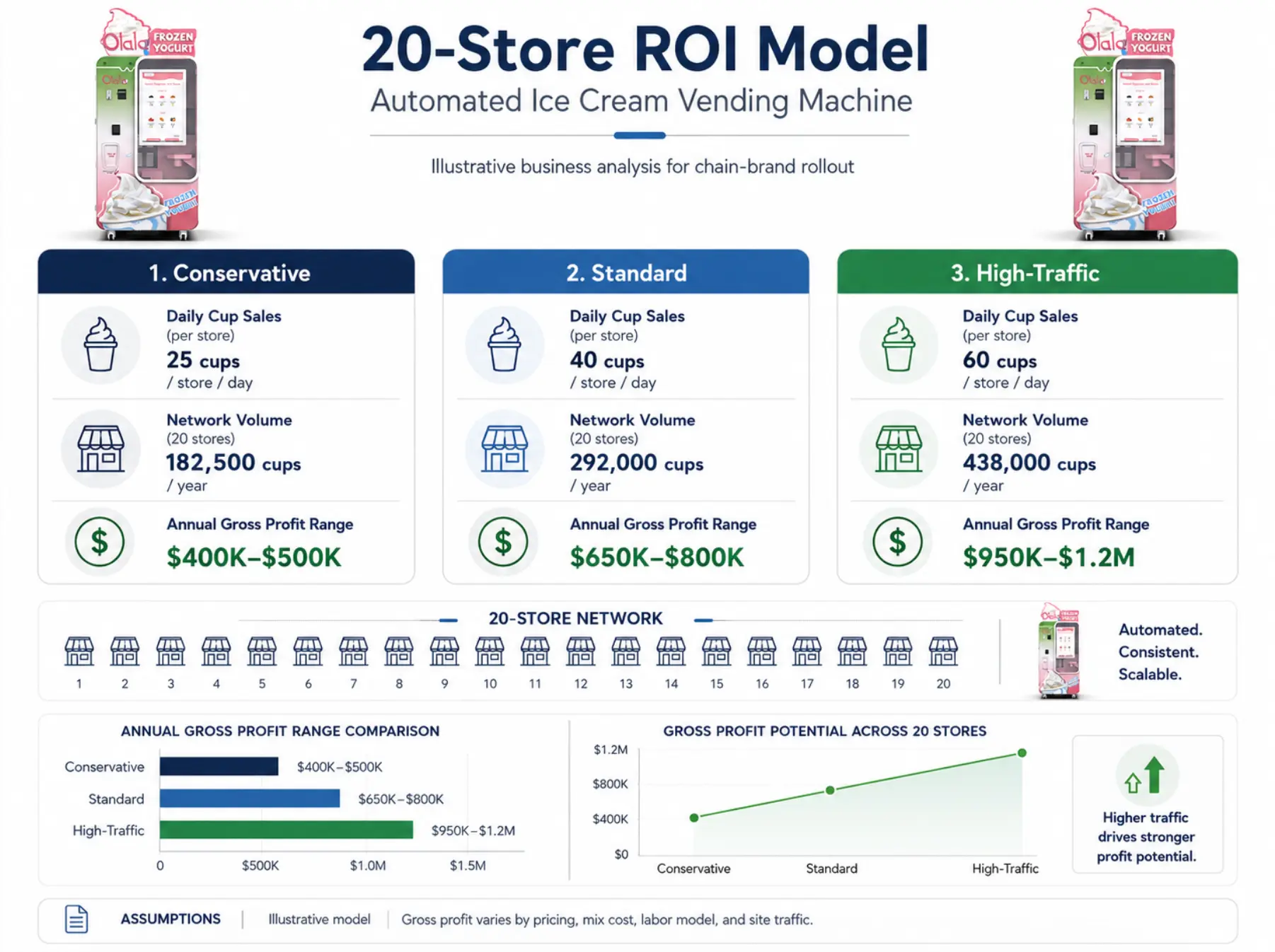
A Practical Expansion Strategy for Chain Brands
Phase 1: Pilot — 1 to 3 Months
Start with 1–2 stores or a few commercial locations. Test demand, pricing, product acceptance, restocking flow, and customer behavior. The goal is to collect real data, not to assume every location will perform the same.
Phase 2: Regional Test — 3 to 6 Months
Expand to 5–10 locations. Build basic SOPs, define store responsibilities, and begin using remote monitoring seriously. Compare performance across different location types.
Phase 3: Scale — 6 to 12 Months
Expand to 20–50 locations. Standardize the menu, visual design, pricing rules, reporting system, and service process. At this stage, the project should become a structured business unit.
Phase 4: Nationwide Expansion — 12+ Months
If the model is stable, the brand can explore wider deployment through owned stores, franchise systems, joint operations, retail channels, or location partners. Supply chain efficiency and service network planning become more important at this stage.
Cost and Revenue Analysis: 20-Store Example
Consider a brand planning to add ice cream sales to 20 stores.
In a traditional model, each store may need additional labor, training, scheduling, and daily management. Even if only part-time support is required, the annual labor cost across 20 stores can be significant. Product quality may also vary depending on staff skill.
In an automated vending machine model, the main investment includes equipment, ingredients, routine maintenance, and possible rent or revenue sharing. Existing store staff can handle basic restocking, so each location does not need a dedicated ice cream employee.
A simple revenue model may look like this:
| Scenario | Cups per Day per Machine | Daily Revenue per Machine | Estimated Annual Gross Profit for 20 Machines |
|---|---|---|---|
| Conservative | 40 cups | $200 | $876,000–$949,000 |
| Standard | 80 cups | $400 | $1.75M–$1.9M |
| High-Traffic | 120 cups | $600 | $2.62M–$2.84M |
Assumptions:
- 20 machines
- Average selling price: $5 per cup
- Estimated gross margin: 60%–65%
- Figures are before rent, service cost, depreciation, tax, and other operating expenses
The conservative model is often the most useful for early planning. It helps brands avoid overestimating payback speed.
Actual results depend on foot traffic, pricing, ingredient cost, rental terms, revenue sharing, machine uptime, seasonality, and operating discipline.
For chain brands, ROI should not be evaluated only by sales revenue. Labor savings, reduced product waste, lower training pressure, brand exposure, and the ability to test new locations faster should also be included in the overall business evaluation.
The key point is not that every machine will perform the same. The key point is that automated ice cream vending machines allow brands to test, measure, and scale a new revenue line with lower labor pressure.
When This Model May Not Be the Right Fit
Automated ice cream vending machines are not suitable for every business or every location.
This model may not be ideal if:
- The location has weak or unstable foot traffic
- There is no staff available to handle restocking
- The brand cannot maintain ingredient consistency
- The site has very high rent or revenue-sharing costs
- The operator expects “fully automatic” to mean no management at all
- There is no clear SOP for cleaning, inspection, and service response
This is why a pilot stage is important. A machine can reduce labor pressure, but it cannot replace basic operational discipline.
For chain brands, the best results usually come from a combination of good equipment, suitable locations, clear SOPs, reliable ingredients, and active remote management.
FAQ
1. What types of businesses are suitable for automated ice cream vending machines?
They are suitable for coffee chains, restaurant chains, convenience stores, hotels, cinemas, shopping centers, retail chains, tourist attractions, campuses, transportation hubs, and franchise systems. The best locations usually have stable traffic, visible placement, and customers who are likely to buy desserts or snacks.
2. How can brands ensure consistency across multiple locations?
Consistency comes from unified ingredients, recipe parameters, digital temperature control, accurate portion settings, standard cleaning procedures, and remote monitoring. A smart ice cream vending machine helps reduce variation caused by different staff members in different stores.
3. What happens if a machine has a fault in a remote location?
The remote management system can provide fault warnings and status updates. Many issues can be diagnosed remotely, and local staff can be guided through basic checks. If needed, the service team can arrange on-site maintenance. This helps reduce downtime and avoids relying only on manual reporting.
4. Can this model work with franchise systems?
Yes. Franchise systems often need standardized products that are easy to copy. Headquarters can control branding, menu structure, pricing rules, recipe parameters, and data reporting, while franchisees handle local restocking and basic site management.
5. Will rapid expansion cause loss of operational control?
Rapid expansion can create risk if there is no system. But with cloud management, role-based access, unified SOPs, data reports, and service response procedures, brands can scale more safely. The key is not to deploy as fast as possible, but to build a repeatable operating model first.
6. How many machines should a brand test before scaling?
A practical pilot usually starts with 3–5 machines in different location types. This gives the brand enough data to compare sales, customer behavior, restocking frequency, and site performance before making a larger investment.
7. What SOP is needed before deploying 20+ machines?
Brands should prepare SOPs for restocking, cleaning, daily inspection, fault reporting, inventory control, remote monitoring, sales review, and maintenance response. Without these procedures, even good machines can become difficult to manage at scale.
8. Are automated ice cream vending machines energy-efficient?
Energy efficiency depends on machine design, compressor performance, operating environment, and daily usage. In commercial applications, a smart ice cream vending machine can help improve energy and ingredient efficiency through digital temperature monitoring, controlled dispensing, inventory alerts, and more stable operating parameters. Brands should still evaluate actual power use, placement conditions, and maintenance quality before large-scale deployment.
A Lighter Way to Build a New Revenue Line
In the past, brand expansion often meant more stores, more employees, more training, and more management complexity.
Today, automated ice cream vending machines offer another path.
For chain brands, they can help add an ice cream product line with lower labor dependency, stronger standardization, faster replication, and better remote control. They are not just machines for side income. They are compact, data-driven retail units that can become part of a larger brand expansion strategy.
For coffee chains, convenience stores, cinemas, hotels, shopping centers, retail operators, and franchise systems, this model offers a practical way to turn existing traffic into a new revenue opportunity.
Huaxin provides automated ice cream vending machines designed for chain brands, retail operators, hospitality groups, and commercial locations that need scalable, standardized, and low-labor growth solutions.
References / Sources