Case Study: Scaling an Automatic Ice Cream Vending Business in the US Market
Explore how an automatic ice cream vending business can scale in the US market with smart vending technology, labor-saving operations, cashless payments, and data-driven site management.

The Automatic Ice Cream Vending Business is becoming more attractive in the US because it sits at the intersection of three strong commercial pressures: rising labor costs, expensive retail space, and consumers’ growing acceptance of self-service technology. For operators, the question is no longer whether vending machines can sell snacks or drinks. The more important question is whether a premium automated dessert concept can be scaled across malls, entertainment centers, campuses, and travel locations without the cost structure of a traditional ice cream shop.
This case study looks at how an anonymized US operator approached the market, what problems they faced, why they selected a flagship automatic ice cream vending solution, and what early operating data revealed after deployment.
The figures in this case are rounded and presented as an anonymized operating model for business analysis. They should be read as a practical reference, not as a guaranteed performance promise.
1. The US Market Background: Mature Vending, Higher Entry Standards
The United States is one of the most developed vending and unattended retail markets in the world. According to the National Automatic Merchandising Association’s 2022–2023 Industry Census, vending machines remained the largest segment of the convenience services industry, with estimated 2023 revenue of $18.2 billion, representing 68% of the broader convenience services industry. The same report estimated 2.9 million vending machines in operation and average annual sales of $6,284 per machine.
For a new Automatic Ice Cream Vending Business, this market maturity is both an opportunity and a challenge.
The opportunity is clear: US consumers already understand self-service buying. Vending, micro markets, kiosks, self-checkout, mobile ordering, and contactless payments are part of daily life. Customers do not need to be educated from zero.
The challenge is that buyers, landlords, and local regulators expect a higher standard. A machine selling soft serve or frozen dairy products is not judged like a basic snack machine. It must satisfy more questions:
-
Can it maintain safe temperature control?
-
Does it support US payment habits?
-
Can the operator monitor machines remotely?
-
Is the machine reliable enough for unattended operation?
-
How quickly can faults be diagnosed?
-
Can multiple machines be managed as a fleet?
-
Are components and certifications suitable for commercial deployment?
This is where many low-end machines fail. They may look acceptable in a showroom, but they are not designed for repeated daily use in American commercial locations.
The FDA Food Code is also important for operators to understand. For time/temperature control for safety foods, cold holding generally requires 5°C / 41°F or below, and vending machines dispensing such foods need automatic controls that prevent vending when temperature safety cannot be maintained. In practice, this means an operator should not only look at production speed or appearance; temperature control, automatic shutoff, cleaning, and fault alerts are part of the business model.
2. The Client’s Pain Points: Labor Cost and Traditional Store Rent
The client in this case was not new to dessert retail. They had experience with mall kiosks and seasonal food service, but the economics were becoming harder to manage.
The first pain point was labor.
US food service labor is expensive and increasingly difficult to schedule. The Bureau of Labor Statistics reported that food preparation and serving related occupations had a May 2025 mean hourly wage of $17.86 and a median hourly wage of $16.85. For a small ice cream kiosk, this number becomes much larger after payroll taxes, insurance, training, sick leave, overtime, supervision, and staff turnover are included.
A traditional dessert kiosk usually needs at least one employee per shift. If the location operates 10–12 hours per day, the monthly labor cost can easily exceed the rent of the equipment itself. During slow hours, the operator still pays wages even when only a few cups are sold.
The second pain point was retail space.
Prime retail locations in the US are not cheap. CBRE’s 2025 retail rent analysis showed that walkable, live-work-play retail districts can command high rents. New York reached an average of $91.40 per square foot in the analyzed districts, while Boston reached $47.33 and Washington, D.C. reached $46.21. Even outside these major urban centers, high-quality mall and entertainment locations usually require operators to control footprint carefully.
This changed the client’s thinking.
Instead of asking, “Can we open another dessert store?” they began asking:
“Can we create the same impulse-buy dessert experience with a smaller footprint, lower labor exposure, and longer operating hours?”
That question became the foundation of their automated ice cream vending operation.
3. Why a Flagship Machine Was Chosen Instead of a Basic Model
The operator first compared several machine types. The cheapest options were attractive on paper, but they raised concerns after reviewing real operating needs.
For a single trial machine, a lower-cost model may appear acceptable. But for a scalable business, the machine must behave like a remote retail terminal. It needs to sell, monitor, protect ingredients, reduce downtime, support payments, and provide actionable data.
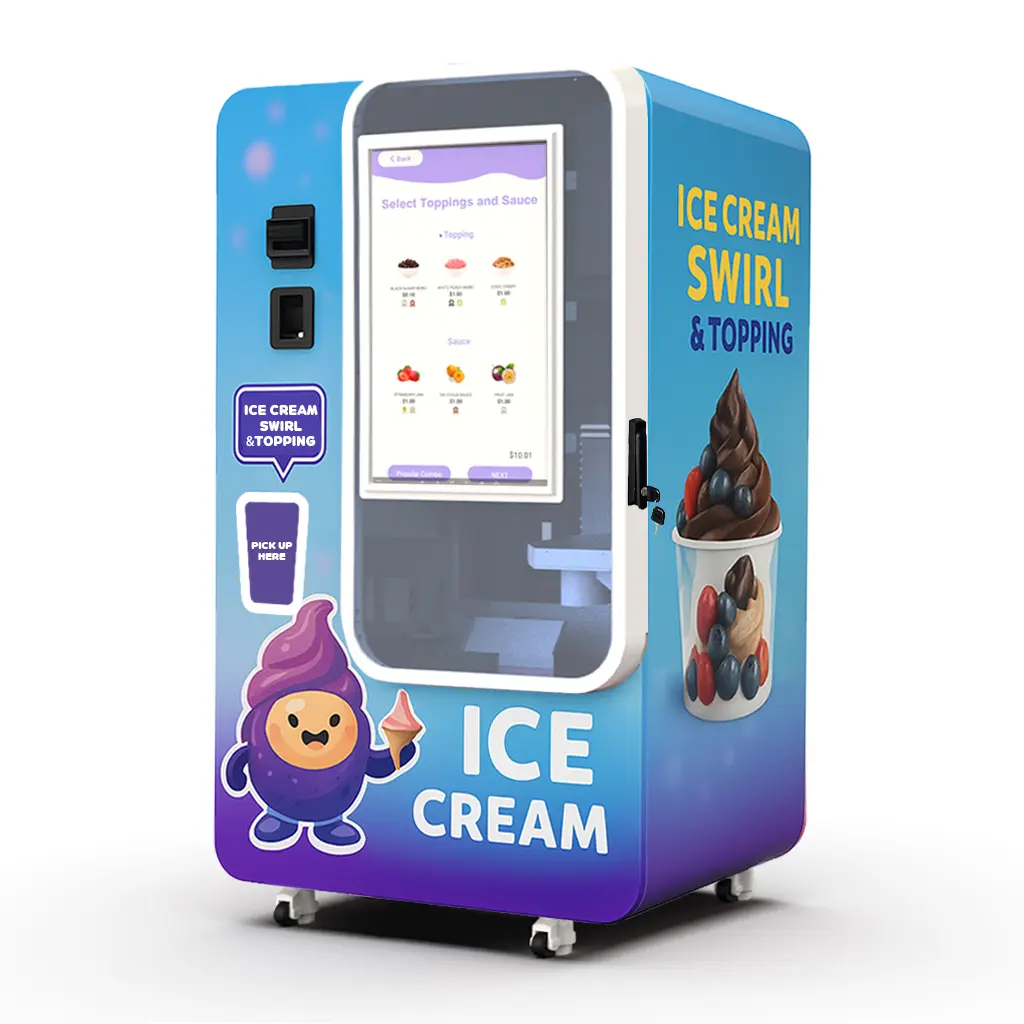
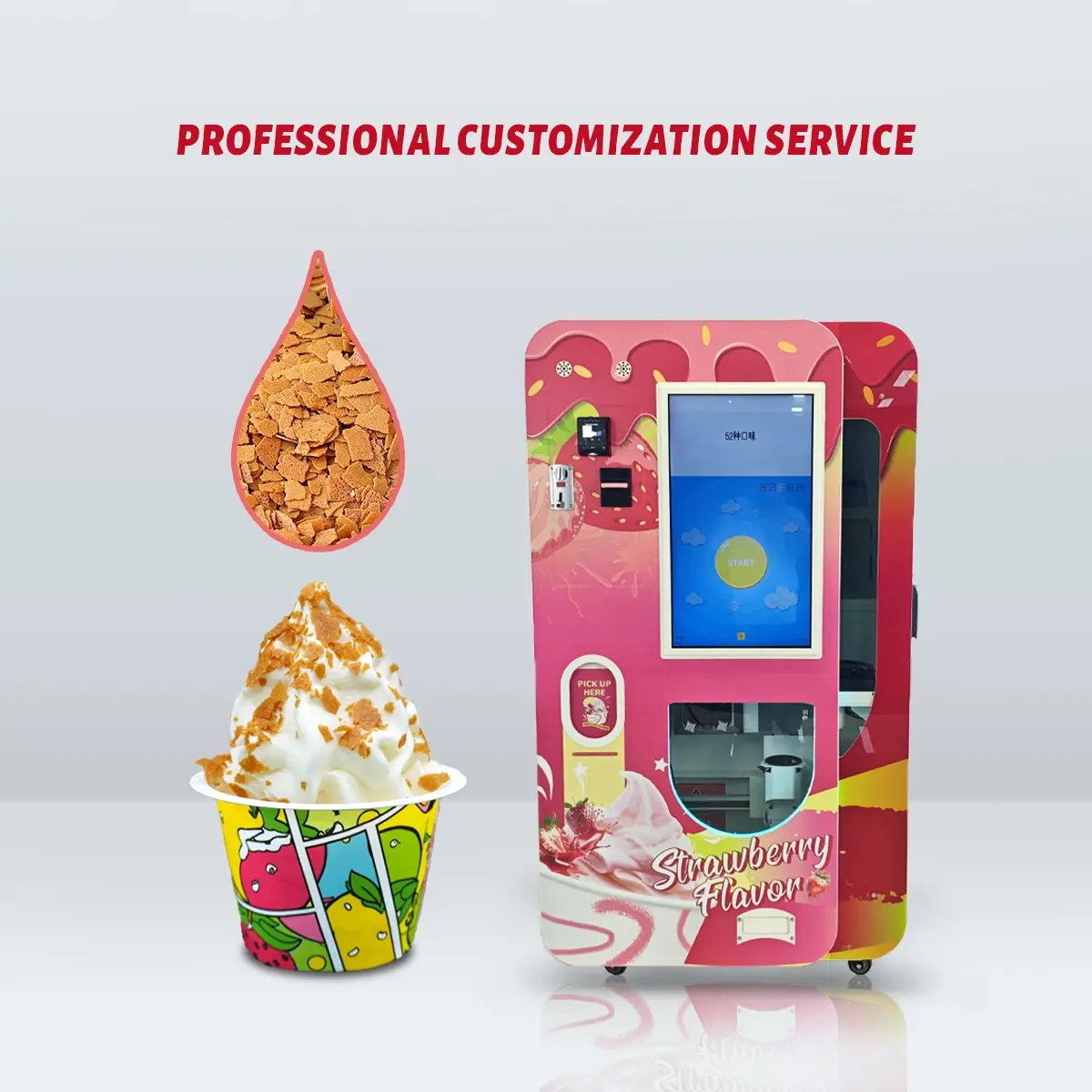
The final solution was based on a flagship-level automatic ice cream vending machine similar to Huaxin’s B86 category. In Huaxin’s B-series positioning, models such as B83 Max, B84, B85, and B86 belong to the flagship automatic vending machine family. Their main differences are exterior door style and visual presentation, while the core functions and internal configuration are designed for high-standard unattended operation.
For the US operator, the most important selection factors were not decorative. They focused on five commercial requirements.
1. Remote Monitoring
A scalable Automatic Ice Cream Vending Business cannot rely on staff physically checking every machine every day. The operator needed real-time visibility into:
-
Sales volume
-
Ingredient levels
-
Temperature status
-
Machine online/offline status
-
Fault codes
-
Cleaning status
-
Payment performance
Remote monitoring allowed the operator to decide which machine needed restocking first, which location was underperforming, and whether a fault required on-site action or remote troubleshooting.
2. High-Quality Core Components
In the US market, downtime is expensive. One machine offline during a Saturday afternoon in a family entertainment center may lose more revenue than several days of maintenance cost.
That is why the operator prioritized compressor quality, refrigeration stability, sensors, payment modules, touchscreen durability, and internal mechanical reliability. A low-cost machine can become expensive if it creates repeated service visits.
3. Payment Compatibility
The US is a card-first and mobile-wallet-friendly market. A machine that only supports QR code payment or limited local methods can lose transactions. The final deployment supported common cashless payment paths, including card and mobile wallet options, depending on the local payment integration.
4. Food Safety and Temperature Control
For frozen dairy products, stable low-temperature storage and automated cleaning logic matter. The operator wanted the machine to reduce human handling as much as possible while keeping ingredient storage, production, and dispensing controlled.
5. Brand Presentation
The operator was not simply buying equipment; they were building a repeatable automated dessert brand. The 32-inch screen, exterior design, menu interface, and product display all influenced customer trust. In a mall, customers may decide within three seconds whether a machine feels clean, modern, and safe enough to buy from.
4. Deployment Strategy: Start Small, Then Scale by Data
The operator did not begin with a large national rollout. They used a controlled deployment model.
Phase 1: Pilot
The first phase included 3 machines in different location types:
| Location Type | Reason for Testing | Expected Customer Behavior |
|---|---|---|
| Family entertainment center | High child and parent traffic | Strong impulse purchase |
| Shopping mall leisure zone | Weekend and evening traffic | Visual attraction and snack demand |
| University-area convenience location | Young customer base | Cashless payment acceptance |
The goal was not only to measure total sales. The operator wanted to understand where customers stopped, which payment methods converted, what time periods mattered, and how much restocking effort was needed.
Phase 2: Optimization
After the first 60 days, the operator adjusted:
-
Flavor combinations
-
Product photos on the screen
-
Pricing tiers
-
Machine placement angle
-
Signage near the machine
-
Restocking schedule
-
Weekend staffing backup plan
One important discovery was that visibility mattered more than raw foot traffic. A corridor with heavy walking traffic did not always perform well. A slightly slower area near seating, children’s activity, or cinema waiting zones often delivered better conversion because people had time to notice the machine and make a dessert decision.
Phase 3: Scale
After the pilot, the operator expanded to 12 machines across two metro areas. The expansion was based on location profile, not simply landlord availability.
They avoided sites where the machine would be treated as decoration. They prioritized locations where the machine had:
-
Clear visibility from 15–20 meters away
-
Family or youth traffic
-
Dwell time of at least several minutes
-
Nearby seating or waiting behavior
-
Stable indoor temperature
-
Easy restocking access
-
Reliable power and network conditions
This is an important lesson for any ice cream vending business in America: the best location is not always the busiest location. It is the location where people are willing to pause.
5. Operating Data: What the First 12 Machines Revealed
After the first stabilization period, the operator reviewed four core data points: daily cup sales, payment conversion, peak-hour performance, and maintenance response.
Fleet-Level Performance
| Metric | Result After Stabilization |
|---|---|
| Machines deployed | 12 units |
| Average daily sales per machine | 68 cups |
| Strongest location average | 112 cups/day on weekends |
| Weakest location average | 31 cups/day |
| Average selling price | USD 5.50 |
| Estimated daily revenue per machine | USD 374 |
| Cashless payment share | 91% |
| Successful payment completion rate | 96.8% |
| Remote-resolved alerts | Around 70% of non-hardware issues |
The most valuable number was not the strongest location’s sales. It was the gap between the strongest and weakest machines.
This gap showed that site selection was the main driver of profitability. The machine itself could operate consistently, but location quality determined the ceiling.
For example, the family entertainment center consistently outperformed a high-traffic shopping corridor. Parents were already in a spending mindset, children noticed the machine quickly, and the waiting time before games or activities created a natural purchase window.
The university-area convenience location had lower daytime sales but performed surprisingly well in the evening. This confirmed one advantage of automated vending: the machine captures demand outside normal staffed dessert-store hours.
6. Payment Conversion: Why Cashless Matters in the US
Payment performance was a major reason the operator chose a smart vending configuration.
Industry data supports this direction. Persistence Market Research estimated that cashless payment systems accounted for approximately 58% of smart vending machine market value in 2025. NAMA’s vending census also noted that cashless payment opportunities have increased average spend per consumer and per machine.
The operator’s own data matched this trend. More than 90% of transactions were cashless. Failed payments were mostly caused by weak connectivity, expired cards, or customers abandoning after taking too long to choose a flavor.
The operator made three changes:
-
Simplified the first menu screen.
-
Moved popular flavors to the top.
-
Added clearer payment icons near the purchase button.
After the UI adjustment, the successful payment completion rate improved to 96.8%.
This is a useful lesson: in automated dessert vending, payment conversion is not only a payment issue. It is a user-interface issue. If the screen is confusing, customers leave before payment. If the menu feels clear, the payment module performs better.
7. Expert View: AI and Remote Data Are Becoming Operational Tools
At the 2025 NAMA Show, Paresh Patel, president and CEO of PayRange, noted that AI helps machines learn patterns and make predictions based on those patterns. This reflects a broader shift in vending: data is no longer just a report after the sale; it is becoming part of daily operating decisions.
For an automated ice cream vending business, the practical meaning is simple.
Data should answer questions such as:
-
Which machine needs ingredients today?
-
Which location sells more after 6 p.m.?
-
Which flavor is underperforming?
-
Which payment method fails most often?
-
Which machine has repeated temperature alerts?
-
Which site deserves a second unit?
-
Which site should be replaced?
The operator in this case did not treat smart monitoring as a “tech feature.” They treated it as an operating system for route planning, maintenance prioritization, and expansion decisions.
This is where many new operators make a mistake. They buy machines first and build the operating system later. Experienced operators do the opposite: they design the operating model first, then choose machines that support it.
8. Key Lessons for Scaling in the US Market
Lesson 1: Do Not Use Store Logic for Vending Logic
A traditional store depends on staff, service, and interior design. A vending machine depends on visibility, trust, payment speed, and operational reliability.
The operator stopped comparing the machine to an ice cream shop. Instead, they compared it to a compact automated retail point with dessert-level margins.
Lesson 2: One Machine Is a Test, Not a Business
A single machine can prove product acceptance, but it cannot prove route economics. Once the operator reached 12 machines, restocking and maintenance could be planned more efficiently. This is where the business began to look scalable.
Lesson 3: High-Traffic Locations Can Still Fail
Fast traffic is often poor traffic. People walking quickly to parking lots, exits, escalators, or work are not always ready to buy ice cream. Better-performing sites usually have slower movement and emotional purchase triggers.
Lesson 4: Remote Monitoring Protects Margin
Every unnecessary service visit reduces profit. Every missed low-ingredient alert loses revenue. Every delayed response to a temperature alert creates risk. Smart monitoring is not optional for scaling.
Lesson 5: The Machine Must Look Trustworthy
In the US, consumers are comfortable with self-service, but food safety trust still matters. A premium screen, clean exterior, clear menu, visible payment options, and professional product presentation all affect conversion.
9. Practical Checklist for US Buyers
Before starting an Automatic Ice Cream Vending Business, operators should review the following checklist:
| Area | Questions to Ask |
|---|---|
| Market Fit | Is the location family-oriented, youth-oriented, or leisure-driven? |
| Site Quality | Do people stop nearby, or only pass through quickly? |
| Payment | Does the machine support card and mobile wallet options? |
| Food Safety | Does the machine support temperature monitoring and automatic shutoff logic? |
| Remote Management | Can you monitor sales, ingredients, faults, and machine status remotely? |
| Maintenance | Can common issues be diagnosed remotely? |
| Scaling | Can one operator manage multiple machines efficiently? |
| Branding | Does the machine look like a premium dessert brand, not a generic appliance? |
| Landlord Terms | Is rent fixed, revenue-share, or a hybrid model? |
| Logistics | Are spare parts, packaging, and technical support prepared before launch? |
FAQ
Is the US market suitable for automatic ice cream vending machines?
Yes, but it is not suitable for every operator or every location. The US market has strong self-service acceptance, mature cashless payment behavior, and high labor costs. However, buyers must pay attention to food safety, payment compatibility, and after-sales support.
How many machines should an operator start with?
A serious pilot can start with 2–3 machines in different location types. Starting with only one machine may test product acceptance, but it does not fully test route planning, restocking efficiency, or multi-location management.
What type of location works best?
Family entertainment centers, malls with leisure zones, cinema waiting areas, campus-adjacent convenience stores, tourist attractions, and indoor recreation venues usually perform better than fast-moving corridors.
Is a flagship machine necessary?
For a scalable operation, yes. A low-cost machine may reduce initial investment, but weak components, poor payment integration, limited monitoring, and higher downtime can damage long-term profitability.
What is the biggest risk?
The biggest risk is not the machine itself. It is poor site selection combined with weak operating discipline. Even a good machine will underperform in the wrong location.
The US Opportunity Is Real, but It Rewards Operators, Not Speculators
The Automatic Ice Cream Vending Business can work in the US market because it answers real business pressures: expensive labor, high retail rents, consumer demand for convenience, and the need for 24/7 revenue opportunities.
But the operators who succeed are not simply buying machines and waiting for passive income. They are selecting locations carefully, monitoring data daily, adjusting menus, improving payment conversion, and building a repeatable operating system.
The anonymized case shows a clear pattern: the machine creates the opportunity, but data-driven operation creates the scale.
For US buyers, the best starting point is not asking, “How much does one machine cost?” The better question is:
“Can this machine support a repeatable, multi-location dessert vending business?”
That is the real difference between buying equipment and building a scalable automated retail operation.
Data Sources
-
National Automatic Merchandising Association — 2022–2023 Industry Census
https://namanow.org/wp-content/uploads/NAMA-Census-FINAL.pdf -
U.S. Bureau of Labor Statistics — May 2025 National Occupational Employment and Wage Estimates
https://www.bls.gov/news.release/ocwage.t01.htm -
CBRE — 2025 Retail Rent Dynamics
https://www.cbre.com/insights/reports/2025-retail-rent-dynamics