How to Differentiate Your Ice Cream Vending Machine Business in a Competitive Market
Date:2026-01-31 Author:Huaxin
This article analyzes the red-ocean ice cream vending machine market, urging operators to abandon easy-money fantasies and homogeneous competition. It proposes building moats via hardware details (cooling, hygiene), brand experience, scenario-based operations, and data ecosystems. Practical FAQs advise against cheap machines and highlight offline backup, emphasizing systematic differentiation for sustained profitability.

When you walk through a shopping mall and notice yet another new ice cream vending machine, don’t they all start to look familiar? Same design, same screen, even the same slogans.
If you’re planning to enter this industry — or you’re already in it but struggling to grow — this article is written for you.
Over the past few years, I’ve been deeply involved in and consulted on dozens of automated ice cream vending machine projects, from deployment to daily operation. Today, I’m not here to talk about generic “advantages,” but to share the real operational logic that helps you stand out, build barriers, and continue making money in a highly competitive market.
The market question is no longer “Do you have one?” — it’s now “Why you?”
Chapter 1: Face Reality — The Truth of a Red-Ocean Market
First, we must abandon a fantasy: the era of making easy money simply by buying a machine is over.Supply is abundant, entry barriers are lower, and competition for prime locations is fierce. Rents keep rising. Many newcomers fall into the trap of competing on machine parameters — larger tanks, bigger screens, cooler looks — while ignoring the real business core: space efficiency and ROI (Return on Investment).
I’ve seen many cases where a bulky machine occupying 1.5㎡ sells fewer than 50 cups per day. After rent, electricity, and revenue sharing, profits are razor thin. Homogeneous competition leads directly to price wars, squeezing margins even further.
True differentiation starts with a mindset shift — from “selling ice cream” to “operating a high-efficiency, high-experience, high-retention retail touchpoint.”
Chapter 2: Build Your First Moat — Hardware Beyond Parameters
When everyone promotes “fully automatic” and “fast dispensing,” what should you really focus on? The invisible details that impact long-term cost, stability, and customer experience.1. Don’t Just Look at Tank Size — Look at Endurance and Energy Efficiency
Large tanks reduce refill frequency, but they also increase pre-cooling time and power consumption. What really matters is the machine’s thermal load capability.For example, leading models such as HUAXIN’s B86 use a “marathon freezing” system with a 5.4㎡ condenser and full-variable inverter compressor. Even after dispensing hundreds of cups during peak hours, texture remains smooth instead of watery.
From internal tracking data, under a 200-cup/day workload, machines with advanced cooling systems reduce compressor failure rates by over 70% compared to standard models.
Decision checklist:
Ask for a video test after producing 100 continuous cups.
Check core components: compressors (e.g., Embraco), sensors (Omron), control boards. These define durability.
Calculate real electricity cost: night mode, standby consumption, and energy-saving logic can save hundreds per month per machine.
2. Make “Contactless & Clean” a Core Selling Point
Hygiene is a hidden purchase driver. Your machine must prove it’s clean.Technology mix:
Look for machines combining UV sterilization, pasteurization, and low-temperature storage (2–6°C). Some systems sterilize the outlet with UV after each order — a small detail that becomes a powerful marketing story.
Transparency:
Display cleaning cycles on the machine: for example, “Deep cleaning every 48 hours.” This alone puts you ahead of 99% of competitors and builds trust instantly.
Chapter 3: Build Your Second Moat — Brand Visual & Experience Ownership
Hardware is the skeleton. Brand experience is the flesh.1. From “Machine” to “Pop-up Brand Store”
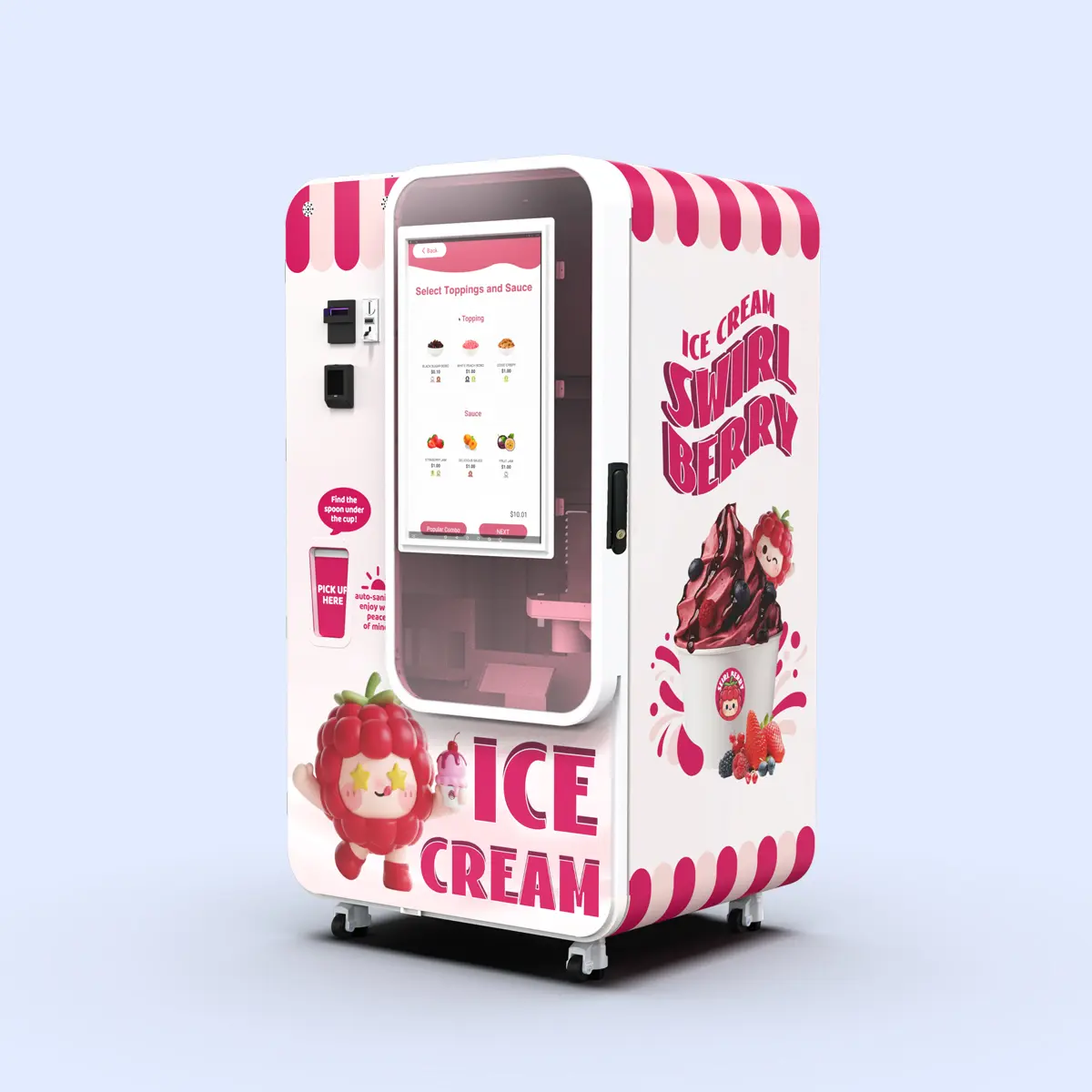
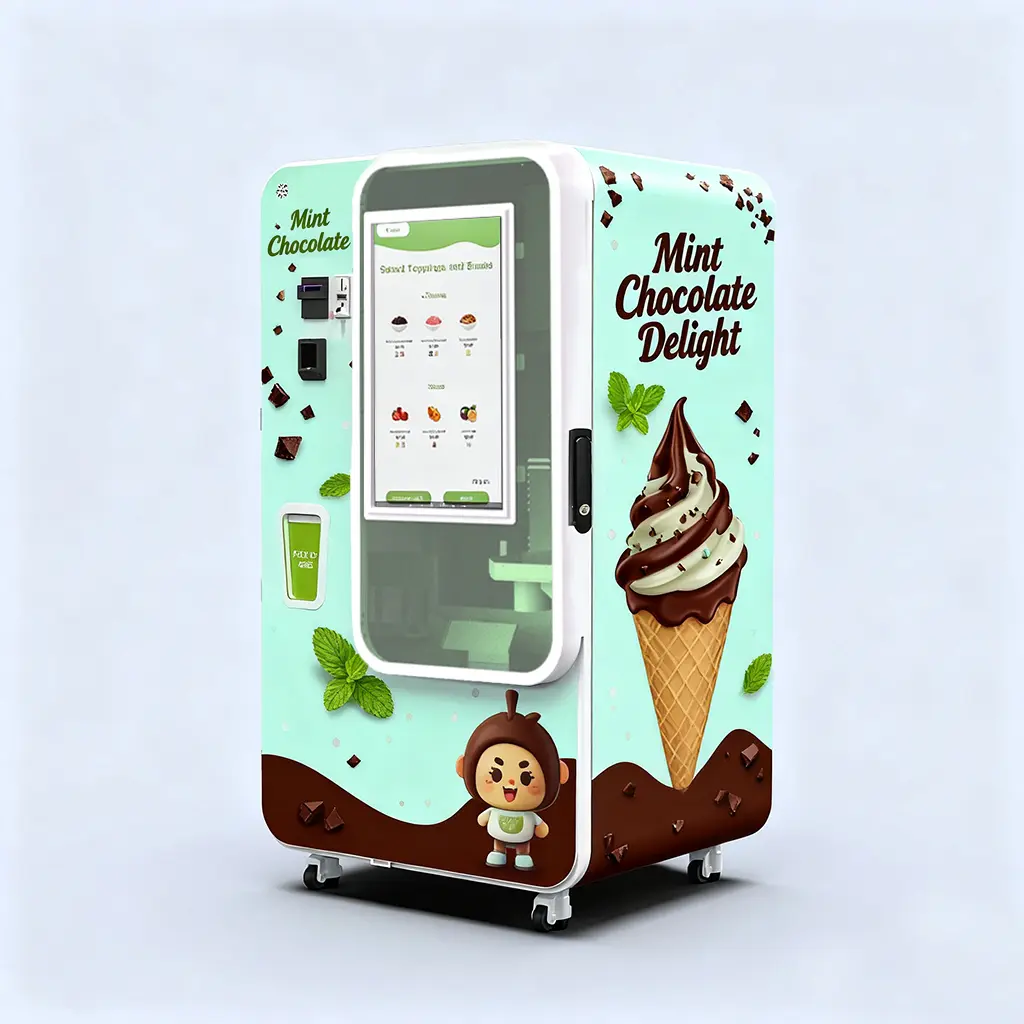
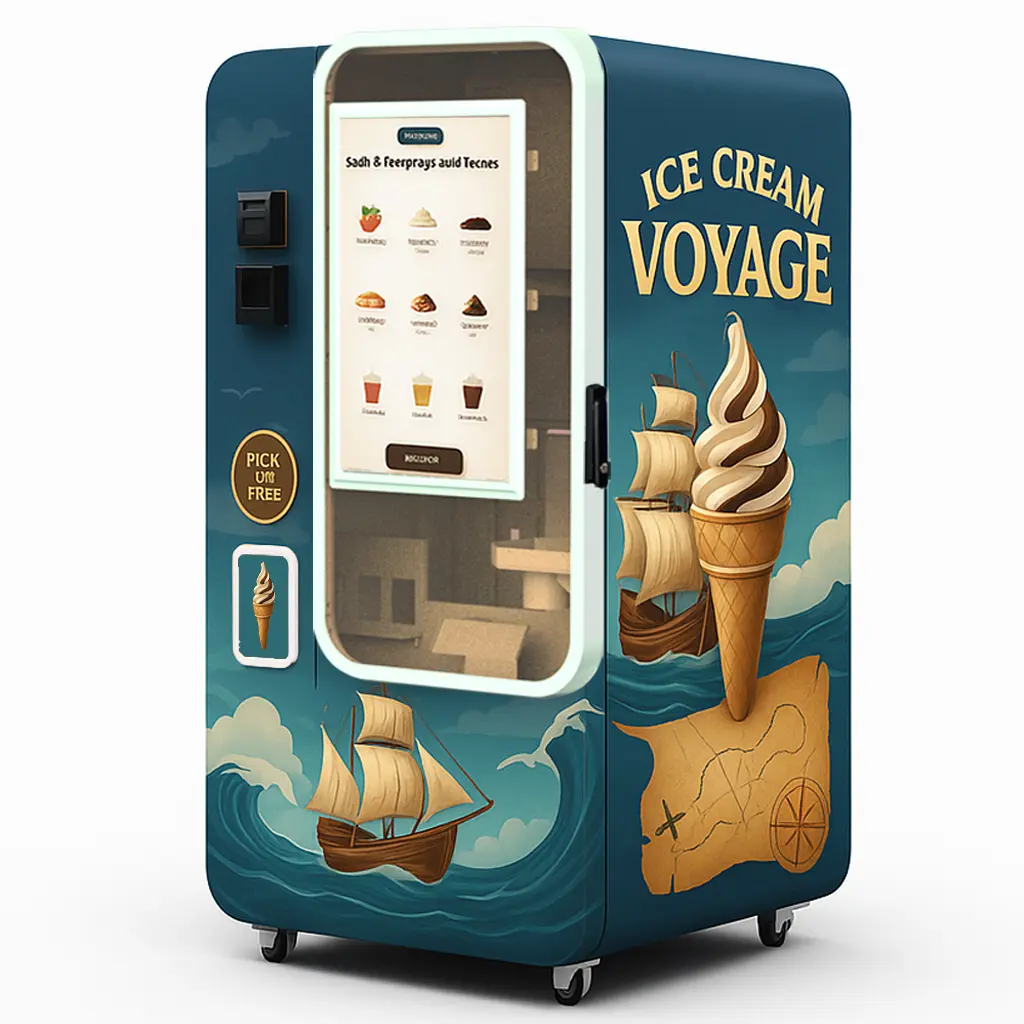
Use full exterior customization, not just a logo sticker. Build a visual system with IP characters, color schemes, and lightbox effects. Machines should become social-media check-in points, not grey boxes.2. Screen Content — Your Free Advertising Space
If a 32-inch screen only takes orders, you’re wasting 90% of its value.Use animations, ingredient storytelling, and looping brand videos (milk sources, imported jams, toppings).
More importantly, build cross-industry traffic flow.
Case:
At a tourist attraction, after purchase the screen automatically plays scenic promo videos, converting one-time visitors into ecosystem customers.
Chapter 4: Build Your Third Moat — Scenario Operations & Partnership Models
“Put machines where people are” is beginner logic. Advanced logic is:What product and cooperation model fits each scenario?
1. Scenario Matching
| Scenario Type | Core Traffic Characteristics | Product / Operation Strategy | Risk Notes |
| High-End Commercial Complexes | Family customers and young couples with strong purchasing power; focus on experience and quality. | Promote premium ingredients (high-quality milk base, exclusive cheese flavors), visually appealing toppings (jams, nut crumbs). Enable revenue-sharing systems to deeply bind with the mall. | Rent or revenue-sharing ratios are high; break-even daily sales must be calculated precisely. High requirements for machine appearance and brand image. |
| University Towns / Tech Parks | High repeat purchase rate, price-sensitive users, eager to try new products. | Launch promotions such as “Second cup 50% off,” “Buy 3 get 1 free.” Use built-in coupons to increase repurchase frequency. | Traffic drops during summer/winter vacations. High requirements for network stability (4G/5G) and remote management capability. |
| Transportation Hubs (Airports / Railway Stations) | Impulse-driven purchases, time-sensitive customers, higher average order value. | Emphasize ultra-fast dispensing (around 15 seconds), portable packaging. Ensure full payment coverage (credit cards, foreign currency, mobile payments). | Most competitive locations with high entry barriers. Machines must support 7×24 continuous operation with top-level durability. |
2. Partnership Models — From Leasing to Joint Operation
Instead of buying locations, try joint operations with cinemas, bookstores, hotels.You provide machines, materials, operations, and maintenance. They provide location and traffic. Revenue is shared by sales percentage.This greatly lowers entry barriers and capital risk.
Chapter 5: Long-Term Barrier — Data and Ecosystem
The ultimate differentiation comes from data and network effects.1. Data-Driven Operations
Don’t just look at revenue. Analyze:Which flavors sell best at what time?
Which promotions convert better?
Is temperature stable?
When to refill before shortages happen?
This turns you from a “restocker” into an “operator-analyst.”
2. Build a Micro Ecosystem
When you operate 10+ machines, cooperate with local cafés, bakeries, and brands to exchange traffic. Your network becomes a local lifestyle entry point.FAQ: Practical Questions
Q: Should beginners choose the cheapest machine?A: Cheap machines often cut corners on compressors and control boards, leading to high maintenance costs, frequent breakdowns, and bad texture (icy, watery). Treat machines as long-term investments. Brands like HUAXIN offer CE/ETL certifications, 1-year full warranty, and 98% remote issue resolution.
Q: What if the network goes down?
A: Good systems must support offline sales and local payments. Once online again, data syncs automatically. This must be verified before purchase.
Q: Can one machine really pay back in 3–4 months?
A: That’s an ideal model (100 cups/day, price $5, 65% margin). In reality, expect 4–6 months. Use differentiation to shorten the cycle.
Differentiation Is a Systematic Expedition
In the ice cream vending machine industry, winners are not the earliest entrants, but those who think systematically, execute meticulously, and continuously build barriers.Opportunities hide in technical details, brand interactions, and scenario decisions.
I hope this guide lights your path and helps you carve out your own blue ocean in a crowded market.