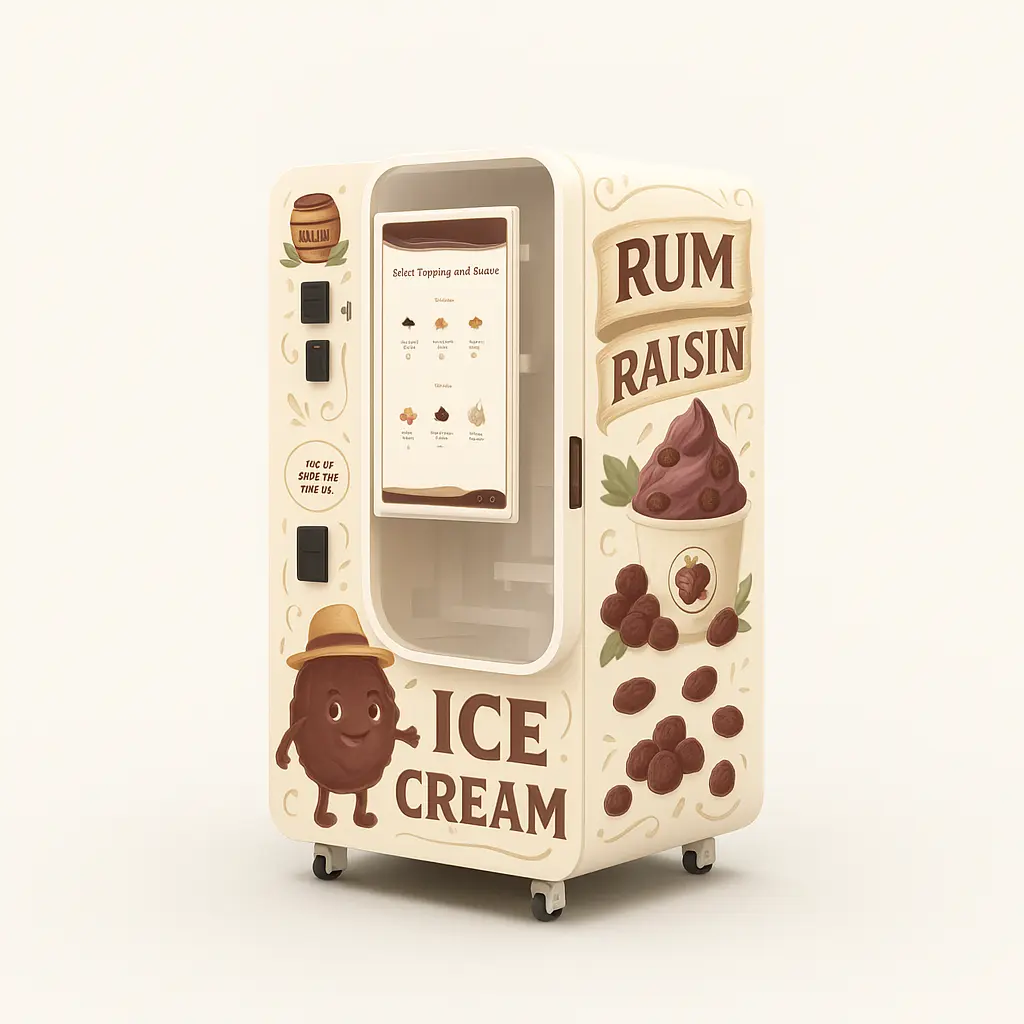
The Convenience Of Ice Cream Vending Machines Enhances User Experience
The competitive edge of ice cream vending machines lies in their convenience and accessibility: strategic placement (e.g., mall entrances), streamlined 3-step operation (under 20 seconds), and 24/7 smart maintenance. This "always-available, effortless" design boosts repurchase rates by 30%, making it key to unmanned retail success.

Location Adaptability: The Foundation of Accessibility for Ice Cream Vending Machines
The convenience of ice cream vending machines first manifests in the "accessibility" of their locations. The selection of high-quality locations needs to balance traffic density and accessibility, such as areas within 5 meters of shopping mall entrances, subway platform waiting areas, and next to community convenience stores. These locations are on users' necessary routes and avoid crowded or hidden corners. Operational data from a chain brand shows that machines located in areas "visible and accessible within 3 steps" have 45% higher daily sales than those in hidden locations, with 60% of orders coming from impulsive purchases made "on a whim."Meanwhile, the installation design of the equipment also affects accessibility. Ice cream vending machines with modular assembly can adapt to space constraints in different scenarios: vertical models with a width of ≤0.8 meters can be chosen for narrow passages, while combined models with rest platforms can be deployed in open areas. This flexibility allows the equipment to enter scenarios that traditional vending machines struggle to cover, such as office building lobbies and dormitory buildings on campuses, further improving user reach.
Simplified Operation Design: The Core Advantage of Lowering Usage Barriers
The operational convenience of ice cream vending machines directly affects user experience, with the core lying in "ultra-simplified steps" and "clear feedback." The purchasing process of mainstream equipment has been optimized to within 3 steps: selecting flavors (via touch screen or scan selection), completing payment, and picking up goods, with an average total time of no more than 20 seconds. Compared with early equipment that required more than 5 steps, the simplified process has reduced the user abandonment rate by 30%.
24/7 Service and Emergency Response: Ensuring Sustained Accessibility
The convenience of ice cream vending machines also lies in "24/7 availability" and "quick problem resolution." Equipment supporting round-the-clock operation uses intelligent monitoring systems to real-time detect ingredient cylinder levels and fault status: when ingredients are insufficient, the background automatically sends replenishment reminders to ensure supply before peak hours.
Huaxin’s ice cream vending machines cases in a late-night snack street show that 24/7 ice cream vending machines have night sales (22:00-02:00) accounting for 20% of the daily total. Moreover, due to fewer faults and quick responses, user satisfaction scores are 18 points higher (out of 100) than those of machines operating only during the day. This feature of "being available when needed and having few problems" ensures that the equipment is always "within reach" when users need it, becoming an important factor in improving repurchase rates.
The convenience and accessibility design of ice cream vending machines may seem like details of user experience, but they are actually the core of building competitiveness in unmanned retail. From accessible location layouts to simplified operation processes, and then to reliable 24/7 services, every design revolves around the goal of "making it easy for users to obtain." For users, this convenience means "being there when needed and effortless to use"; for operators, it means higher user stickiness and broader market coverage. In the fast-paced modern life, the convenience of ice cream vending machines is exactly why they can continue to occupy a place in the retail landscape.