BLOG Robotic vs. Traditional Ice Cream Vending Machines: 2026 Comparison Guide
Robotic vs. Traditional Ice Cream Vending Machines: 2026 Comparison Guide
Date:2026-05-20 Author:Huaxin
Compare robotic and traditional ice cream vending machines in 2026. Discover how the B83 Max improves operational performance in high-traffic locations through better automation, broader payment compatibility, and faster ROI payback periods.
When many investors first encounter robotic ice cream vending machines, they are often attracted by the robotic arm, automated production process, and interactive visual effects.
However, as operating experience grows, many operators begin to realize that ice cream vending machines placed in malls, airports, universities, cinemas, or amusement parks rarely fail because they "cannot make ice cream." More common challenges actually come from operations: slow serving speed during peak hours, unstable payment systems, high cleaning costs, difficulty controlling ingredient waste, and limited remote management capabilities.
After 2026, competition between ice cream vending machines is shifting from "feature presentation" to "long-term operational efficiency."
This article compares robotic arm ice cream vending machines, traditional ice cream vending machines, and operation-focused systems like the B83 Max from a practical B2B investment and operations perspective.
What Is the Real Difference Between Traditional Machines, Robotic Arm Systems, and Operation-Focused Automation?
Currently, ice cream vending equipment on the market can generally be divided into three categories:
1. Traditional Ice Cream Vending Machines
These machines mainly provide:
These systems typically include:
The issue, however, is that many robotic arm systems focus more on "visual presentation" than on long-term operational efficiency.
In real-world operations, common issues include:
3. Operation-Focused Fully Automated Ice Cream Vending Systems
The focus of these machines is no longer simply "higher automation."
Instead, the key question becomes: how can ice cream vending truly become a scalable and sustainable unattended retail business?
For example, systems like the B83 Max focus more on:
Which Type of Machine Is Better for Long-Term Operations?
How Automation Changes OPEX
Many first-time buyers are naturally attracted to the appearance of robotic ice cream machines. Machines with strong visual appeal do attract more attention.
But experienced operators usually ask a more practical question:
"How much labor can this machine actually reduce without increasing maintenance risks?"
In unattended soft-serve operations, automation truly impacts:
Serving speed is not just a technical parameter. It directly affects queue length, customer patience, and revenue performance.
In locations such as cinemas, shopping malls, and airports, customers often have very limited dwell time. If the waiting time is too long, many customers will simply leave.
Peak-Hour Capacity Example
Actual capacity already considers customer hesitation, payment time, cup collection, and occasional delays.
Based on our experience, the real operational bottleneck is not always the refrigeration system. Sometimes the issue comes from the payment process or UI interface. If the interface is complicated or customers cannot quickly find the card reader, the machine may waste 10–20 seconds before production even begins.
Therefore, a machine truly designed for long-term operation should be viewed as a complete sales process rather than simply an automatic ice cream dispenser.
Payment Compatibility: A Core Purchasing Requirement in 2026
Cashless payment has become a basic requirement for high-quality locations.
According to Cantaloupe data, 71% of vending transactions in 2024 were cashless, and 77% of those were contactless payments. In addition, average transaction values are generally higher with cashless payment systems.
For ice cream vending machines, cashless payment is especially important because soft serve is often an impulse purchase. If customers cannot pay quickly, they are likely to leave immediately.
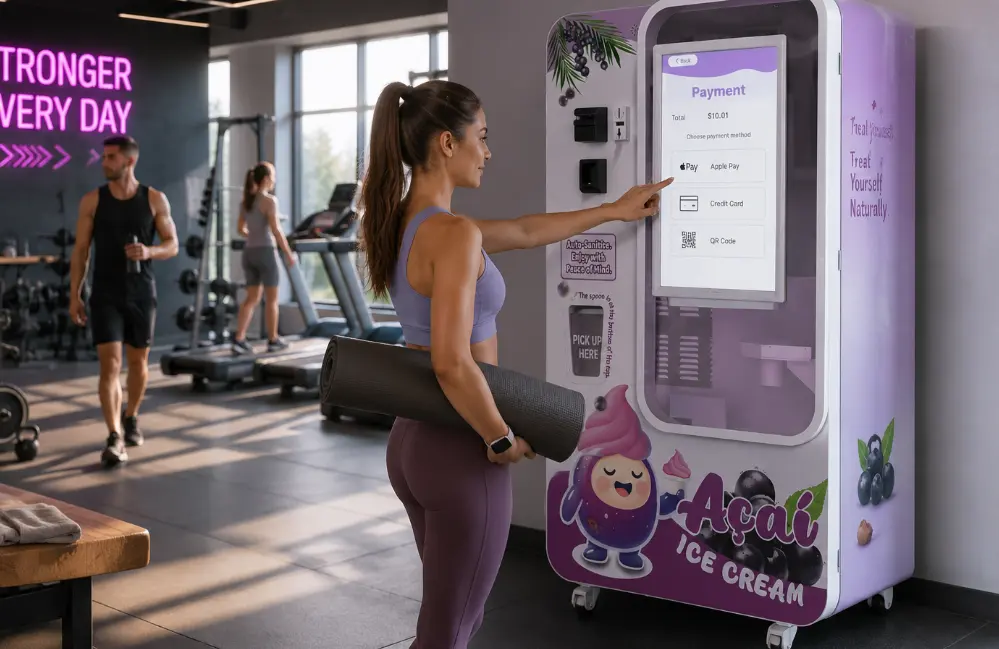
Common Payment Options Supported by B83 Max
For operators, the key question is not simply: "Can the machine accept payments?"
But rather:"Can the machine integrate with the payment systems required by local banks, venues, and settlement models?"
This is especially important for international distributors.
The United States, UAE, Saudi Arabia, Mexico, Australia, and Southeast Asia often require different payment modules.
The Real Operating Costs of Ice Cream Vending Machines
Many people calculate profits like this:
Selling price – ingredient cost = profit
But actual operational structures are far more complex.
A more realistic OPEX structure includes:
Operating costs vary significantly depending on the country and location. The following data is for operational modeling reference only.
Why ROI Should Not Be Evaluated Based Only on Machine Price
For many first-time buyers, the first question is usually: "How much does the machine cost?"
But mature operators focus more on:
What Conditions Are Required for an 8-Month ROI Model to Work?
Basic ROI Formula
Monthly Revenue = Daily Sales × Unit Price × 30
Monthly Net Profit = Monthly Revenue – Monthly OPEX
Payback Period = Initial Investment ÷ Monthly Net Profit
B83 Max 8-Month ROI Example (Project Model Reference)
Key Conditions Required to Achieve an 8-Month ROI
Typically, the following conditions must be met simultaneously:
What truly matters is never simply "how many people pass by," but rather "how many people are willing to stop and buy."
If customer dwell time is too short or the consumption scenario does not match, even locations with heavy traffic may produce very low ice cream conversion rates.
Therefore, ROI should be evaluated based on location type, not just machine model and purchase price.
After 2026, competition between ice cream vending machines will increasingly center on which system comes closer to becoming a scalable, repeatable, and sustainable unattended retail operation.
Traditional machines are more suitable for low-cost testing. Robotic arm systems are better for display and marketing-focused scenarios. Operation-focused fully automated systems like the B83 Max are more suitable for long-term, high-frequency operations and multi-location expansion.
However, as operating experience grows, many operators begin to realize that ice cream vending machines placed in malls, airports, universities, cinemas, or amusement parks rarely fail because they "cannot make ice cream." More common challenges actually come from operations: slow serving speed during peak hours, unstable payment systems, high cleaning costs, difficulty controlling ingredient waste, and limited remote management capabilities.
After 2026, competition between ice cream vending machines is shifting from "feature presentation" to "long-term operational efficiency."
This article compares robotic arm ice cream vending machines, traditional ice cream vending machines, and operation-focused systems like the B83 Max from a practical B2B investment and operations perspective.
What Is the Real Difference Between Traditional Machines, Robotic Arm Systems, and Operation-Focused Automation?
Currently, ice cream vending equipment on the market can generally be divided into three categories:
1. Traditional Ice Cream Vending Machines
These machines mainly provide:
- Basic payment functions
- Automatic dispensing
- Simple refrigeration systems
- Relatively simple structure
- Lower initial investment
- Suitable for low-cost market testing
- Higher frequency of manual inspections
- Limited remote management capabilities
- Average efficiency during peak hours
- Cleaning and maintenance rely more heavily on manual labor
- Small-scale testing
- Single-location operations
- Early-stage startup projects
These systems typically include:
- Robotic arm preparation processes
- Stronger visual interaction
- A more noticeable "robotic" experience
The issue, however, is that many robotic arm systems focus more on "visual presentation" than on long-term operational efficiency.
In real-world operations, common issues include:
- Longer production times
- Queues during peak hours
- More complex structures
- Higher cleaning difficulty
- Increased long-term maintenance costs
- Brand showcase projects
- Pop-up events
- Marketing-oriented environments
3. Operation-Focused Fully Automated Ice Cream Vending Systems
The focus of these machines is no longer simply "higher automation."
Instead, the key question becomes: how can ice cream vending truly become a scalable and sustainable unattended retail business?
For example, systems like the B83 Max focus more on:
- Peak-hour serving efficiency
- Payment success rates
- Automatic cleaning capabilities
- IoT remote management
- Multi-location operational efficiency
- Long-term maintenance costs
Which Type of Machine Is Better for Long-Term Operations?
| Comparison Item | B83 Max Ice Cream Vending Machine | Traditional Ice Cream Vending Machine | Robotic Arm Ice Cream Vending Machine |
| Peak-hour queue performance | Better suited for high-traffic locations | Average | More likely to create waiting lines |
| Daily cleaning | Higher automation level | More manual work | More complex structure |
| Multi-location management | Better for scalable operations | Limited functionality | Average |
| Payment stability | More complete payment compatibility | Depends on payment module | Higher integration cost |
| Long-term maintenance | More operation-oriented maintenance | Frequent manual inspections | Higher maintenance difficulty |
| Suitable scenarios | Long-term operations in malls, cinemas, transport hubs, etc. | Small-scale testing | Display and marketing purposes |
How Automation Changes OPEX
Many first-time buyers are naturally attracted to the appearance of robotic ice cream machines. Machines with strong visual appeal do attract more attention.
But experienced operators usually ask a more practical question:
"How much labor can this machine actually reduce without increasing maintenance risks?"
In unattended soft-serve operations, automation truly impacts:
- Transaction efficiency: customers can order, pay, and collect without staff assistance
- Product consistency: every cup should maintain stable portion size, texture, and appearance
- Cold chain and food safety: ingredient temperature and refrigeration status must remain visible and controllable
- Cleaning efficiency: the system should reduce repetitive manual labor while meeting hygiene standards
- Remote operations: operators should know sales, machine status, ingredient levels, and alerts before arriving on-site
Serving speed is not just a technical parameter. It directly affects queue length, customer patience, and revenue performance.
In locations such as cinemas, shopping malls, and airports, customers often have very limited dwell time. If the waiting time is too long, many customers will simply leave.
Peak-Hour Capacity Example
| Average Serving Time | Theoretical Maximum Cups/Hour | Actual Peak Cups/Hour | Operational Meaning |
| 90 seconds | 40 cups | 26–32 cups | Suitable for medium traffic |
| 60 seconds | 60 cups | 40–50 cups | Better suited for malls, cinemas, schools, and airports |
| 30 seconds | 120 cups | 100–110 cups | Stronger peak-hour performance |
Based on our experience, the real operational bottleneck is not always the refrigeration system. Sometimes the issue comes from the payment process or UI interface. If the interface is complicated or customers cannot quickly find the card reader, the machine may waste 10–20 seconds before production even begins.
Therefore, a machine truly designed for long-term operation should be viewed as a complete sales process rather than simply an automatic ice cream dispenser.
Payment Compatibility: A Core Purchasing Requirement in 2026
Cashless payment has become a basic requirement for high-quality locations.
According to Cantaloupe data, 71% of vending transactions in 2024 were cashless, and 77% of those were contactless payments. In addition, average transaction values are generally higher with cashless payment systems.
For ice cream vending machines, cashless payment is especially important because soft serve is often an impulse purchase. If customers cannot pay quickly, they are likely to leave immediately.
Common Payment Options Supported by B83 Max
| Payment Category | Examples |
| Global bank card payments | Visa、Mastercard |
| Contactless payments | Apple Pay、Google Pay、Samsung Pay |
| Unattended payment terminals | Nayax、PAX |
| QR code payments | Local e-wallets, bank QR systems |
But rather:"Can the machine integrate with the payment systems required by local banks, venues, and settlement models?"
This is especially important for international distributors.
The United States, UAE, Saudi Arabia, Mexico, Australia, and Southeast Asia often require different payment modules.
The Real Operating Costs of Ice Cream Vending Machines
Many people calculate profits like this:
Selling price – ingredient cost = profit
But actual operational structures are far more complex.
A more realistic OPEX structure includes:
- Ice cream powder and ingredient costs
- Cups, spoons, and packaging
- Electricity costs
- Venue rent or revenue sharing
- Restocking and logistics labor
- Maintenance reserves (maintenance difficulty and costs vary by machine type)
- Location marketing expenses
Operating costs vary significantly depending on the country and location. The following data is for operational modeling reference only.
| Cost Item | Typical Range |
| Ice cream ingredients | $0.4–0.6 |
| Packaging | $0.08–0.15 |
| Venue revenue share | 15–25% |
| Electricity | $50–120/month |
| Maintenance reserve | $120–250/month |
| Restocking labor | $200–500/month |
For many first-time buyers, the first question is usually: "How much does the machine cost?"
But mature operators focus more on:
- Whether daily sales remain stable
- Whether uptime is high enough
- Whether maintenance is frequent
- Whether venue revenue sharing is reasonable
- Whether the business model is scalable
What Conditions Are Required for an 8-Month ROI Model to Work?
Basic ROI Formula
Monthly Revenue = Daily Sales × Unit Price × 30
Monthly Net Profit = Monthly Revenue – Monthly OPEX
Payback Period = Initial Investment ÷ Monthly Net Profit
B83 Max 8-Month ROI Example (Project Model Reference)
| Item | Assumption |
| Daily sales | 50 cups |
| Selling price | $4/cup |
| Monthly sales volume | 1,500 cups |
| Monthly revenue | $6000 |
| Monthly net profit | $2660 |
| Initial investment | $21000 |
| Estimated payback period | 7.9 months |
Typically, the following conditions must be met simultaneously:
- Stable daily sales of 45–60 cups
- Strong match between foot traffic and consumption scenarios
- Venue revenue share below 25%
- Machine uptime above 95%
- Relatively low maintenance frequency
What truly matters is never simply "how many people pass by," but rather "how many people are willing to stop and buy."
If customer dwell time is too short or the consumption scenario does not match, even locations with heavy traffic may produce very low ice cream conversion rates.
Therefore, ROI should be evaluated based on location type, not just machine model and purchase price.
After 2026, competition between ice cream vending machines will increasingly center on which system comes closer to becoming a scalable, repeatable, and sustainable unattended retail operation.
Traditional machines are more suitable for low-cost testing. Robotic arm systems are better for display and marketing-focused scenarios. Operation-focused fully automated systems like the B83 Max are more suitable for long-term, high-frequency operations and multi-location expansion.
References / Sources