Ice Cream Vending Machine Cost Breakdown for Commercial Buyers
Use this commercial ice cream vending machine cost breakdown to budget for equipment, payment systems, shipping, import charges, ingredients, maintenance, site fees, and daily operation
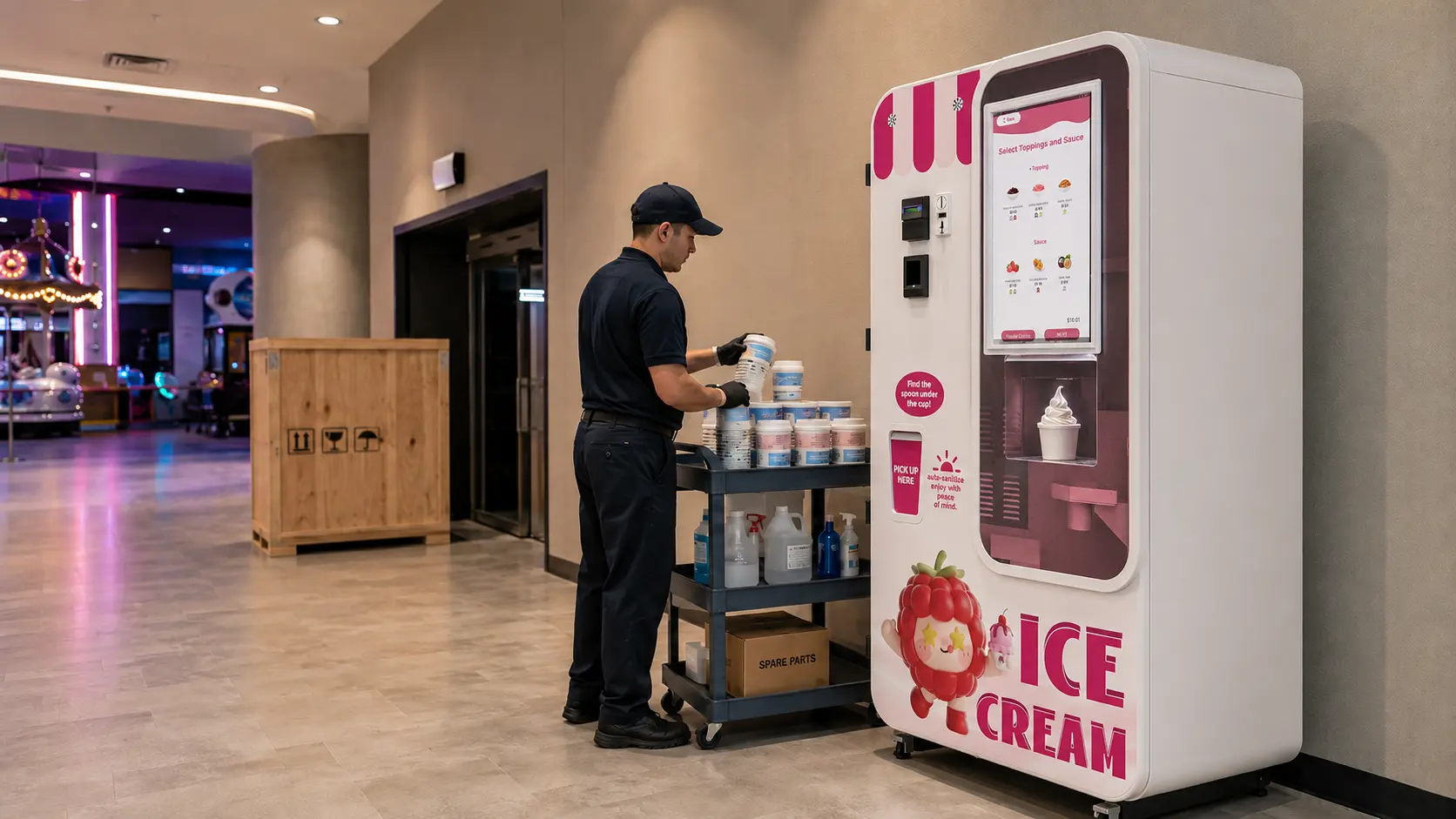
A useful ice cream vending machine cost breakdown must go beyond the number printed at the bottom of a supplier quotation. The machine is only the first cost layer. Commercial buyers also need to budget for payment integration, export packaging, ocean freight, customs clearance, initial ingredients, paper cups, cleaning, site fees, routine refilling, maintenance, and spare parts.
This is why apparently similar quotations can lead to very different final investments. One quote may include a suitable cashless payment interface, remote monitoring, export-grade packaging, training, and a starter spare-parts package. Another may cover only the basic machine.
The difference is not always obvious until the equipment is ready to ship—or has already arrived.
For a first-time operator, regional distributor, investor, or commercial project buyer, the most reliable approach is to calculate the full cost of ownership in separate cost blocks:
- Machine and configuration
- Shipping and import
- Launch inventory and consumables
- Ongoing operation
- Site-specific and contingency costs
The objective is not to produce one universal budget. It is to identify every line that needs a real number before the purchase decision is made.
The Cost Equation Commercial Buyers Should Use
Instead of asking only for the unit price, build the project budget around this equation:
Total initial project cost = Purchase-ready machine cost + landed import cost + site-launch cost + opening consumables + spare-parts reserve
Then create a separate operating budget:
Ongoing operating cost = Product consumables + payment fees + site fees + refill and cleaning labor + maintenance + network or software charges
Keeping these two calculations separate matters.
The initial project cost tells you how much capital is needed before the machine begins operating. The ongoing budget tells you what the machine must support after launch.
Mixing the two together can create misleading conclusions. For example, a buyer may believe the initial investment is low because the quoted machine price excludes payment hardware, local delivery, initial stock, and spare parts. Another buyer may overestimate the project by treating recurring ingredients as if several years of product stock must be paid in advance.
A structured worksheet prevents both mistakes.
Master Cost Breakdown
| Cost Block | Typical Items | One-Time or Recurring? | Who Should Confirm It? |
|---|---|---|---|
| Machine and configuration | Base machine, screen, refrigeration, payment interface, capacity, remote system, customization | Mainly one-time | Supplier and payment provider |
| Export and shipping | Packaging, origin transport, declaration, freight, insurance | One-time per shipment | Supplier and freight forwarder |
| Import and destination | Port charges, customs broker, duty, tax, local delivery | One-time per shipment | Importer and local broker |
| Launch consumables | Mix, cups, spoons, toppings, cleaning products | Initial and recurring | Operator and local suppliers |
| Site launch | Positioning, power, network, permits, signage | Mainly one-time | Operator and site owner |
| Daily operation | Refill, cleaning, transaction fees, rent or revenue share | Recurring | Operator |
| Maintenance | Wear parts, service visits, spare parts, emergency logistics | Recurring or irregular | Operator and supplier |
| Working reserve | Unexpected shipping, setup, service, or replacement cost | Reserved capital | Buyer |
This table should be completed with project-specific figures. It is not useful to assign universal percentages because rent, wages, duties, payment fees, and freight conditions vary widely by country and location.
1. Machine and Configuration Cost
The first section of the budget is the purchase-ready machine—not merely the lowest advertised base price.
A purchase-ready configuration is the version that can realistically be shipped to the target country and used in the intended location. It may include market-specific voltage, language, payment preparation, branding, remote functions, and export packaging.
Screen and Ordering Interface
The screen affects cost because it is both a hardware component and the main ordering interface.
A commercial screen may need to support:
- Product and price display
- Multiple languages
- Ordering instructions
- Promotional video
- Payment guidance
- Menu updates
- Brand graphics
A large touchscreen can be valuable in a shopping mall, cinema, airport, or family entertainment center where the machine must attract attention and explain the process to first-time customers.
It may be less important in a controlled office or small hotel environment where customers already understand the product.
The correct question is not whether the largest screen is always better. It is whether the screen is suitable for the viewing distance, menu complexity, location traffic, and branding objective.
Refrigeration and Production System
A commercial machine that prepares fresh soft serve or frozen yogurt has a more demanding refrigeration and production system than a cabinet that dispenses packaged frozen products.
This system influences:
- Ingredient temperature
- Product consistency
- Consecutive serving performance
- Recovery between orders
- Peak-hour capacity
- Cleaning requirements
- Component life
A lower-cost refrigeration setup may be acceptable for limited-volume indoor use but unsuitable for a busy commercial point. Buyers should therefore ask about expected operating conditions rather than comparing rated cooling specifications in isolation.
Important questions include:
- What ambient temperature range is recommended?
- How does the machine behave during repeated production?
- Which temperature and fault alerts are available?
- What cleaning routine does the ingredient system require?
- Which refrigeration parts can be serviced locally?
Refrigeration is not a decorative upgrade. It affects food handling, product quality, uptime, and maintenance exposure.
Payment Module and Local Integration
A machine may be technically “cashless-ready” without including a payment terminal that can process transactions in the buyer’s market.
The quotation should clarify whether it includes:
- Payment mounting position
- Card reader
- NFC/contactless capability
- QR payment
- Coin or bill equipment
- MDB interface
- Network hardware
- Software integration
- Payment-provider activation
NAMA’s MDB/ICP specification is designed for vending credit and control communication, including communication with peripherals such as coin mechanisms, bill validators, and cashless devices. Compatibility with the protocol, however, does not guarantee that every terminal or local payment provider can be activated in every country.
The buyer should confirm both sides:
- Can the machine communicate with the proposed payment hardware?
- Can the local payment company legally and commercially activate that hardware?
A low quotation that excludes local payment integration may create additional hardware, certification, development, and service costs later.
Cup, Ingredient, and Serving Capacity
Capacity affects the purchase price, but it also affects labor.
A higher-capacity machine may:
- Operate longer between visits
- Handle concentrated peak traffic
- Reduce emergency refilling
- Support locations with stronger daily demand
A lower-capacity machine may be easier to place and less expensive, but it could require more frequent visits.
Buyers should estimate:
- Target daily sales
- Peak-hour orders
- Refill access
- Distance from the service base
- Weekend and seasonal traffic
- Acceptable refill frequency
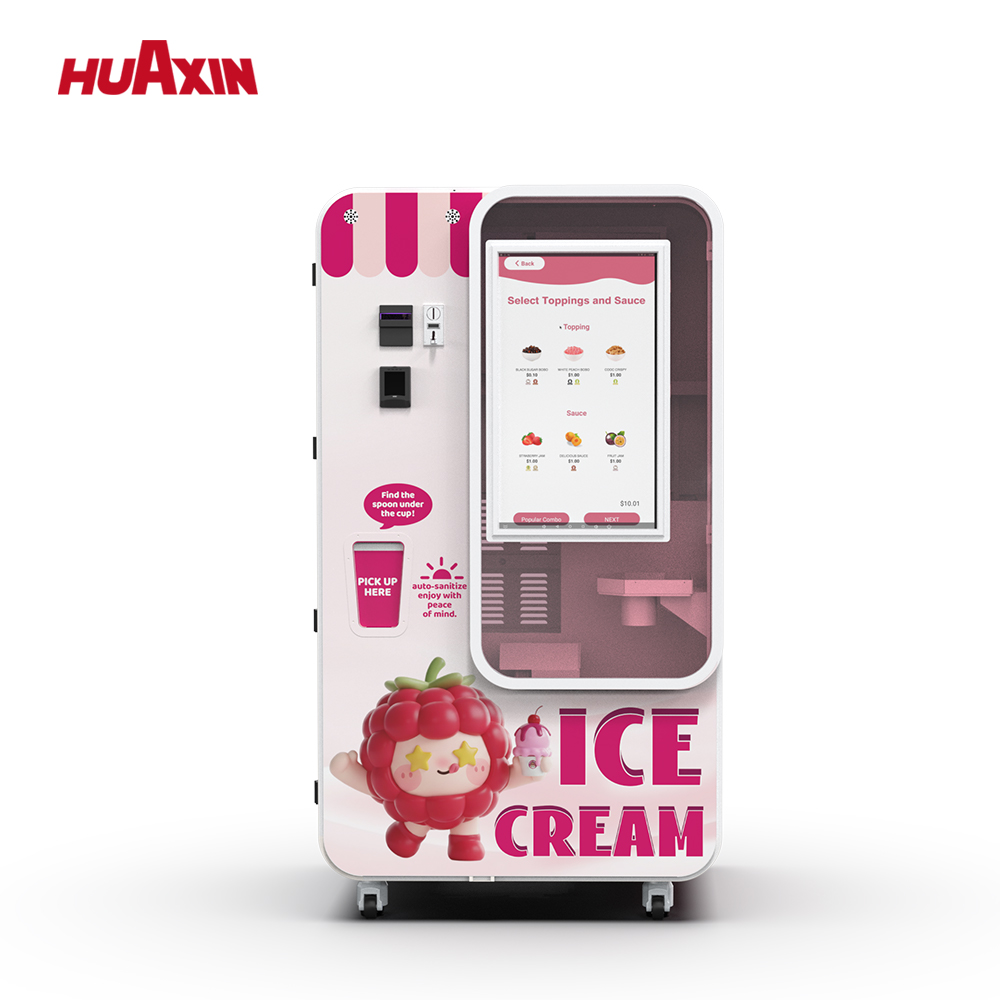
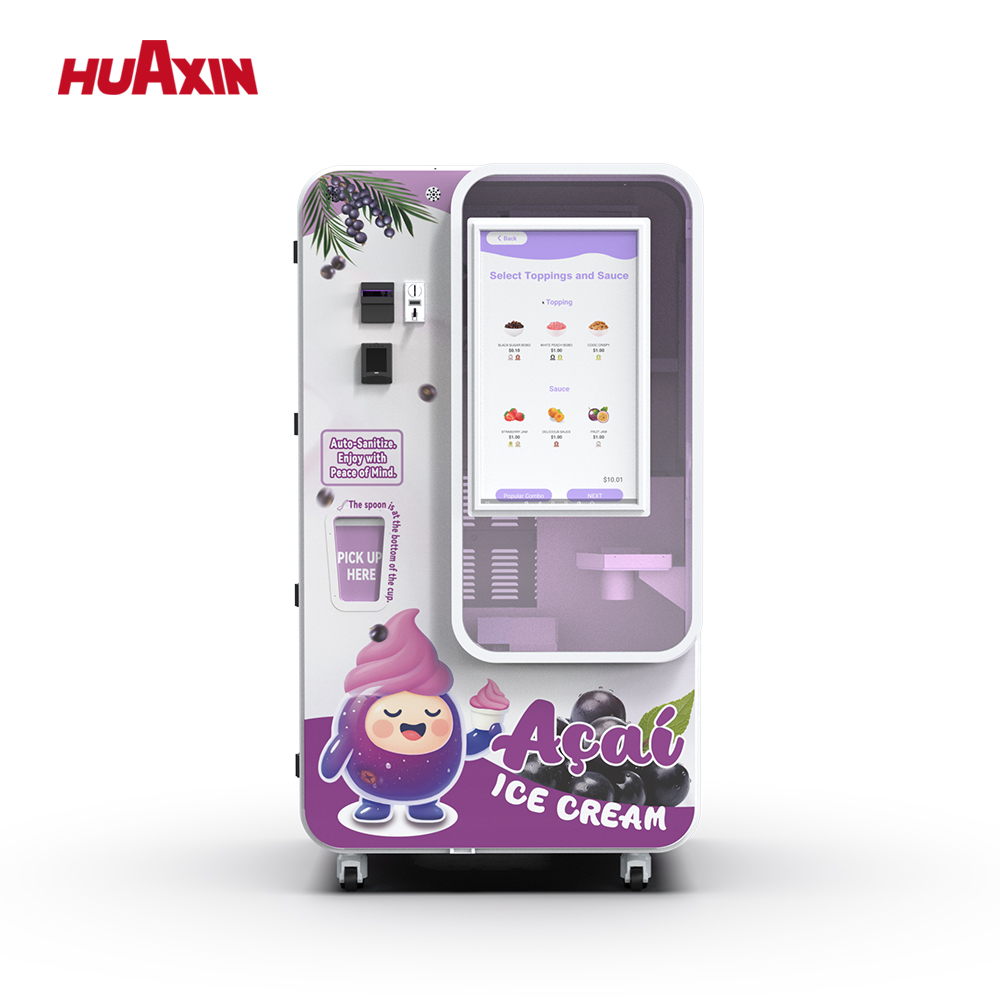
Huaxin’s full-size commercial platform can be configured for automated serving with remote management, and typical serving time is approximately 15–20 seconds depending on the product, recipe, and operating conditions. This performance figure should be treated as a production reference rather than a guaranteed customer-throughput calculation.
Automation Level
The word “automatic” can describe different levels of machine operation.
The cost may change depending on whether the machine automates:
- Order processing
- Payment confirmation
- Cup movement
- Product preparation
- Serving
- Pickup access
- Fault detection
- Temperature monitoring
- Inventory alerts
Buyers should ask the supplier to show the complete order-to-pickup process. A feature list alone may not explain which steps still require customer or operator intervention.
Remote Management
Remote management becomes more valuable as the number of machines grows.
Potential functions include:
- Sales records
- Online/offline status
- Temperature monitoring
- Cup or ingredient alerts
- Fault codes
- Payment records
- Cleaning reminders
- Remote menu or price management
For a one-machine pilot, the system can reduce unnecessary site visits. For a multi-location operator, it supports route planning and faster response.
The quotation should explain:
- Which functions are included
- Whether software charges apply
- Whether a SIM card or local data plan is required
- Whether remote access works in the destination country
- How long data is retained
- Who provides technical support
How Configuration Changes the Cost
| Configuration Area | Basic Commercial Requirement | Higher-Demand Requirement | Cost Effect |
| Screen | Clear ordering interface | Large display, multilingual UI, advertising | Hardware and UI customization |
| Refrigeration | Stable indoor operation | Strong peak-load and warmer-environment performance | Components, testing, energy use |
| Payment | One confirmed method | Card, NFC, QR, coin or local integration | Hardware, activation, integration |
| Capacity | Moderate daily demand | Longer operation between refills | Storage and internal mechanism |
| Automation | Automatic preparation | More automated cup and pickup flow | Mechanical and control complexity |
| Remote system | Basic status monitoring | Multi-machine alerts and data tools | Software and communication setup |
| Branding | Standard exterior | Customized stickers, UI and menu | Design and production work |
A valid comparison requires suppliers to quote the same configuration. Otherwise, the buyer is comparing different products under a similar name.
2. Shipping and Import Cost
The second cost block is the amount required to move the machine from the factory to the operating site.
This is often described too simply as “freight.” In reality, it can include several separate charges.
Origin-Side Costs
Possible origin costs include:
- Export wooden case or protective packaging
- Moisture protection
- Internal machine fixing
- Factory-to-port transport
- Export declaration
- Documentation
- Port or warehouse handling
The buyer should ask whether export packaging is included in the machine quotation. A machine designed for indoor operation still needs sufficient protection against vibration, handling, and moisture during international transport.
Ocean Freight
Freight is not a permanent fixed figure.
As of July 9, 2026, Drewry reported that its World Container Index had reached USD 4,639 per 40-foot container, the highest level recorded by the index since September 2024. The figure is a global composite rather than a quotation for a specific route, but it illustrates why buyers should request a dated freight estimate instead of using an old shipping figure.
The freight calculation depends on:
- Origin port
- Destination port
- LCL or full-container shipment
- Machine quantity
- Packed volume and weight
- Route availability
- Fuel or peak-season surcharges
- Transshipment requirements
- Sailing schedule
A freight quotation should always include an expiry date.
Huaxin Shipping Reference
For preliminary planning, a typical full-size Huaxin machine uses the following reference data:
- Approximate dimensions: 1180 × 1100 × 2130 mm
- Approximate weight: 500 kg
- Approximate volume: 2.76 CBM
- 20-foot container reference: approximately 10 units
- 40-foot high-cube reference: approximately 22 units
Final packing measurements and loading quantities should be confirmed before booking transportation.
These figures explain why quantity changes the landed cost:
- A single machine is commonly handled as LCL cargo.
- Several machines can share some documentation and origin charges.
- A larger order may make container planning more efficient.
- Spare parts and consumables can sometimes be consolidated with the main shipment.
Incoterms and Quote Boundaries
FOB, CIF, FCA, DAP, and other Incoterms are not interchangeable price labels. They define how responsibilities, costs, and risks are allocated between buyer and seller. ICC describes Incoterms 2020 as the authoritative rules for determining these responsibilities in international sales contracts.
Even when a quotation says CIF, the buyer should not assume that it includes:
- Destination port charges
- Import duty
- VAT or GST
- Customs brokerage
- Storage
- Inspection
- Local delivery
- Unloading at the final site
The quotation should list inclusions and exclusions rather than relying only on a three-letter term.
Import and Destination Costs
The buyer or local broker should confirm:
- Customs classification
- Import eligibility
- Duty
- VAT, GST, or sales tax
- Port handling
- Customs broker fee
- Documentation fee
- Inspection cost
- Storage or demurrage exposure
- Port-to-site delivery
- Unloading equipment
This article should not be used to determine a country-specific tax rate. Customs treatment can change, and the importing authority makes the final classification decision.
3. Consumables and Launch Inventory
The third cost block begins before the first sale.
A machine that has arrived without ingredients, cups, cleaning materials, and tested recipes is not a completed commercial launch.
Base Product
Depending on the concept, the machine may use:
- Soft serve mix
- Frozen yogurt mix
- Sorbet formulation
- Açaí-style frozen dessert formulation
A Huaxin machine normally operates with one base product at a time. Changing product category requires changing the ingredient and adjusting the recipe rather than selling several unrelated base mixes simultaneously.
The cost per serving depends on:
- Local ingredient price
- Recipe
- Portion size
- Product yield
- Waste
- Import or domestic sourcing
- Storage conditions
Before ordering large ingredient volumes, the operator should test the formula with the selected machine and local water or milk conditions where applicable.
Cups, Spoons, and Packaging
Small consumables become meaningful when multiplied by daily sales.
The operating budget should include:
- Paper cups
- Spoons
- Lids if used
- Napkins
- Branded stickers
- Outer packaging if required
Cup dimensions must also be compatible with the storage and pickup system. A cheaper locally sourced cup is not useful if its shape or rigidity causes feeding problems.
Toppings and Sauces
Toppings can improve the menu but add complexity.
They may affect:
- Ingredient cost
- Refill frequency
- Cleaning time
- Allergen management
- Storage
- Waste
- Customer pricing
Dry products such as granola, nuts, and certain fruit pieces generally follow a different handling process from sauces, jam, or refrigerated toppings.
The budget should reflect the actual menu rather than assuming toppings are a free addition.
Cleaning Supplies and Wear Consumables
Recurring cleaning and service supplies may include:
- Approved cleaning agent
- Sanitizing materials
- Brushes and cleaning tools
- Food-safe lubricant
- Seals
- Tubes
- Nozzles
- Small wear parts
These items rarely dominate the budget, but missing them can interrupt operation.
Consumables Worksheet
| Item | Supplier | Unit Cost | Expected Usage | Reorder Lead Time | Storage Requirement |
| Base mix | |||||
| Cups | |||||
| Spoons | |||||
| Dry toppings | |||||
| Sauces | |||||
| Cleaning products | |||||
| Seals and wear items |
This is more useful than asking what percentage of the total budget consumables should represent. The correct answer depends on the recipe, local sourcing, sales volume, and stocking period.
4. Operating Expenses
The fourth cost block determines how much work and recurring spending are needed to keep the machine available.
Automation reduces the need for continuous on-site staffing, but it does not remove operational work.
Refilling and Cleaning
The operator must plan:
- Travel to the location
- Ingredient refill
- Cup refill
- Topping refill
- Cleaning
- Waste handling
- Exterior sanitation
- Routine inspection
- Record keeping
A machine located five minutes from the operator’s warehouse has a different service cost from one located two hours away.
Route density therefore matters. Five machines in one city may be easier to support than three machines spread across a large region.
Labor
Labor should be calculated using the real time required for each service visit, including travel, access, cleaning, refilling, and reporting.
For context, U.S. Bureau of Labor Statistics data published in May 2026 reported a national mean hourly wage of USD 17.86 and a median of USD 16.85 for food preparation and serving-related occupations based on May 2025 data. This is only a U.S. reference; actual employer cost and local wage levels can be materially different.
The labor worksheet should therefore use:
Service cost per visit = Travel time + On-site time + Employer labor cost + Transport cost
Do not calculate labor using only the minutes spent pouring mix into the machine.
Payment and Connectivity
Recurring technology costs may include:
- Transaction fee
- Payment gateway fee
- Terminal rental
- SIM card
- Mobile data
- Software subscription
- Bank settlement fee
- Refund processing
The cheapest payment terminal is not necessarily the lowest-cost option if approval rates are poor or local support is weak.
Site Fee
Commercial locations may use:
- Fixed monthly rent
- Revenue share
- Minimum guarantee
- Rent plus revenue share
- Electricity or service fee
- Promotional contribution
The agreement should also clarify:
- Contract duration
- Access hours
- Electricity responsibility
- Network availability
- Relocation conditions
- Exclusivity
- Cleaning responsibility
- Insurance requirements
A high-traffic site can still be commercially unattractive if the site fee absorbs too much of the contribution margin.
Maintenance and Downtime Reserve
Maintenance cost is irregular, so buyers often leave it out of the monthly model.
The budget should still include a reserve for:
- Wear parts
- Sensors
- Refrigeration service
- Payment hardware
- Local technician visits
- International courier
- Emergency replacement
- Lost operating time
For an overseas project, it is normally more practical to hold selected low-cost parts locally than to wait for each item to be shipped after a fault occurs.
5. How Location and Quantity Change the Budget
A correct breakdown should reflect the proposed operating model.
Location Budget Differences
| Location | Main Cost Pressure | Configuration Priority | Operating Consideration |
| Shopping mall | Rent, branding, payment, weekend demand | Large interface, cashless payment, capacity | Access windows and revenue share |
| FEC | Peak demand, refilling, cups and toppings | Fast serving, capacity, strong alerts | Weekends and events |
| Hotel | Appearance, quiet operation, moderate traffic | Clean design, simple payment | Irregular late-hour demand |
| Campus | Payment fit, price sensitivity, repeat users | Durable operation, simple menu | Academic calendar |
| Gym | Recipe and topping strategy | Health-positioned menu, clean display | Smaller but targeted demand |
| Tourist site | Seasonality, multilingual use | Visual appeal, payment flexibility | Peak season and weather |
| Distributor network | Training, support, spare parts | Standardized configuration | Local after-sales capability |
The same equipment package should not automatically be quoted for all of these projects.
Quantity Budget Differences
One Machine
The buyer should expect:
- Higher freight cost per unit
- Pilot-level spare parts
- Limited route efficiency
- Lower customization leverage
- Strong need to validate location assumptions
Three to Five Machines
The budget should add:
- Centralized monitoring
- Route planning
- Larger consumable stock
- Standard cleaning process
- Shared spare parts
- Location comparison
Ten or More Machines
The project may require:
- Container-based logistics
- Local parts inventory
- Technical training
- Standardized branding
- Payment rollout plan
- Installation procedure
- Distributor or service structure
Volume discounts are only one part of the difference. Larger orders create more responsibility for deployment and local support.
6. Build a Cost Worksheet Before Comparing Quotations
A useful cost worksheet should contain at least five sections.
Section A: Purchase-Ready Machine
Enter:
- Base machine
- Required configuration
- Payment hardware
- Language
- Branding
- Remote management
- Spare parts
- Export packaging
Section B: Landed Cost
Enter:
- Origin transport
- Ocean freight
- Insurance
- Destination charges
- Customs broker
- Duty and tax
- Local delivery
- Unloading
Section C: Site Launch
Enter:
- Power preparation
- Network
- Positioning
- Signage
- Site deposit
- Permit or inspection
- Initial training
Section D: Opening Inventory
Enter:
- Base mix
- Cups
- Spoons
- Toppings
- Sauces
- Cleaning supplies
- Wear consumables
Section E: Monthly Operation
Enter:
- Site fee
- Payment charges
- Connectivity
- Labor
- Travel
- Cleaning
- Product replenishment
- Maintenance reserve
Do not compare suppliers until each quotation can be transferred into the same worksheet.
7. Accurate Quote Checklist
Provide the following information before requesting a commercial quotation.
Project Information
- Target country
- Destination city or port
- Purchase quantity
- Planned launch date
- Import experience
- Preferred trade term
Location Information
- Mall, FEC, hotel, campus, gym, tourist site, or other
- Indoor or outdoor placement
- Available floor area
- Access hours
- Estimated customer traffic
- Target daily sales
- Distance from the service base
Product Information
- Soft serve, frozen yogurt, sorbet, or açaí-style
- Cup size
- Topping requirements
- Ingredient source
- Expected menu complexity
Technical Information
- Voltage and frequency
- Payment methods
- Local payment provider
- Language
- Network availability
- Remote management requirements
- Certification or documentation needs
Commercial Information
- One-machine pilot or rollout
- Need for branding
- Need for spare parts
- Need for ingredient or cup support
- Port delivery or door delivery
- Training requirements
Quote Request Template
Company / Buyer Name:
Country:
Destination City or Port:
Purchase Quantity:
Project Type: Pilot / Multi-location Operation / Distribution
Target Location: Mall / FEC / Hotel / Campus / Gym / Tourist Site / Other
Indoor or Outdoor:
Available Space:
Product Type: Soft Serve / Frozen Yogurt / Sorbet / Açaí-Style
Expected Daily Sales:
Expected Peak-Hour Demand:
Cup Size:
Topping Requirements:
Payment Methods Required:
Local Payment Provider, if known:
Required Language:
Remote Management Requirements:
Branding Requirements:
Certification or Documentation Requirements:
Preferred Trade Term:
Port or Door Delivery:
Need Initial Cups or Ingredients:
Need Spare-Parts Package:
Planned Launch Date:
Future Expansion Plan:
Other Questions:
This information gives the supplier enough context to recommend a configuration instead of responding with an incomplete base price.
FAQ
Does a machine quotation normally include shipping and import duty?
Not automatically. The answer depends on the quoted trade term and the inclusions listed by the supplier. Buyers should separately confirm export packaging, freight, insurance, destination charges, customs clearance, tax, and local delivery.
What percentage of the budget should be allocated to consumables and operation?
There is no reliable universal percentage. Ingredient prices, rent, wages, transaction fees, sales volume, and service distance vary too much. Build the budget with local unit costs instead.
Is the landed cost much lower when purchasing several machines?
It can be more efficient because origin handling, documentation, spare parts, and container space may be shared. The exact saving depends on the route, packed dimensions, order quantity, and whether the shipment moves as LCL or a full container.
How much should a buyer prepare for the first machine?
The required amount is the total of the purchase-ready machine, landed import cost, site preparation, opening stock, spare parts, and an operating reserve. A machine-only figure is not sufficient for launch planning.
Why do two suppliers quote very different prices?
They may be quoting different screens, refrigeration systems, payment equipment, capacities, software, packaging, customization, spare parts, and support. Ask each supplier to complete the same configuration checklist.
Are operating expenses lower than a traditional staffed dessert kiosk?
An automatic machine can reduce continuous on-site staffing, but it still requires refilling, cleaning, monitoring, payment processing, maintenance, and location management. A direct comparison must use the real operating schedule of both models.
Which cost is most commonly underestimated?
Destination charges, local delivery, payment integration, site fees, and refill labor are frequently overlooked because they may not appear in the factory quotation.
Conclusion: Build the Budget Before Choosing the Quote
A professional ice cream vending machine cost breakdown is not a list of approximate prices. It is a structured method for identifying who will charge each cost, when it will be paid, and whether it is one-time or recurring.
The machine price matters, but it does not show the full commercial commitment.
A realistic budget should include:
- The purchase-ready machine
- Payment and market-specific configuration
- Export and shipping
- Import and local delivery
- Initial ingredients and cups
- Site preparation
- Refilling and cleaning
- Payment and network fees
- Maintenance and spare parts
- A working reserve
Once these lines are visible, supplier quotations become easier to compare and project risks become easier to discuss.
For a configuration-based recommendation, provide the supplier with your country, destination city or port, target location, purchase quantity, product type, payment requirements, expected daily sales, and planned launch date.
That information is more valuable than asking for the lowest available machine price because it allows the supplier to quote the project you actually intend to operate.
References
-
Drewry, World Container Index, July 9, 2026.
-
International Chamber of Commerce, Incoterms® 2020.
-
National Automatic Merchandising Association, Multi-Drop Bus / Internal Communication Protocol.
-
U.S. Bureau of Labor Statistics, National Employment and Wage Data, May 2025.
References / Sources