BLOG Ice Cream Vending Machine Payment Systems: How to Choose the Right Setup for Each Market
Ice Cream Vending Machine Payment Systems: How to Choose the Right Setup for Each Market
Date:2026-06-09 Author:Huaxin
Learn how to choose the right payment system for an ice cream vending machine, including credit cards, Apple Pay, Google Pay, Nayax, Ingenico, Square, coin acceptors, and ROI impact by market.
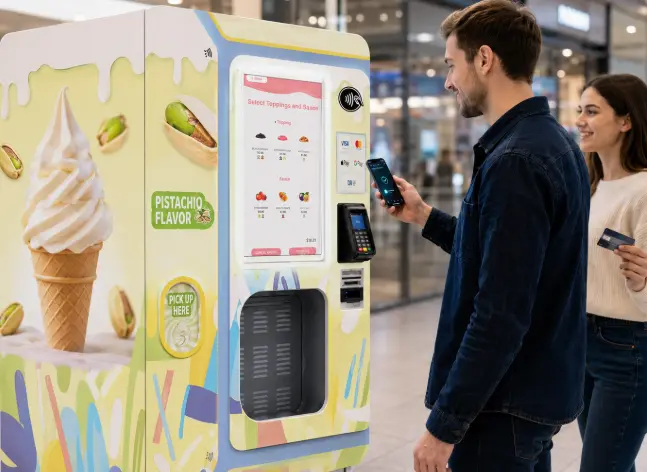
As consumer payment habits rapidly shift toward cashless transactions, payment systems have become a critical factor affecting the profitability of an Ice Cream Vending Machine. This article explores the optimal integration of credit cards, Apple Pay, Google Pay, Nayax, Square, Ingenico, and coin/bill acceptors across different markets, helping operators improve conversion rates, operational stability, and ROI.
一、How Can Localized Payment Configurations Improve the Conversion Rate and ROI of an Ice Cream Vending Machine?
If I had to summarize one of the most underestimated aspects of operating an Ice Cream Vending Machine over the past few years, payment systems would easily rank among the top three.Many investors spend weeks comparing compressor brands, cooling performance, dispensing speed, screen sizes, and machine designs.
However, once operations begin, many realize something surprising:
Sometimes it is not the ice cream itself that affects sales.
It is whether the customer can successfully complete payment during those final few seconds.
It may sound exaggerated, but we have seen this happen repeatedly.
In 2023, one of our UK clients deployed several Ice Cream Vending Machines in a shopping mall.
"The machines were functioning perfectly. The product quality was excellent. Foot traffic exceeded expectations. Yet sales consistently fell short of projections."
Initially, the client suspected pricing.
Then they questioned the machine's appearance.
Eventually, after reviewing backend sales data together, we discovered the real issue was neither.
It was the payment experience.
A significant number of customers completed product selection but never completed payment.
Further investigation revealed a surprisingly simple reason:
Many transactions stalled at the payment screen.
At that moment, everyone realized the problem was not the ice cream—it was the available payment options.
Most young shoppers preferred Apple Pay and Google Pay.
The machine only accepted traditional credit cards.
After upgrading the payment system, overall transaction conversion increased by approximately 18% within the first month.
This experience taught the client an important lesson:
For an Ice Cream Vending Machine, the payment system is no longer just a tool for collecting money.
It is a critical component of the sales conversion process.
In many situations, the payment experience has a greater impact on purchase completion than the product itself.
二、Global Payment Habits Are Changing: Why Diverse Payment Options Have Become Essential
Over the past decade, global retail has undergone a major transformation.If you travel frequently, you will notice something interesting.
In Singapore, London, and Dubai, many young consumers rarely carry cash anymore.
Yet in parts of Germany, especially around local communities and transportation hubs, cash remains surprisingly common.
This is where many international operators make their first mistake.
They assume that payment habits in their home country will apply elsewhere.
As a result, machines are installed in high-traffic locations but fail to achieve expected sales performance.
The reason is simple:
Consumers will not change their payment habits just to buy an ice cream.
Particularly in markets such as:
Singapore
United Kingdom
United States
Australia
United Arab Emirates
Nordic Countries
Mobile and contactless payments have become mainstream.
According to industry reports and data from our own operating projects across multiple countries, cashless transactions now account for over 70% of purchases in most unattended retail environments.
In some markets, the figure exceeds 90%.
Consumer Payment Preferences by Region
| Region | Cash | Credit Card | Mobile Payment |
| Singapore | 5%-10% | 40%-50% | 40%-60% |
| United States | 15%-25% | 50%-60% | 20%-30% |
| United Kingdom | 10%-20% | 45%-55% | 30%-40% |
| Germany | 30%-40% | 40%-50% | 10%-20% |
| Saudi Arabia | 10%-15% | 45%-55% | 35%-45% |
| Thailand | 15%-25% | 20%-30% | 50%-60% |
"If my machine accepts Visa and Mastercard, isn't that enough?"
Based on real operational experience, the answer is often no.
Consumers will not adapt to the machine.
The machine must adapt to consumers.
For impulse purchases like ice cream, the simpler the payment process, the higher the conversion rate.
三、Why Payment Systems Have Become a Core Competitive Advantage
When evaluating equipment, investors typically focus on:Cooling performance
Dispensing speed
Hopper capacity
Compressor brand
All of these matter.
However, from an operational perspective, payment systems directly affect conversion rates.
Simply put:
Traffic × Conversion Rate × Average Order Value = Revenue
Payment systems directly influence conversion rate.
Based on our internal operational samples:
| Payment Configuration | Average Conversion Rate |
| Cash Only | 15%-25% |
| Credit Card Only | 25%-35% |
| Credit Card + Mobile Payment | 35%-45% |
| Full Payment Solution | 40%-55% |
The more payment options available, the lower the probability of abandoned purchases.
四、Integrating Mainstream Cashless Payment Systems
Modern Ice Cream Vending Machines generally use the MDB communication protocol.This allows integration with most mainstream payment systems worldwide.
For international operators, compatibility is crucial because payment preferences vary dramatically between markets.
1、Nayax: The Most Common Solution in Global Unattended Retail
If you have researched vending businesses in Europe or North America, you have probably encountered Nayax.Many first-time operators assume Nayax is simply a card reader.
In reality, its greatest value often lies in data management.
When your machine fleet grows from three machines to thirty, new questions emerge:
Which machine is running low on inventory?
Which location is underperforming?
Which SKU generates the highest sales?
Which payment terminal is experiencing issues?
Without real-time data, operators are often forced into manual troubleshooting.
Nayax provides:
Visa
Mastercard
Apple Pay
Google Pay
NFC payments
Cloud-based management
Sales analytics
Remote monitoring
For operators managing ten or more machines, the management capabilities often deliver more value than payment processing itself.
2、Square: Popular in North America
Square is widely used across the United States and Canada.Best suited for:
Startups
Small-scale operators
Market testing projects
Advantages include:
Easy deployment
User-friendly interface
Low learning curve
However, its fleet management and analytics capabilities are generally less comprehensive than Nayax.
3、Ingenico: Preferred in Europe and the Middle East
Many European operators favor Ingenico due to:Strong banking compatibility
Mature EMV certification
Extensive local payment integrations
Global maintenance support
Particularly in France, Spain, and Italy, operators often integrate Ingenico directly with existing acquiring banks to reduce long-term transaction costs.
五、Recommended Payment Configurations by Market
There is no universal payment strategy.The best configuration is always localized.
Several years ago, we made a mistake ourselves.
Believing that cashless payments represented the future, we recommended removing coin acceptors from a project in Germany.
After deployment in a tourist destination, cash transactions exceeded expectations.
The machines eventually had to be retrofitted with coin payment modules.
Since then, we have followed a simple principle:
Never assume local consumers share your payment habits.
1、Singapore
Recommended Mix:Apple Pay: 35%
Google Pay: 20%
Credit Cards: 35%
Cash: 10%
Recommendation:
Coin acceptors are generally unnecessary.
2、United States
Recommended Mix:Credit Cards: 50%
Apple Pay: 20%
Google Pay: 15%
Cash: 15%
Recommendation:
Retain bill and coin acceptors, especially for:
Schools
Tourist attractions
Amusement parks
3、Germany
Recommended Mix:Cash: 35%
Credit Cards: 45%
Mobile Payments: 20%
Recommendation:
Keep coin payment functionality.
4、Middle East
Recommended Mix:Credit Cards: 45%
Apple Pay: 30%
Local E-Wallets: 20%
Cash: 5%
Recommendation:
Prioritize local digital wallet integration.
六、Payment Security and Network Stability: The Hidden Profit Driver
Many operators focus heavily on card reader brands.Few pay equal attention to network quality.
In reality:
Payment Stability = Payment Terminal + Network Connectivity
The payment terminal is only one part of the transaction chain.
Even the best payment terminal cannot perform well on an unstable network.
One European client repeatedly reported payment failures.
Initially, everyone suspected the card reader.
The client was even preparing to replace the entire payment module.
Eventually, our technical team discovered the actual problem:
The shopping mall's public Wi-Fi disconnected periodically.
After switching to a dedicated 4G connection, transaction success rates immediately returned to above 99%.
Since then, we often tell customers:
For unattended retail, network infrastructure is effectively part of the machine itself.
七、What Does a Failed Payment Really Cost?
It is not simply the loss of one ice cream sale.More importantly:
Consumers rarely give vending machines a second chance.
A failed transaction can lead to:
Lost customers
Negative reviews
Brand damage
This is why experienced operators typically implement:
Wi-Fi connectivity
4G/5G backup networks
Auto-reconnection mechanisms
Cloud-based monitoring systems
八、Three Common Payment Mistakes Made by New Operators
Mistake 1: Choosing the Cheapest Card Reader
Saving a few hundred dollars on hardware often costs far more in lost sales later.Mistake 2: Ignoring Local Consumer Behavior
A successful payment strategy in Singapore may fail in Germany.A German solution may not work in Thailand.
Localization matters more than payment features.
Mistake 3: Focusing Only on Transaction Fees
Many operators spend excessive time comparing:1.8%
2.0%
2.3%
transaction fees.
In reality, a 10% increase in conversion rate usually creates far more value than a small reduction in processing fees.
If I were advising a first-time operator, I would not start by recommending a payment terminal.
I would tell them to spend a day observing customers in their target market.
Watch how people actually pay.
That insight is often worth more than any technical specification sheet.
九、ROI Analysis: The Financial Impact of Additional Payment Methods
Assume:Daily Foot Traffic: 300 Visitors
| Metric | Before Upgrade | After Apple Pay & Google Pay |
| Conversion Rate | 20% | 25% |
| Average Ticket | $5 | $5 |
| Daily Revenue | $300 | $375 |
Daily Increase: $75
Monthly Increase: $2,250
Even if payment system upgrades cost between $500 and $800, the investment can often be recovered within the first month of operation.
The Future Competition Is Not Between Machines, But Between Payment Experiences
After working on projects across multiple countries, we have come to believe that Ice Cream Vending Machine competition is gradually shifting from equipment performance to operational excellence.Five years ago, operators compared:
Compressors
Cooling systems
Dispensing speed
Today, these have become baseline expectations.
The real differentiation comes from details that consumers barely notice:
Payment convenience
Network reliability
Data visibility
Transaction success rates
Most customers do not care whether a machine uses Nayax, Ingenico, or another payment platform.
They care about one thing:
"Can I buy my ice cream without any hassle?"
For operators, that simple transaction influences conversion rates, repeat purchases, daily revenue, and overall ROI.
In the future of unattended retail, payment systems are no longer optional accessories.
They are foundational infrastructure.
The most successful operators are not obsessed with payment technology itself.
They focus on removing every possible barrier between purchase intent and completed payment.
Because in unattended retail, every second saved and every failed payment avoided ultimately translates into higher profitability.
FAQ
1. Does an Ice Cream Vending Machine still need a coin acceptor?
It depends on the market. Germany, tourist attractions in the United States, and school locations often still benefit from coin acceptance, while highly cashless markets like Singapore may not require it.2. What is the difference between Nayax and Ingenico?
Nayax focuses more on unattended retail management and analytics, while Ingenico specializes in payment processing terminals and banking integrations.3. Is it worth adding Apple Pay and Google Pay?
Yes. Operational data from multiple projects shows that mobile payments are now among the most preferred payment methods for younger consumers.4. Can payment systems affect machine sales?
Absolutely. More payment options reduce purchase friction and generally increase conversion rates and daily sales volume.5. How should operators choose a payment solution for global markets?
Prioritize systems that support MDB protocols, open APIs, and compatibility with Nayax, Ingenico, credit cards, Apple Pay, Google Pay, and local e-wallets to maximize market adaptability and future scalability.References / Sources