AI Ice Cream Machine: Automation vs Smart Features vs AI
What an AI ice cream machine is: how automation, connected smart features and AI differ, what is smart on Huaxin machines and how to check any AI claim
Marketing for an AI ice cream machine often packs three different things into one word. The first is automation, where the machine makes the ice cream by itself. The second is connected management, where the machine reports to a back office and the operator can check and change it remotely. The third is artificial intelligence (AI): software that infers, predicts or decides from data. A machine labeled “AI” could mean any one of them, and knowing which tells you what to look for in a demonstration and what to put in the contract.
We are Huaxin, a factory that specializes in fully automatic ice cream machines, including the B Series and Easy7 models discussed here. On our machines, the smart part is automated control plus connected management through Master OS. We describe what each of them actually does, and we do not call either one AI. This article is for investors and operators, mainly in the US, who have seen “AI vending machine” marketing and want to know what the machines can really do. The step-by-step process from order to pickup is covered in how an ice cream vending machine works from ordering to pickup.
Automation, Smart Features and AI Are Three Different Things
The most useful line between them is whether a machine follows rules that people wrote in advance or infers a result from data. The EU Artificial Intelligence Act builds its definition of an AI system around inference: the system works out from its input how to generate outputs such as predictions, content, recommendations or decisions. The same regulation states that the definition does not cover systems that carry out operations automatically under rules defined solely by people [1].
Automation | Connected smart features | AI | |
|---|---|---|---|
What it does | Runs ordering, cup handling, freezing, toppings and serving step by step, driven by its program and sensor signals | Sends machine status, orders and sales data to a back office, and sends permitted settings back to the machine | Infers a result from data, such as a forecast, a recognition or a recommendation |
Where the rules come from | A program written by engineers; every cup goes through the same sequence | Rules and permissions set by people, such as an alert when an ingredient runs low | Learned from data, or inferred by a model |
Example on an ice cream machine | B Series machines with a cup dispenser drop a cup and confirm its position with a photoelectric sensor; Easy7 dispenses only after confirming that a compatible cup is in place | Remote fault alerts, ingredient alerts, sales data, remote price changes | Forecasting from sales history which site will run short on which day; using a camera to recognize what a customer took |
What to check in a demo | Whether consecutive servings stay consistent, and how the machine stops when something goes wrong | How fast alerts reach a phone, and what happens to remote functions when the network drops | What data it uses, what it outputs, how accurate it is and who is responsible when it is wrong |
Automation, connected smart features and AI compared
So what is an AI vending machine? A June 2026 report in the trade publication Vending Times lists the main uses of AI across the vending industry. Operators use it to forecast demand and restocking times from sales history, weather and local events, to analyze machine sensor data and catch likely failures early, and to plan service routes around machine condition and stockout risk. Refrigerated cashierless units use cameras and AI to recognize what customers take and charge them automatically [2]. Apart from product recognition in those units, all of these uses run in operations software, away from the mechanical work of making a product.
The same line separates “robot” from “AI” in searches for AI robot ice cream. A robotic arm that moves to set positions, at set speeds and along a set path, the same way for every cup, is automation. Alerts follow the same logic. “Notify me when the mix is nearly out” is a rule. “Predict which machine will run short on Saturday afternoon from the last few weeks of sales” is an inference.
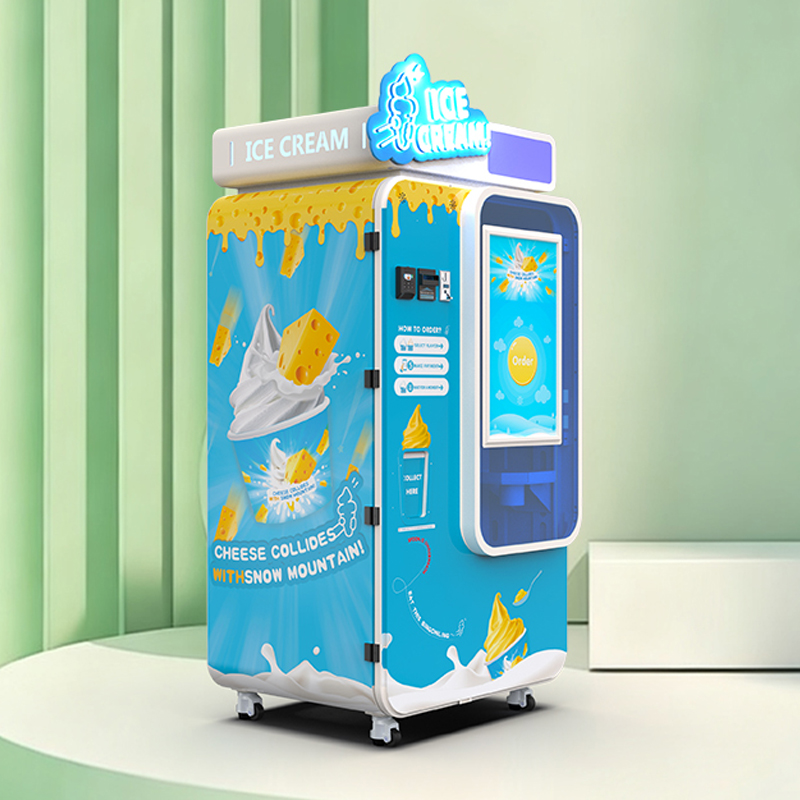
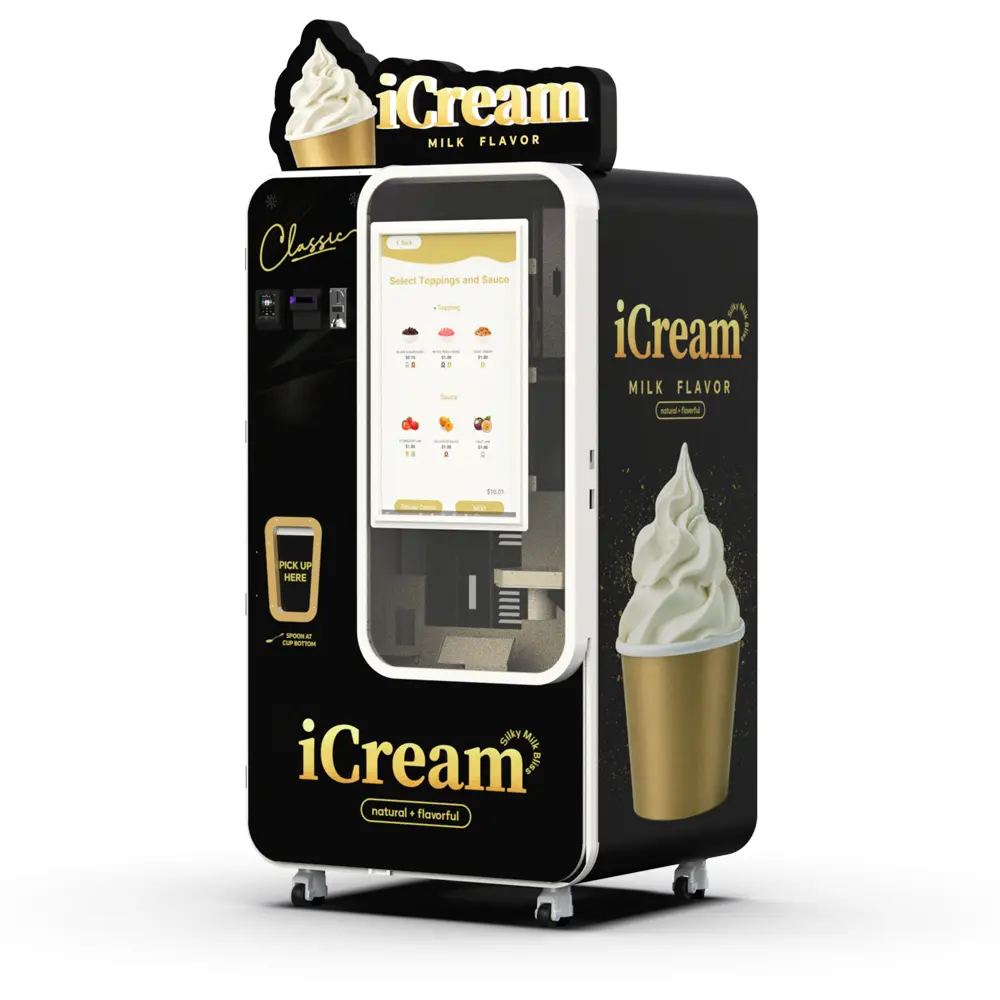
On an ice cream vending machine, automation and connected management are the parts that let it sell and let you run it. Consistent servings come from repeating the same motions for every cup, and fewer site visits come from alerts and sales data. The next two sections cover what our machines do at each of these levels.
What Is Smart on a Huaxin Machine
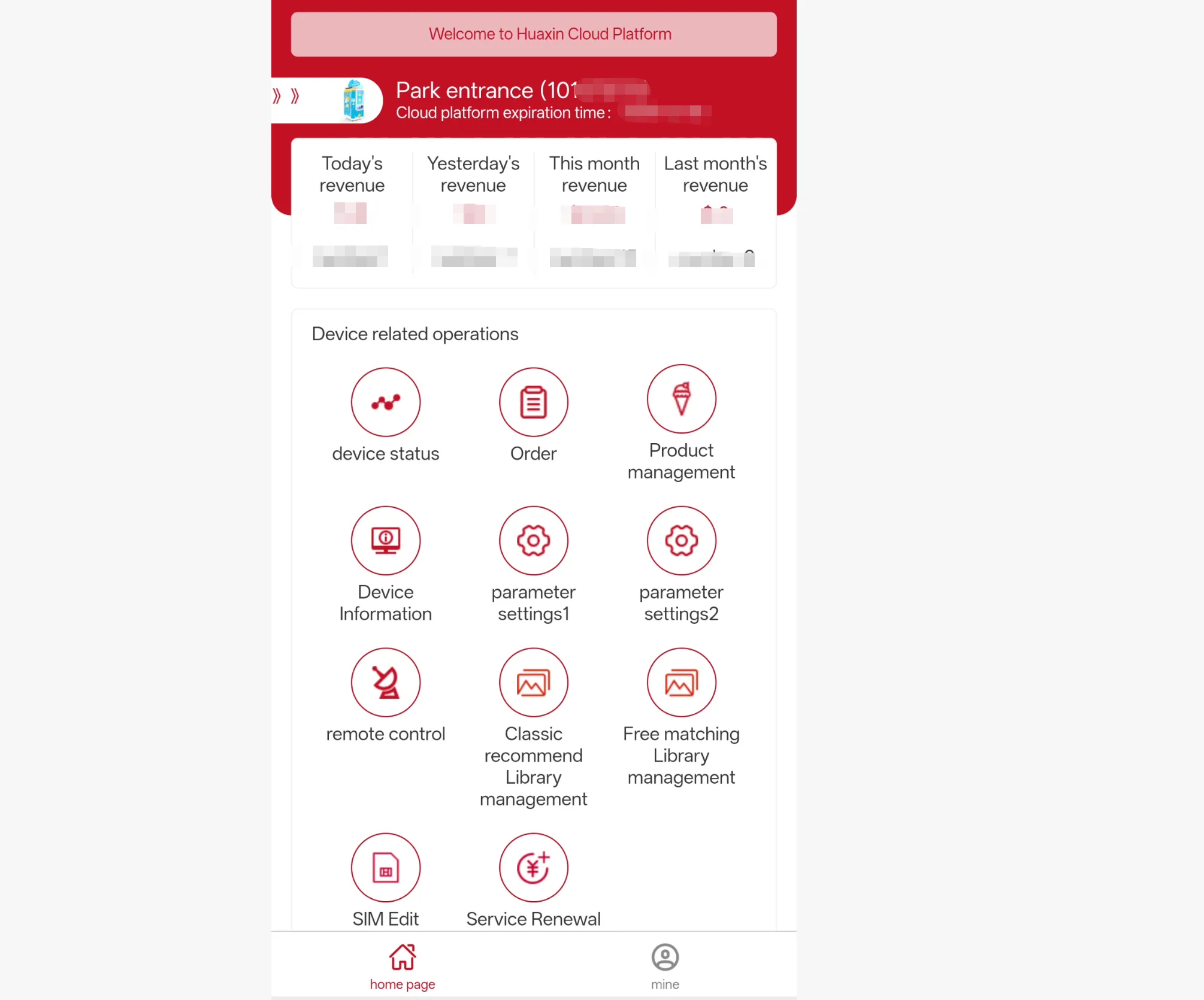
Our connected management system is called Master OS. The table lists its functions by where you use them on network-enabled B Series machines (B83, B83 Max, B84, B85, B86 and B86 Max). An overview of the system is on our Master OS and machine systems page.
Where | Settings | Status and alerts | Data |
|---|---|---|---|
Machine screen | Language, refrigeration parameters, automatic cleaning, prices, promotions, scheduled on/off, night mode, serving size, payment | Operating status, refrigeration parameters, ingredient alerts | Products, orders, sales data |
Mobile | Prices, promotions, scheduled on/off, night mode, remote power on/off, starting a serving remotely, remote online refunds (depending on the payment setup) | Remote fault alerts, remote ingredient alerts | Products, orders, sales data |
Computer | — | Remote fault alerts, remote ingredient alerts, machine map | Products, orders, sales data |
Master OS functions on network-enabled B Series machines
In terms of the three levels above, the settings on the machine screen belong to the machine’s own control program, while the mobile and computer views are connected smart features. All of them run on set rules. An alert goes out when an ingredient runs low, and after you change a price, the machine charges the new one. Nothing in the table makes a prediction, so we do not call Master OS AI.
What these functions save is travel and time. Alerts tell your team which machine needs a visit and what to bring. Prices, promotions, opening hours and night mode can be changed without sending anyone to the machine. Order and sales data for each machine helps you decide how often to refill and which sites to keep. For turning alerts and sales data into a daily service route, see using remote monitoring alerts and sales data to plan site visits.
This layer relies on the network and on people at the site. Remote functions work in real time only while the machine is online, so confirm the network at each site before opening day. An alert finds a problem sooner, but fixing faults, refilling and cleaning still need someone at the machine. One-touch cleaning is a preset program. The operator adds clean water and the machine runs the cleaning cycle, while daily manual cleaning and scheduled disassembly cleaning continue as the user manual describes.
Easy7 and Power7 handle remote functions differently from the B Series. With its smart integration module and a network connection, Easy7 can report status and sales, send alerts and accept changes to selected settings. A connected Power7 shows ingredient, status and sales information in an app and also allows remote price changes and selected setting changes. If you are choosing a countertop model, confirm its functions in a demonstration of that model.
The Easy7 Robotic Arm: Programmed Motion, Not Machine Learning
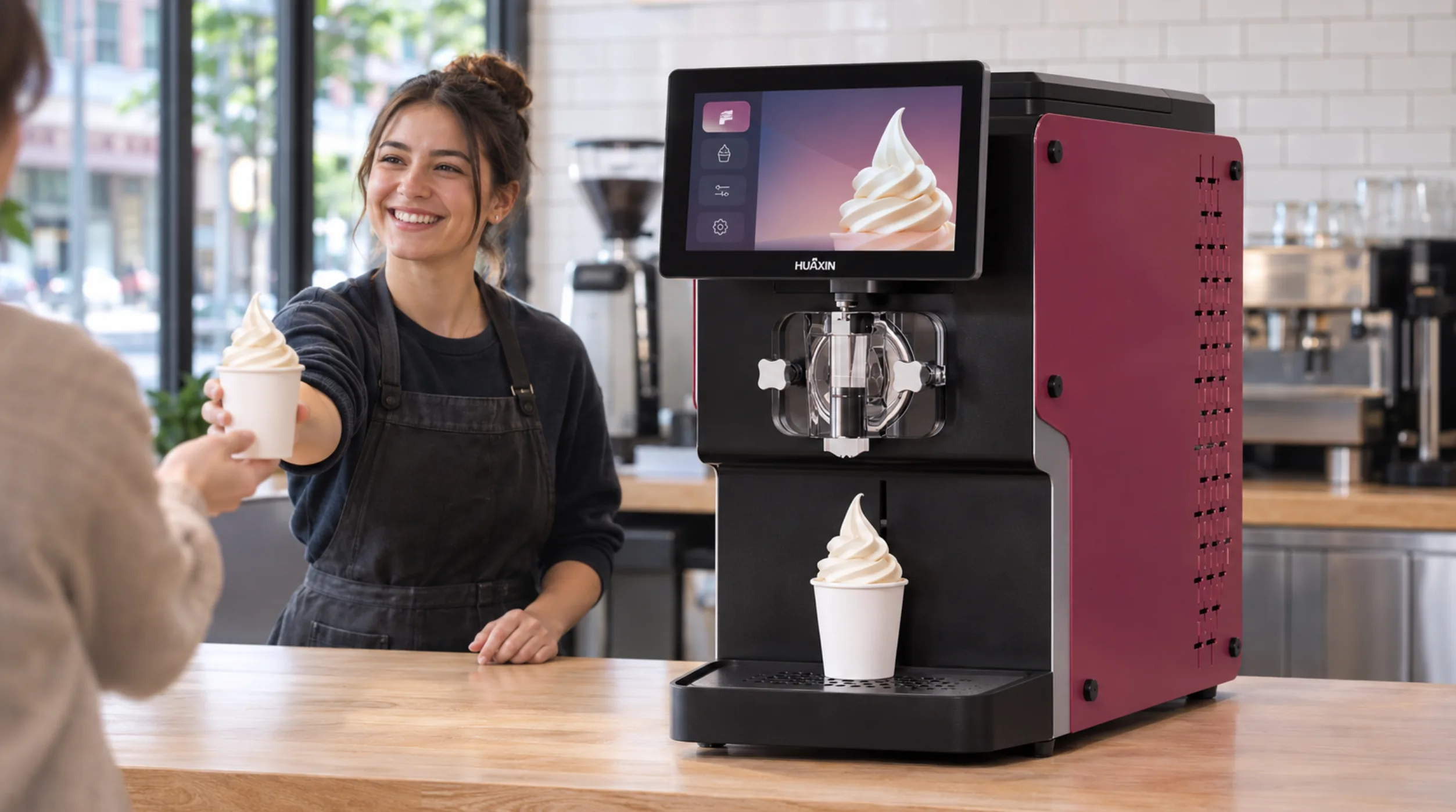
Easy7 is our countertop fully automatic ice cream machine, and its robotic arm is the feature most likely to be called “AI” in marketing. This is how it serves. The customer places a cup or cone in the cup holder, and container detection confirms that it is a compatible type. After Make is tapped on the screen, the arm returns to its preset dispensing position and forms the serving using the position, speed and path set in its program. Each serving takes about 20 seconds under standard conditions.
Because the path is set in advance, every serving comes out the same shape. The arm and the dispensing nozzle have to match the cup type in use. The machine does not recognize containers of any shape, and it does not learn from the cups it has made, which is why we call it a programmable robotic arm.
Easy7 also needs to be kept apart from an unattended vending machine. It has no automatic cup dispenser, so the customer or staff places the cup. The standard configuration has no automatic sauce or topping system, and payment requires an external payment module on compatible projects. It works best on a staffed counter, for example beside the register in a coffee shop, dessert shop or convenience store. Our Easy7 customers include coffee equipment distributors and shop owners who have installed it in their own stores. Specifications and suitable locations are on the Easy7 countertop ice cream machine page.
For sites where customers order, pay and collect their cup with no staff nearby, look at self-service models such as the B Series or Power7. Power7 also uses a robotic arm, a lifting arm that brings the cup into position, and it too runs on programmed motion.
How to Check an “AI” Claim Before You Buy
In the US, AI marketing claims are already a matter for law enforcement. In September 2024 the Federal Trade Commission (FTC) launched Operation AI Comply with five initial actions against businesses that used AI hype to deceive consumers or sold AI tools that could be used to deceive others. The FTC’s then-chair said there is no AI exemption from the laws on the books [3].
Buyers can apply the same scrutiny to suppliers, including us. A September 2026 Vending Times article makes a similar point to operators: the useful question is whether AI actually improved operations, not whether it was added [4]. These six questions can go straight into a demonstration or a request for quotation.
Name the function. “The whole machine is AI” is not an answer. Ask the supplier to name the specific function, such as demand forecasting or container recognition, and show it to you on screen.
Ask what it outputs and who acts on it. Find out whether it gives a forecast or suggestion for a person to decide on, or whether the machine acts on the result directly.
Ask what data it uses. It may draw on your machine’s own sales records or on another source. Ask how much history it needs before it becomes useful.
Ask whether it is a rule or an inference. Have the supplier change an input and show you how the result changes. If a threshold set by a person sits behind it, it is a rule. Rules are useful too, so judge them by what they actually do.
Ask what any accuracy figure is based on. If the marketing quotes a percentage, ask under what conditions and on how many samples it was measured.
Ask what happens offline or when it is wrong. Whether the function still works without a network, and who bears the consequences of a wrong result, both belong in the contract.
Put these questions to our machines and every answer can be seen in a demonstration. Consecutive servings show the automation at work. Master OS alerts, price changes and sales data can be shown live on a network-enabled B Series machine. The Easy7 robotic arm can form servings in front of you with a compatible cup type. Ask for the demonstration on the configuration you plan to buy, not a video or screenshots.
Get a Configuration Recommendation with Remote Management Details
Send us your locations and the number of machines you plan to run. We will recommend a configuration and set out which remote management functions it includes and what network each site needs. Please include:
Locations: country and city, venue type (such as a mall, a tourist attraction or a coffee shop counter), and whether each site is indoors or semi-outdoor
Number of machines: your first order, and whether you plan to add more later
Network: whether each site has venue Wi-Fi, mobile signal or a wired connection
Back-office users: owner, operations staff, technicians and venue partners, and what each needs to see or change
Start here: request a configuration recommendation.
References / Sources
[1] Regulation (EU) 2024/1689 of the European Parliament and of the Council of 13 June 2024 laying down harmonised rules on artificial intelligence (Artificial Intelligence Act), Article 3(1) and Recital 12. Official Journal of the European Union, 12 July 2024. https://eur-lex.europa.eu/eli/reg/2024/1689/oj
[2] Slawsky, R. “How AI is making vending smarter.” Vending Times, 12 June 2026. https://www.vendingtimes.com/articles/how-ai-is-making-vending-smarter/
[3] Federal Trade Commission. “FTC Announces Crackdown on Deceptive AI Claims and Schemes.” Press release, 25 September 2024. https://www.ftc.gov/news-events/news/press-releases/2024/09/ftc-announces-crackdown-deceptive-ai-claims-schemes
[4] Slawsky, R. “Does AI really save time in vending operations?” Vending Times, 4 September 2026. https://www.vendingtimes.com/articles/does-ai-really-save-time-in-vending-operations/

PREVIOUS ARTICLE
Soft Serve Overrun: What It Is, How to Calculate It, and How It Changes Texture and Cost per Cup
NEXT ARTICLE