How Much Work Does an Ice Cream Vending Machine Take? Daily, Weekly and Monthly Tasks
Is an ice cream vending machine passive income? See the daily, weekly and monthly tasks, the cleaning schedule, and how work changes from one machine to ten
An ice cream vending machine removes the person behind the counter who takes orders, makes the product and handles payment. Refilling, cleaning and checks still need someone, so it is not fully passive income. Taking a Huaxin B Series machine with the pasteurization option as the example, the machine is cleaned every 5 days. Between cleanings you restock as sales require and look at the back office once a day. For one machine, that comes to one or two site visits a week.
Huaxin manufactures ice cream vending machines. This article answers one main question: how much work does an ice cream vending machine take? It is based on conditions in the US market and written for operators buying their first machine and for investors who plan to run one as a side business.
What the Machine Automates and What Stays With the Operator
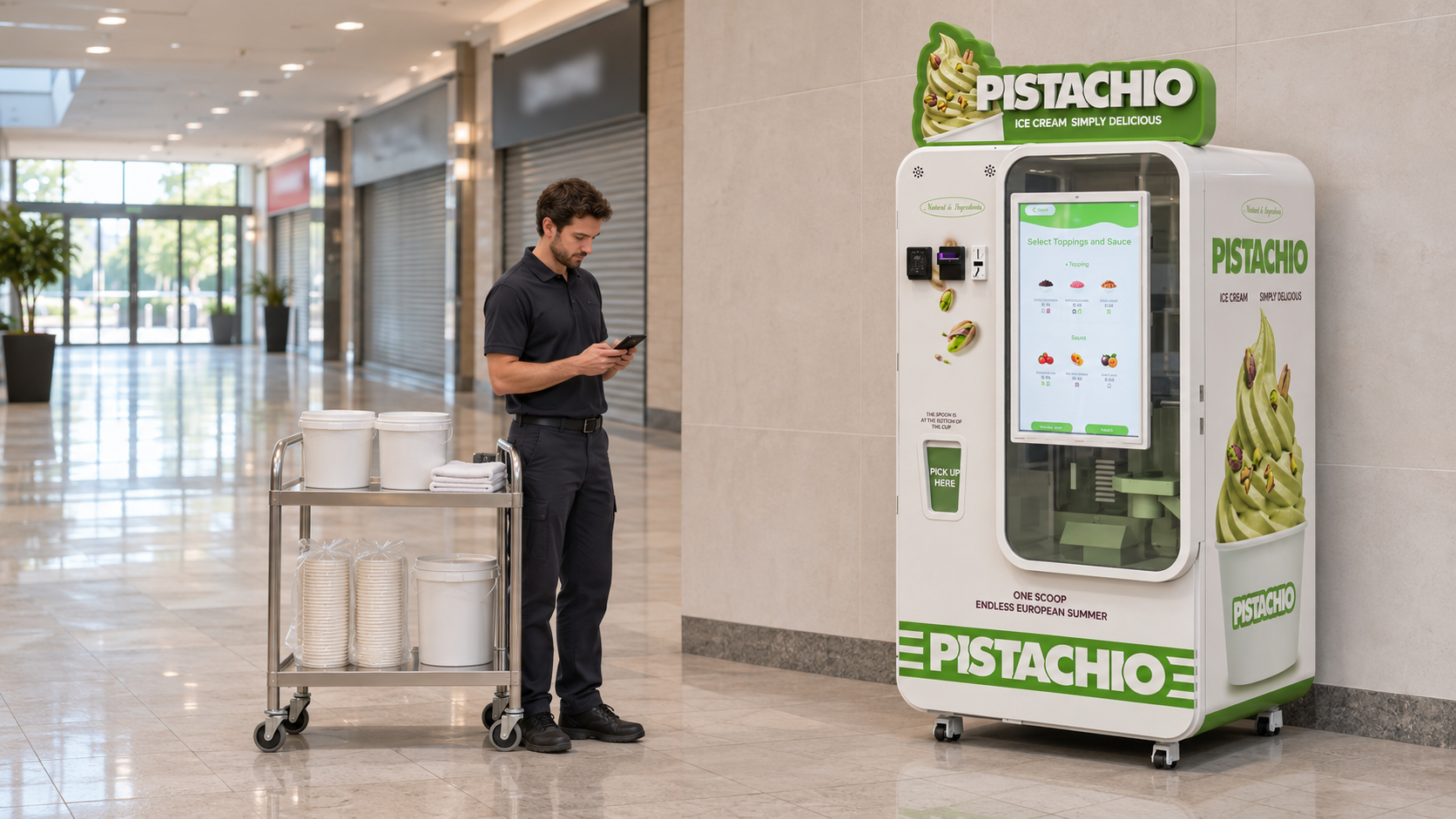
The customer orders and pays on the screen. The machine dispenses a cup, makes the soft serve, adds sauces and toppings and delivers the finished cup to the pickup port, with no staff involved. Our guide to how an ice cream vending machine works from ordering to pickup follows that sequence from payment to preparation and lists the manual tasks before opening, during trading and after closing. This article puts a frequency and a time on each of those tasks.
Four kinds of work stay with the operator: refilling mix and restocking cups, toppings and sauces; cleaning; periodic checks; and responding to alerts and customer questions. Once the machine is online, part of this can be done from a phone.
Ice Cream Vending Machine Daily Tasks, Weekly Visits and Monthly Checks
Here is the full routine for one B Series machine, listed by frequency:
Frequency | Task | Where |
|---|---|---|
Daily | Check the back office: whether the machine is online, whether there are low-ingredient or fault alerts, and whether orders look normal | Phone or computer |
Every 5 days | Clean the mix hopper and freezing cylinder, taking a machine with the pasteurization option as the example: run the cleaning program with water, then refill | On site |
As sales require | Refill mix and restock cups, toppings and sauces | On site |
Every visit | Wipe down the machine and keep its exterior clean | On site |
Monthly | Check that the machine’s components are working properly | On site |
As needed | Handle fault alerts, payment problems and customer refunds | Remote or on site |
Daily: A Remote Check
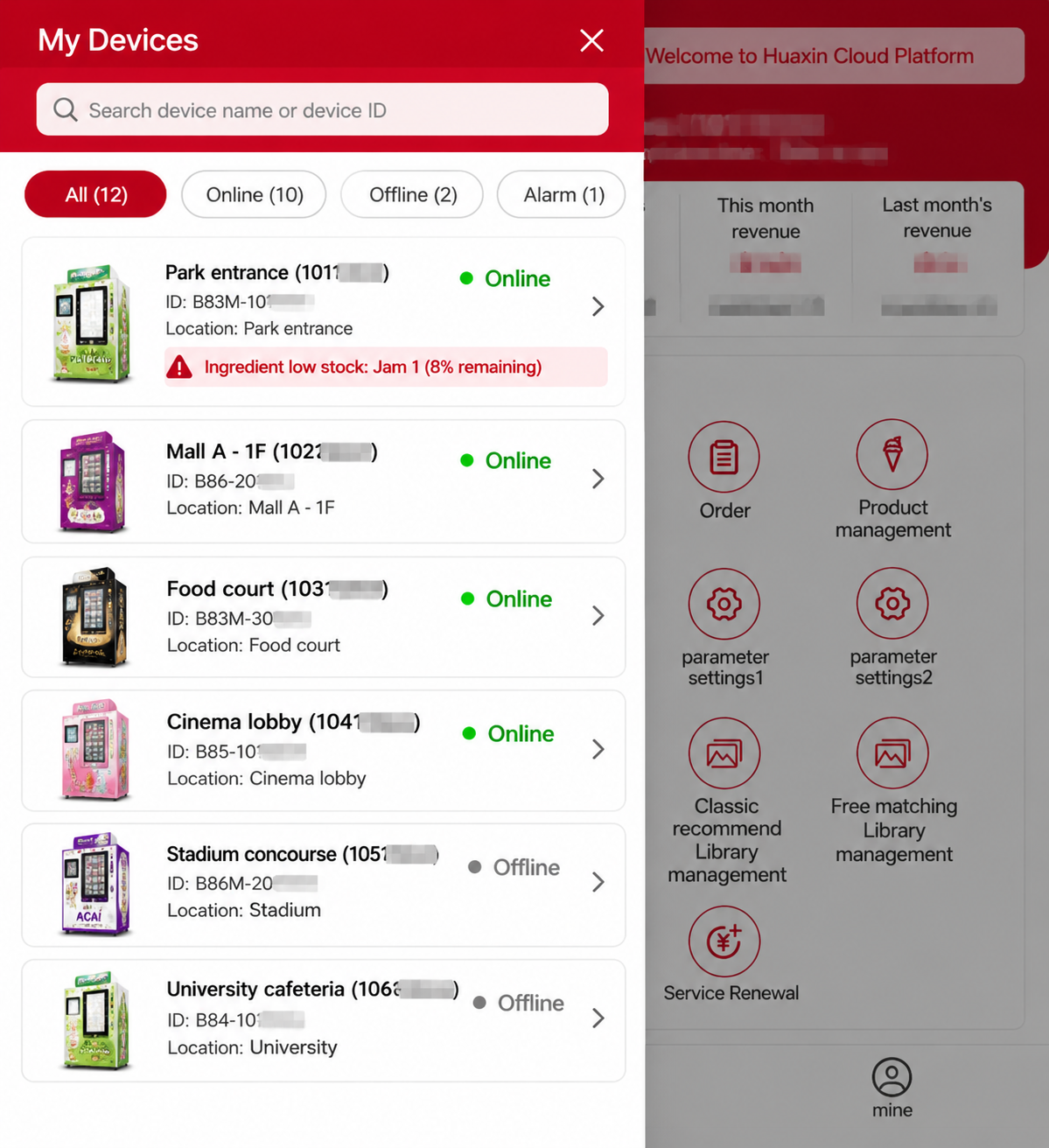
On a connected machine, the Master OS back office shows sales orders, online status, selected supply levels and fault information on a computer or a phone, and it sends an alert when ingredients run low or the machine reports a problem. Look at three things each day: whether the machine is online, whether any alert is still open, and whether the order count looks normal for that time of day. You can also change prices, set scheduled power on/off times and issue an online refund from your phone. Which payment methods a remote refund covers depends on your payment setup.
All of this needs a network connection. An alert tells you what has happened, and refilling or fixing the fault still takes a visit. Our guide to remote monitoring for ice cream vending machines covers which data to look at and how to plan visits around it.
Every 5 Days: The Cleaning Visit
Cleaning is the largest block of fixed work. The interval runs by the calendar and does not change with sales.
Switch off refrigeration, run the 3-minute defrost and drain any unsold soft serve from the freezing cylinder.
Add water and run the cleaning program four times: cold water, warm water at about 55°C, sanitizer solution, then cold water again.
Refill with mix, switch refrigeration back on and resume sales.
Product left in the machine is drained before cleaning, so load only as much mix as you expect to sell before the next cleaning. The One-Touch Cleaning Program runs the wash automatically. Adding the water and draining it are done by hand.
In the United States, cleaning frequency also depends on your local health department. The FDA Food Code is a model offered to state and local governments for adoption and is not itself federal law [1]. The rules that apply are those of your state or county. When you apply for a permit, ask what cleaning frequency applies to soft serve equipment, compare it with your machine’s user manual and follow the stricter of the two. If your machine has the pasteurization option, confirm its cleaning interval with us. Pasteurization does not replace cleaning.
Our ice cream vending machine maintenance checklist covers when seals and wear parts are replaced and which signs mean the machine needs service.
As Sales Require: Mix, Cups, Toppings and Sauces
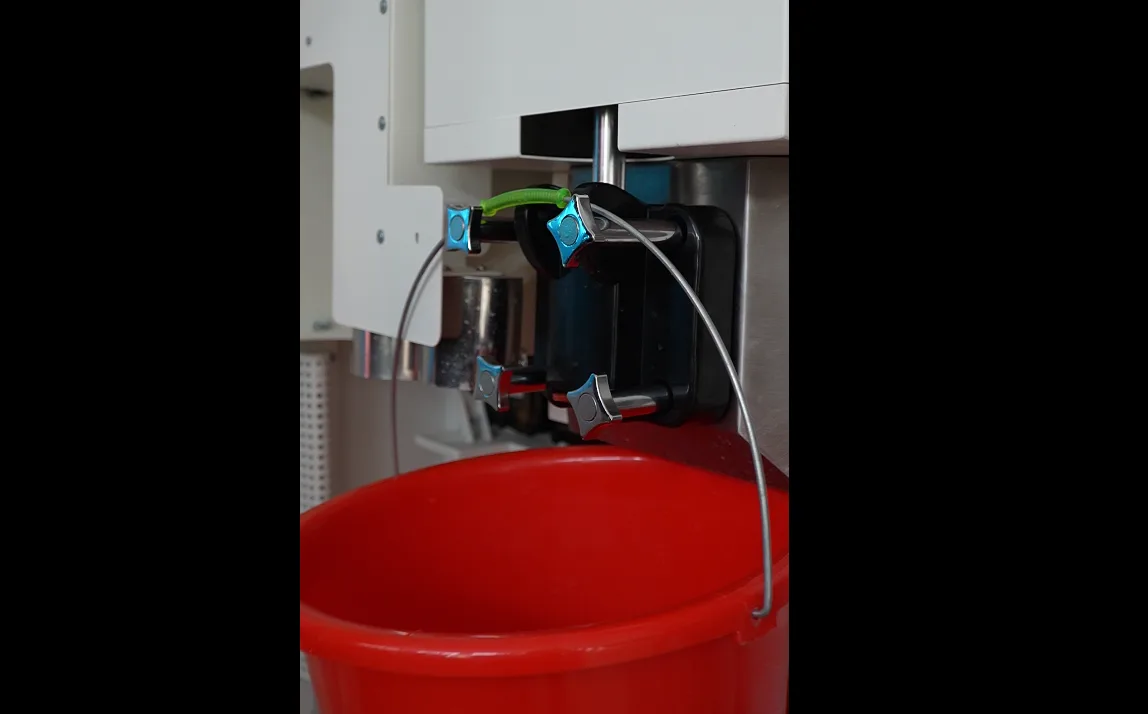
B83 Max, B84, B85, B86 and B86 Max machines have a mix hopper of about 20 liters and cup storage for about 160 cups. Here is an example, for illustration only and not a sales forecast. At 35 cups a day, 160 cups last 5 days, so restocking cups and cleaning can share one trip. At 100 cups a day, the cups run out in under two days and you make an extra trip between cleanings. How many servings one hopper of mix gives depends on serving weight, overrun and recipe, so work it out from your own serving records.
Monthly Checks
We recommend five checks each month: look for oil or mix leaks, clean the overflow pipe, check the tension of the mixing motor belt, check the lubrication of door locks, mechanical parts and gears, and check for loose fasteners. Clean the dust from the condenser filter at regular intervals. These checks can be combined with one of the month’s cleaning visits.
What a Week Looks Like With One Machine
With a cleaning every 5 days, one machine needs one or two site visits a week and about 6 cleanings a month. A busy site adds restocking trips in between. The rest of the time, a look at the back office is enough. On each visit, place a test order: pay for one serving yourself, check that it comes out correctly and make sure nothing is blocking the pickup port.
The machine cannot sell while it is being cleaned or refilled. Schedule visits for the quiet hours at the site, within the access times the venue allows.
When the machine arrives, our after-sales specialist guides you through start-up, refilling, menu setup, cleaning and basic troubleshooting, and we provide operating manuals, video tutorials and remote training. In mid-July 2026, a customer in the country of Georgia received his machine before his site was ready. He set it up in a warehouse to practice, and by the end of July he told us he had learned to operate it and the machine was running well. Run through the full cleaning routine several times before the site opens, so you are not working it out in front of customers.
One Machine vs Several: How the Hours Change
With more machines, some work grows with the number of machines and some can be shared.
On-site work grows with the count. The cleaning interval runs by the calendar whatever the sales, so 10 machines mean about 60 cleanings a month. Refilling and restocking are also done machine by machine.
Four things can be shared. The back office manages multiple machines centrally, so checking ten uses the same screen as checking one. Sites in the same city can be grouped into a route and covered in one trip, which cuts the travel time per machine. Where two machines stand at the same site, you can restock one while the other runs its cleaning program. Training, procedures and spare parts are learned once and stocked once for the whole fleet.
One machine (pilot) | Ten machines (formal operation) | |
|---|---|---|
Who does the on-site work | The owner | A dedicated person or small team working a route |
Cleanings (5-day interval) | About 6 a month | About 60 a month |
Where the owner’s time goes | Learning the routine and recording the time and sales for each visit | Reviewing back-office data, negotiating venues, reconciling payments and managing route staff |
Stage it suits | Proving the site, the payment setup and the refill and cleaning routine | Sites secured and served on fixed routes |
With one machine, the owner does the work by hand. With ten, the owner mostly manages people and reads data. This matches our advice on first orders: a single unit is for testing, and formal operation is planned around 10 units, as set out in our guide to choosing between a single-unit pilot and a 10-unit rollout. During the pilot, record the reason for each visit and the time it took. You will then have your own hours-per-machine figure before you scale to ten.
In 2026, a Swiss operator already working in the vending machine industry came to us because he was unhappy with the cleaning routine on his existing equipment, and ease of cleaning was the main thing he compared between suppliers. The more machines you run, the more of your time cleaning takes. Every Huaxin B Series machine has a One-Touch Cleaning Program.
Is an Ice Cream Vending Machine Passive Income?
Not fully. More precisely, it is a business that runs without counter staff. Nobody stands at the machine during trading hours and the on-site work fits a fixed schedule, but someone has to turn up and do it on time.
There are two ways to cut your own hours. You can hire or assign someone to do the on-site work while you watch the back office and manage, in which case labor goes into your cost model. Or you can agree with the venue that its staff wipe down the machine’s exterior and pickup port and tell you when something looks wrong. Cleaning and refilling with the door open stay with a trained person.
This business suits you if you live near your sites and can keep one or two fixed slots free every week, or if you are willing to pay someone local to make the visits on schedule. If you live several hours’ drive from the site and have nobody local you can rely on, we do not recommend buying.
Get a Model and Remote Management Recommendation
Send us these three details and we will recommend a model and a remote management configuration:
Planned number of machines: one unit to test first, or a multi-unit plan from the start.
Site layout: the city, the types of site and the rough distance between them.
Who will do the on-site work: you, an employee, or the venue’s staff with your support.
References / Sources
[1] U.S. Food and Drug Administration. "Food Code 2026." https://www.fda.gov/food/fda-food-code/food-code-2026

PREVIOUS ARTICLE
AI Ice Cream Machine: Automation vs Smart Features vs AI
NEXT ARTICLE