Single-Unit Pilot or 10-Unit Rollout? Planning Your First Ice Cream Vending Machine Order
Decide whether your first ice cream vending machine order should be a one-unit pilot or a 10-unit plan: what a pilot proves, what to record, and when to scale
How many ice cream vending machines to start with is the first real decision most buyers make: one machine to see how it goes, or enough machines to run a proper operation. Both are sound starting points. They answer different questions, and trouble starts when one is expected to do the other's job.
An ice cream vending machine pilot is a test with an end date. One machine at one site shows whether the venue, the product, the payment setup and your refill routine work in your market. A 10-unit plan is an operation: several sites, one shipment, shared spare parts and procedures, and service routes worth driving. As a manufacturer of fully automatic commercial ice cream vending machines, Huaxin builds both kinds of order. Which one fits depends on what you still need to prove.
This guide covers what a single unit can and cannot tell you, why ten machines suit formal operation, what to record during a pilot, and how to move from one machine to ten in stages. Profit and payback calculations belong to a separate guide; the subject here is the size and sequence of your first order.
1 What a single-unit pilot can settle, and where it falls short
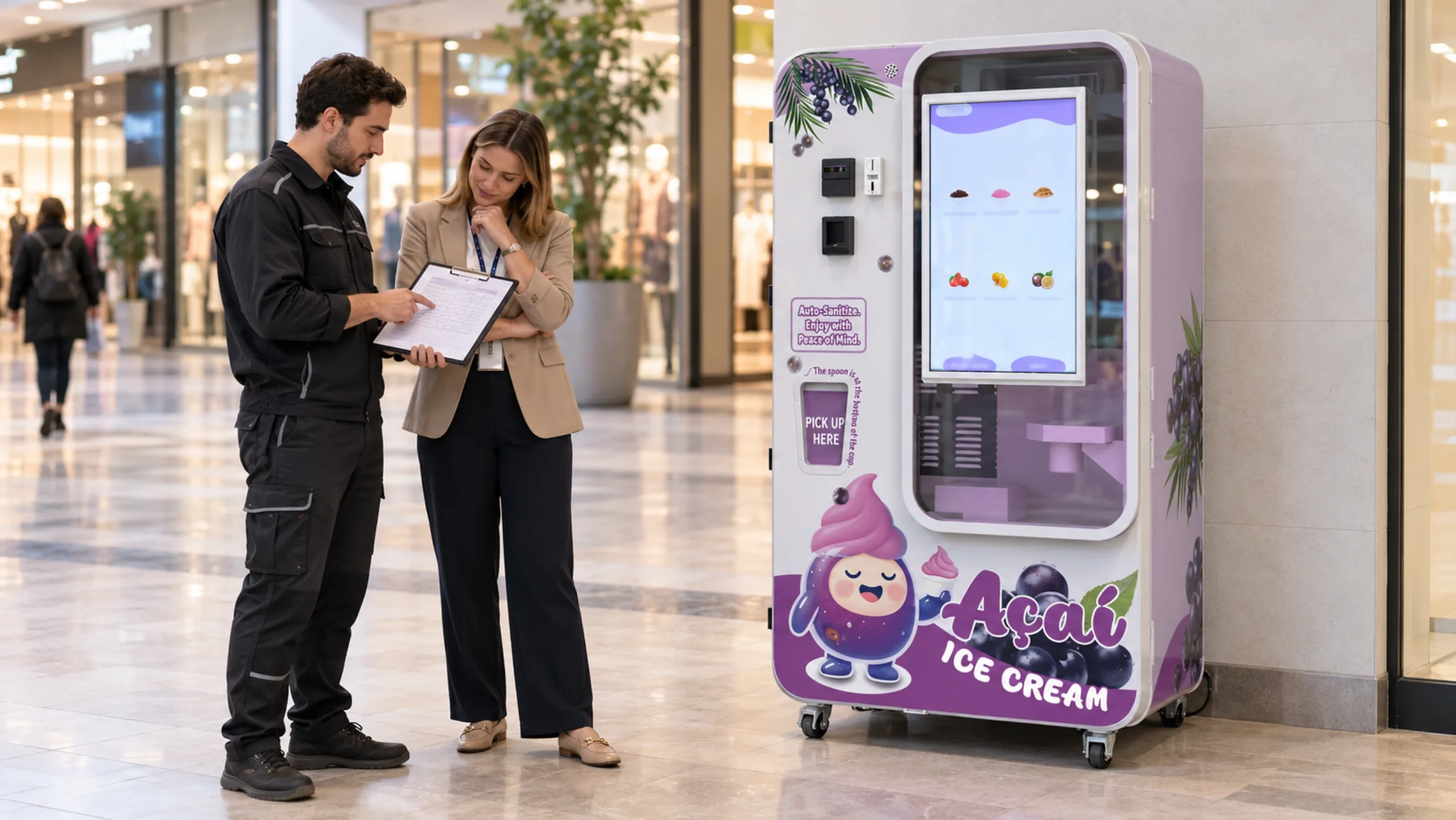
One machine is the right first order when something outside your control has to be proven before you can commit. The most common case is a venue that will not approve more. Shopping centres in particular often allow one machine for a season before they talk about further locations, and a pilot is the way through that door.
Questions one machine can answer
Venue approval. Whether the landlord or venue operator will agree to more machines once one has run without complaints.
Taste and portion. Factory demonstrations use whatever mix is on hand. Your customers will taste the base you can source locally every week, at the portion size you set.
Payment in real conditions. Payment integration depends on the market, the provider and the terminal. The pilot is where your chosen combination of terminal, merchant account, currency and site network is proven with real customers.
The refill and cleaning routine. How long a visit takes, when the venue allows access, where mix and cups are stored, and who is responsible for each task.
Customer behaviour. Whether people follow the screen, find the pickup opening without help, and how often venue staff get called over.
Distributors use a pilot in the same way. One customer in Kuwait that already supplied a network of convenience stores started with a single B83 Max, intended for a high-footfall store, before deciding anything about the wider network.
What tends to go wrong first
Huaxin's 2026 customer records show where first machines actually lose time, and it is rarely the ice cream. After delivery, buyers have been held up by cash and change settings, a payment provider account still being set up, a mall network connection not yet arranged, and mix and cups that had not been sourced. In one US case the machine went into storage because no test site with a power supply was ready. A pilot exists to surface these issues while only one machine is waiting on them.
What one machine cannot tell you
A pilot is a sample of one. If sales are strong, you cannot tell how much is the site and how much is the concept. If they are weak, you cannot tell whether a different site would have done better. One location also has its own timing: opening weeks bring curiosity sales that fade, and weather moves demand. USDA statistics put US hard ice cream production at about 69.5 million gallons in July 2025, roughly 42 percent above December's 49.0 million[1]. Factory output is not vending sales, but it shows how closely the category follows the season. A pilot that runs only through summer will flatter the annual picture.
The costs of a single unit also do not spread. A floor-standing B Series machine weighs several hundred kilograms and usually travels as one crate in shared container space. Export documents, customs brokerage, port handling and the final delivery by forklift or tail-lift truck are charged largely per shipment, so one machine carries the whole amount. Spare parts follow the same logic: a local stock of wear parts is hard to justify for one machine and easy to justify for ten. None of this makes a pilot a poor decision. It means the landed cost per unit of a pilot says little about the cost per unit of a fleet, and it should not be used to judge the larger plan.
2 Why a 10-unit plan suits formal operation
Once the open questions are answered, or when you already have sites and operating experience, ten machines is a more workable unit than one. The reasons are operational. This section makes no sales forecast.
A group of sites, not a single bet
Ten machines let you spread placements across different kinds of site: a few in proven high-footfall venues, several in steady mid-traffic locations, and one or two in site types you want to try. Because every site runs the same machine, menu and price, results can be compared site against site, and a weak site becomes a placement decision instead of a verdict on the business. Venues respond to this too. A leasing manager discussing a second or third location wants to see that you can supply and service a network, not just one machine.
One shipment, one import, one installation plan
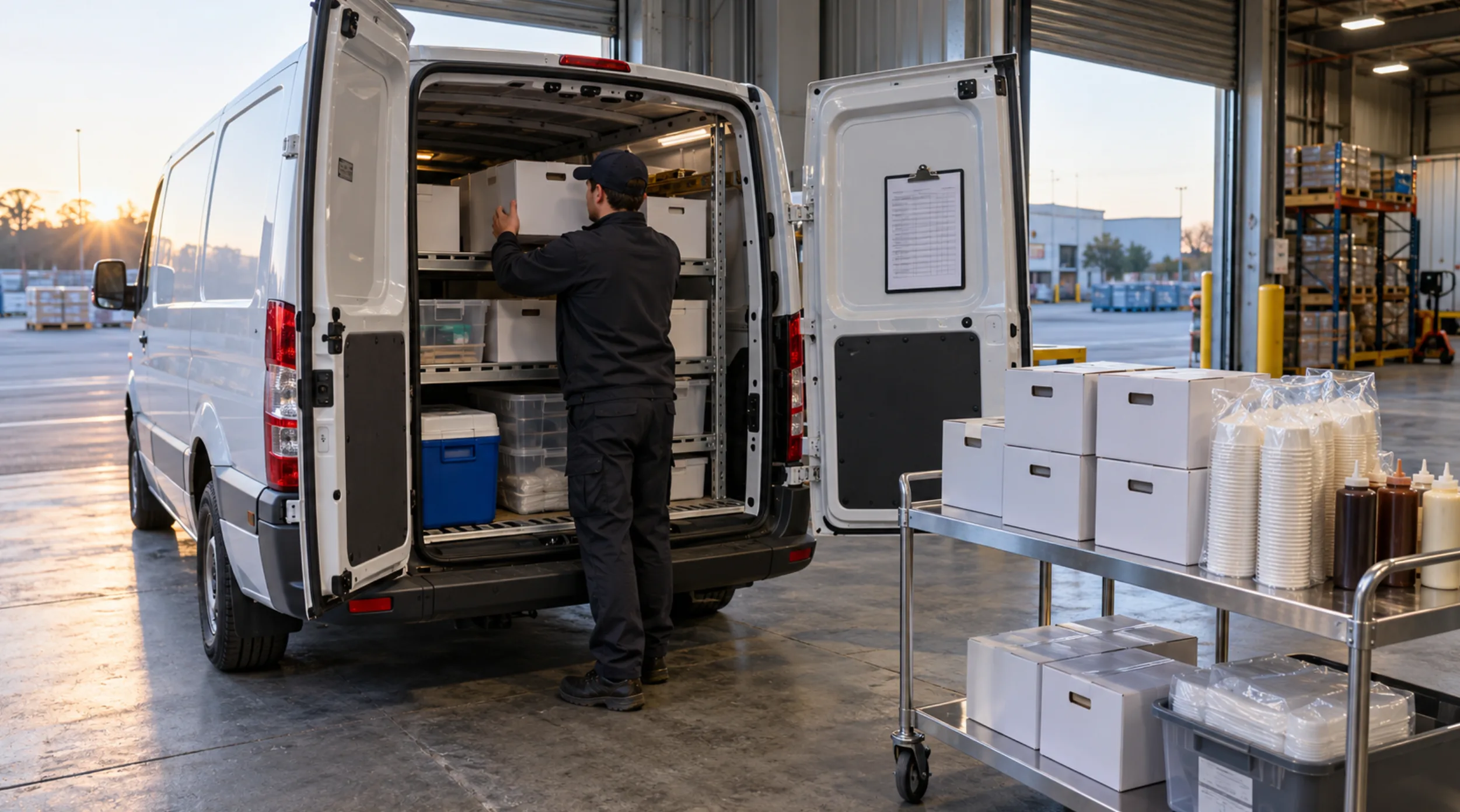
A bulk ice cream vending machine order of ten floor-standing units can be planned around a full container. Export documents, customs clearance, port handling and inland delivery are arranged once for the group, and the machines arrive together, so installations run as one scheduled sequence instead of a string of one-off jobs. Settle the delivery terms at quotation stage, for example delivery to your door versus collection at the destination port, because they decide who handles each of these steps.
Spare parts, training and procedures in one place
With ten machines in the same configuration, a small local stock of the parts that wear or get damaged first becomes practical, so a fault means a site visit and not an international parcel. One trained person or a small team learns the routine once and applies it at every site: loading mix and cups, running the cleaning program, clearing a cup or pickup fault, handling a refund. The B Series one-touch cleaning program simplifies routine cleaning, but manual hygiene tasks remain, and a fleet benefits from having them written down once.
Ask the supplier for a recommended parts list for your configuration, and agree in writing who diagnoses, supplies and repairs in your market. Our after-sales support guide covers what to settle before you sign.
Service routes that hold together
A single machine across town costs a full trip for every refill. Ten machines in one metropolitan area can be grouped into two or three routes and visited in sequence. On network-enabled B Series machines, the back office shows operating status and selected sales data remotely, so visits can follow what each machine has actually sold instead of a fixed calendar. Restocking and cleaning still happen on site.
Configuration, branding and delivery options for multi-unit orders are set out on our wholesale ice cream vending machines page.
3 What to record during the pilot, and the rules to write before it starts
An ice cream vending machine pilot without written decision rules tends to run on hope. Fix the measures and the thresholds before the machine is switched on, and agree them with any partner, investor or venue involved.
Five measures worth recording
Pilot record sheet
Measure | How to record it | What it tells you |
|---|---|---|
Daily cups sold | Daily total from the back office or machine records, split by weekday and weekend, with peak hours noted | Demand at this site, and whether it holds once the opening weeks pass |
Downtime | Hours the machine could not sell, with the cause: fault, cups or mix run out, cleaning, power or network, venue closed | How reliable the whole setup is, and which causes are yours to fix |
Refill frequency | Date of each visit, what triggered it (cups, mix, toppings, cleaning) and time spent on site | Labour per machine, and how a route would work at ten units |
Payment failures | Declined, timed-out and cancelled payments, plus any paid order that was not delivered, by payment method | Whether the terminal, provider and network are ready to copy to more machines |
Customer help requests | Each time staff or the operator is asked for help, with the reason: screen, payment, pickup or refund | Where instructions, signage or settings need to change |
Remote data covers part of this. On network-enabled machines, orders and machine status are recorded automatically. The causes of downtime and the reasons for help requests usually need a short manual log kept by whoever visits the machine, with a simple way for venue staff to add to it.
How long to run it
Run the pilot long enough to cover full weeks, at least one change in the weather and several refill cycles. For most sites that means eight to twelve weeks, and longer if the test starts at the height of summer. The German customer described in section 4 tested its sample machine for more than three months before ordering at container scale.
Write continue, adjust and stop conditions
Translate your break-even point into cups per day with our ROI calculation guide, then write down three outcomes in advance. The structure below is a template; the figures are yours.
Pilot decision rules (template)
Decision | Condition to write down |
|---|---|
Continue to the 10-unit plan | Over the last four full weeks: average daily cups at or above your break-even figure; downtime under the weekly limit you set, with a fix for every recurring cause; payment failures under the rate you set for each method; and agreement in principle from the venue, or other venues, to further sites. |
Adjust and extend | Demand is close to break-even, or problems trace to a fixable cause such as the position inside the venue, price, menu, payment method or signage. Change one variable at a time and set a new end date. |
Stop | Demand stays clearly below break-even after the adjustment period, or the venue's terms rule out further sites. The machine can be moved to a better site instead of being written off. |
4 From one machine to ten: a phased ordering path
Buyers who scale after an ice cream vending machine pilot usually do it in three stages: a sample or pilot unit, a first batch, then add-on orders as new sites are signed.
Pilot unit: order the configuration you intend to scale
An ice cream vending machine sample order earns its cost only if the sample matches the fleet you would build. Specify it as the first of ten: model, voltage and frequency for your market, payment terminal and provider, interface language and exterior. B Series machines run on 220 V/50 Hz as standard, with 110 V and 60 Hz configurations available as options that must be confirmed before ordering, which matters for sites in North America. If the pilot runs a different terminal or menu from the later fleet, its results will not carry over.
Huaxin builds machines to order. Production typically takes about 30 days from order confirmation, and the contract sets the actual date. Sea freight, customs clearance and local delivery come on top and vary by route. Use that time to secure the site, the power supply and the payment account, so the test period starts when the machine arrives, not weeks later.
First batch: ten machines for signed sites
When the continue conditions are met, place the first batch against sites that are signed or close to signing. For most operators this is the 10-unit plan. Keep the configuration identical to the pilot unless the pilot showed a change was needed, and then apply that change to the whole batch. Before the batch ships, check each unit at the factory; our pre-shipment inspection checklist lists the tests to run.
Add-on orders: order ahead of the venue
Each add-on order carries the same production and shipping time as the first, so place it when new site agreements are well advanced, not when a venue is already waiting for its machine.
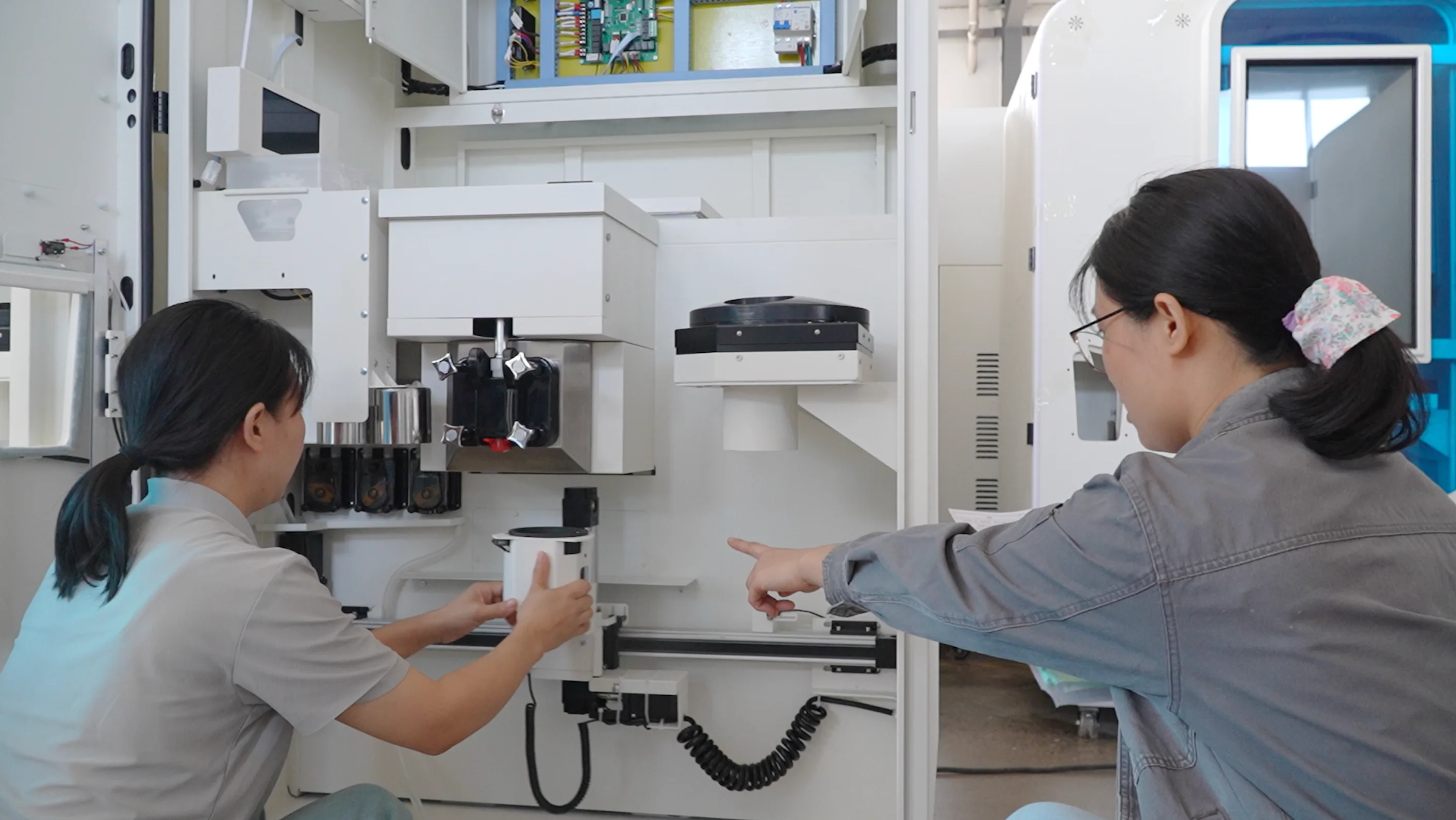
Huaxin's sales records show this path in practice. A German customer watched Huaxin machines running at a trade show over several days, then brought in its own technical staff to go through the construction, software, wiring and refrigeration with Huaxin's team. The customer bought one sample machine and tested it in Germany for more than three months before moving to a full-container order. During that period, Huaxin adjusted the payment hardware over several rounds to fit the customer's requirements, and the customer later became a Huaxin agent. In the United States, an operator that already ran ice cream vending machines placed a second batch soon after the first had shipped, and moved to an agency arrangement once both batches had been tested.
Single-unit pilot vs 10-unit plan at a glance
Single-unit pilot For testing | 10-unit plan For formal operation | |
|---|---|---|
Main purpose | Prove the venue, product, payment and routine in your market | Run a formal operation across several sites |
Best fit | A venue approves only one machine; first entry into a market; configuration not yet settled | Sites lined up or signed; configuration settled; a service person or team in place or being hired |
What you learn | How one site and one setup perform | How sites compare under the same machine, menu and price |
Shipping and import | One crate in shared container space; per-shipment costs fall on one machine | Planned around a full container; documents, customs and delivery arranged once |
Spare parts | A local parts stock is hard to justify | A small local stock of wear parts is practical |
Training and procedures | Learned on one machine, often by the owner | Written once and applied across all sites |
Service visits | A dedicated trip for every visit | Grouped into routes, guided by remote data on network-enabled machines |
Next step | Continue, adjust or stop against rules set in advance | Add-on orders as new sites are signed |
Compare a pilot and the 10-unit plan for your market
Send Huaxin your country, the number of sites you plan to open, and how many machines you want in the first batch. Huaxin's sales team will reply with a side-by-side configuration comparison of a single-unit pilot and the 10-unit plan for your market, covering model, voltage, payment, interface language, exterior and shipping method, so you can size your first order with the details in front of you.
References / Sources
1. U.S. Department of Agriculture, National Agricultural Statistics Service. Dairy Products 2025 Summary, April 2026. Table: Ice Cream Production by Product and Month, United States: 2025.

NEXT ARTICLE