New vs Used vs Rental Ice Cream Vending Machine: Which Is Best for Your Operation?
Compare new, used, and rental ice cream vending machines by upfront cost, downtime risk, warranty, support, total cost of ownership, pilot fit, and scale-readiness.
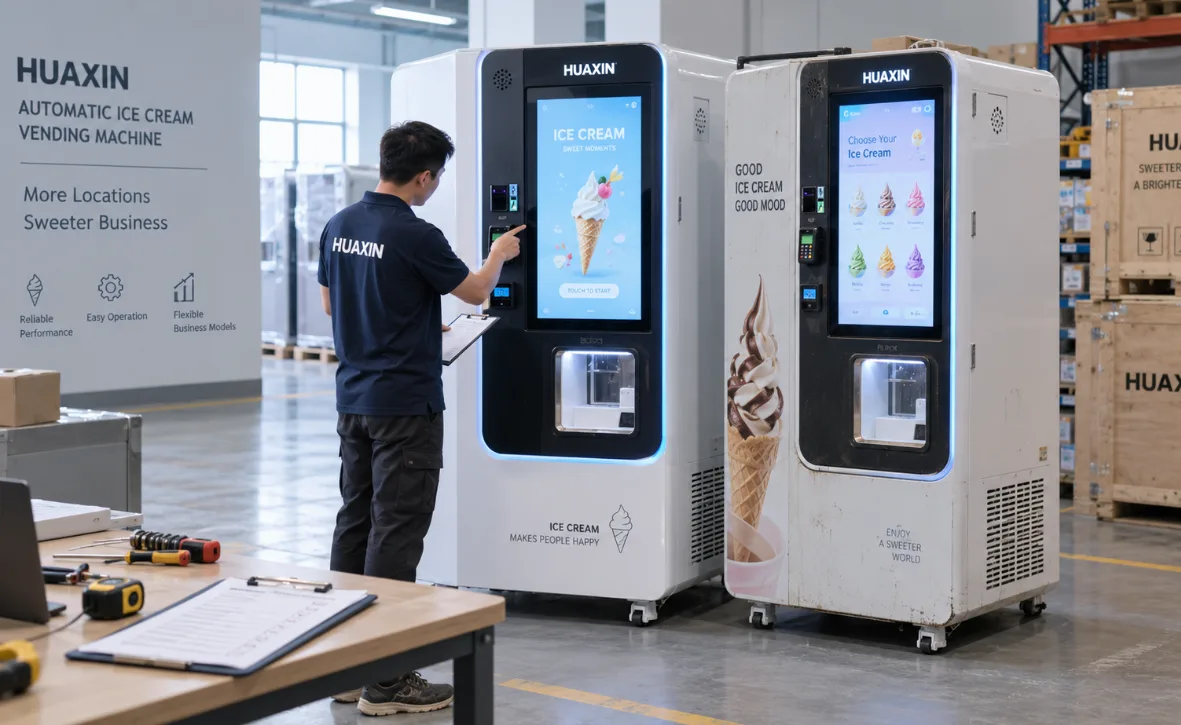
Buying an ice cream vending machine looks like a price decision until the first repair, payment upgrade, site move, or expansion order arrives. For anyone comparing new vs used ice cream vending machine options, the useful question is not simply which machine costs less today. It is which procurement route gives the project an acceptable combination of cash requirement, uptime, support, configuration flexibility, and exit risk.
That answer changes with the stage of the business. A one-machine pilot in a location that has never sold self-service desserts can justify more flexibility. A chain planning ten or twenty locations needs repeatable hardware, predictable spare parts, consistent payment integration, and a support process that does not depend on one technician knowing one unusual machine.
Rental adds a third option, but it needs careful definition. A short-term equipment rental, an operating lease, and a finance lease may all reduce the initial cash outlay while creating very different maintenance responsibilities and end-of-term obligations. The contract matters as much as the monthly payment.
Start With Operating Risk, Not the Purchase Price
A lower acquisition price can be valuable. Cash preserved at launch can be used for freight, site deposits, ingredients, payment hardware, branding, permits, spare parts, and working capital. That is why used equipment and rental should not be dismissed automatically.
The mistake is comparing only the first invoice.
For a commercial vending project, equipment cost continues after installation. The operator may have to absorb repair labor, replacement parts, software or payment upgrades, emergency site visits, lost sales during downtime, and the operational burden of moving customers or venue managers through a service disruption. On a multi-site project, one hardware inconsistency can also create extra training, stocking, and troubleshooting work across the fleet.
This is where total cost of ownership, or TCO, becomes more useful than unit price. A new vs used ice cream vending machine comparison only becomes meaningful when both options are measured over the same operating period. The relevant question is: what will this equipment cost to acquire, keep available for sale, support, update, and eventually replace or dispose of during the period you actually intend to operate it?
New, Used, and Rental at a Glance
Procurement route | Main advantage | Main exposure | Usually strongest fit |
|---|---|---|---|
New equipment | Current configuration, manufacturer warranty, parts/support continuity, easier standardization | Highest initial cash requirement; import and commissioning still need planning | Long-term operation, multi-site rollout, distributor projects, locations where downtime is expensive |
Used equipment | Lower purchase price; faster local availability in some markets | Unknown wear, incomplete service history, limited warranty, older payment/software hardware, parts availability | Budget-constrained pilot when condition can be verified and local technical support is strong |
Rental / lease | Lower initial capital commitment; possible flexibility or bundled service | Monthly commitment, contract restrictions, uncertain ownership of upgrades, maintenance exclusions, limited model availability | Temporary sites, short pilots, organizations preserving capex, projects with strong replacement/service terms |
The table is only a starting point. Two used machines of the same age can carry very different risk. Two rental contracts with the same monthly fee can have completely different service coverage. A new machine can also be the wrong decision if the location itself has not been validated and the operator is buying far more equipment than the pilot requires.
Where Used Equipment Can Save Money — and Where the Risk Moves
The case for used equipment is straightforward: another owner has already absorbed part of the original purchase cost. If the machine is in good condition, still supported, and compatible with the new site, that discount can be meaningful.
Condition matters more than age alone. An inspection should cover the refrigeration system, compressor, pumps, valves, seals, dispensing mechanisms, touchscreen, payment hardware, cleaning system, wiring, and control electronics. Also establish whether the unit was continuously operated, stored for a long period, modified by a third party, or exposed to poor cleaning or harsh environmental conditions.
Service history shows whether the lower price is real or whether deferred maintenance is being transferred to the next owner. Record the serial number, original configuration, major repairs, replaced components, software version, and recurring faults. Without that evidence, treat the machine as an unknown-condition asset.
Payment compatibility deserves separate attention. A machine can still cool and dispense while its reader, controller, or software stack is unsuitable for the destination market. Provider approval, protocol support, software configuration, and merchant onboarding must work together.
Parts can also change the economics. Generic components may be easy to source; proprietary boards, sensors, mechanisms, or software may depend on the original manufacturer. Confirm what is still supplied, typical lead times, and whether technical documentation is available.
A used purchase is easier to defend when the buyer has a verifiable history, a competent technician who can inspect the machine before payment, and a realistic spare-parts path. Without those, the discount is mainly compensation for uncertainty.
Rental and Leasing Solve a Capital Problem, Not Automatically a Service Problem
Equipment finance is widely established across major B2B markets, although structures vary by country. In the United States, the Equipment Leasing and Finance Association reports that 82% of equipment and software end users that acquired assets in 2023 used some form of financing [1]. Leaseurope reported nearly EUR 454 billion in new leasing volume in 2024, with equipment representing 22% of new volume [2]. Saudi Arabia regulates finance leases for movable assets [3], and the Bank of Thailand lists leasing and hire purchase as financing options for machinery and equipment [4]. Australia, Brazil, and Chile also have established asset-finance or leasing frameworks [5][6][7].
This confirms that leasing is a normal commercial finance tool. It does not mean a ready-to-deploy ice cream vending machine rental fleet exists in every country. An operator may find financing more easily than a specialist lessor willing to provide the exact machine, payment setup, food-contact configuration, software, branding, and maintenance coverage required.
When comparing buy vs rent ice cream vending machine options, check who pays for preventive maintenance, emergency repairs, replacement parts, on-site labor, payment-terminal fees, software subscriptions, and transport. The contract should also define what happens during downtime. Repair within an unspecified period is very different from a guaranteed replacement unit.
Rental is often attractive when reversibility has real value: a temporary event, a seasonal concession, a short pilot, or an operator preserving capital until the location model is proven. It becomes less attractive when a long contract accumulates payments without providing ownership, upgrade flexibility, or a clear service advantage.
Why New Equipment Often Has a Stronger TCO Case for Long-Term Operation
A new machine normally requires more cash at the beginning. In return, the buyer starts with a known configuration, a defined warranty period, current components, and a direct support path. Those advantages become more valuable when downtime is expensive or the same setup will be repeated across multiple locations.
A practical TCO model is:
TCO = acquisition or lease payments + setup + financing cost + planned maintenance + repairs + parts + software/payment upgrades + downtime cost - residual value
Downtime is frequently omitted. It can include lost contribution from sales that could not be completed, emergency service travel, extra operator labor, and the commercial effect of repeated service disruption. Use the site's own sales and margin assumptions rather than an industry average.
The following 36-month example is hypothetical and illustrative only. It is not a Huaxin quotation, market-average pricing, or an expected customer result. It only demonstrates the method.
36-month TCO item | New purchase | Used purchase | Rental |
|---|---|---|---|
Purchase / lease payments | $9,000 | $5,500 | $14,400 |
Setup / commissioning | $700 | $900 | $800 |
Repairs and planned maintenance | $1,500 | $3,200 | $600 |
Payment / software upgrades | $300 | $1,200 | $0 |
Modeled downtime cost | $600 | $2,000 | $500 |
Estimated end value | -$3,000 | -$1,200 | $0 |
Illustrative 36-month TCO | $9,100 | $11,600 | $16,300 |
A different contract could reverse the rental result. A short rental with payment hardware, preventive maintenance, and fast replacement may be more economical than ownership. A professionally refurbished used unit with critical components renewed and a real warranty may also behave very differently from an unknown liquidation asset. The model is useful because every option is forced through the same cost categories.
For a new Huaxin machine, remote management can support multi-site fault visibility and reduce unnecessary inspection trips. Automated cleaning and pasteurization functions can standardize part of the hygiene workflow, but manual cleaning and food-safety routines remain necessary. Serving speed of roughly 15–20 seconds per cup helps an operator test peak-demand capacity. Payment options can be configured for different markets, while actual compatibility still depends on the country, provider, terminal, and configuration.
These functions create value only when they remove a real operating constraint. A feature that is never used should not be counted as a TCO saving.
Scale Changes the Procurement Decision
A one-machine operator can sometimes live with an unusual part, a manual workaround, or a technician who knows the history of a particular used unit. A twenty-machine network cannot depend on that kind of memory.
Scale makes standardization valuable. The same model and configuration allow the operator to keep a smaller spare-parts inventory, train technicians once, use consistent cleaning and refill procedures, deploy the same payment stack, and compare operating data across locations without constantly adjusting for hardware differences.
Service response also becomes an operational metric. If one machine is down in a pilot, the owner sees one problem. If the same failure pattern appears across a fleet, the business may face simultaneous lost sales, venue complaints, technician scheduling conflicts, and parts demand. Chain and franchise projects therefore need to evaluate not only whether a supplier can repair a machine, but how support will work when several units need help in different places.
This is one reason new equipment tends to make more sense as a project moves from pilot to rollout. The value is not simply that the machine is newer. It is that the fleet starts from a controlled baseline.
Match the Procurement Mode to the Stage and Location
Project situation | New | Used | Rental / lease | Main decision factor |
|---|---|---|---|---|
First 1–2 machine pilot in a long-term location | Strong fit if budget allows | Possible with verified condition and local service | Useful when the site is still uncertain | Preserve learning flexibility without creating avoidable downtime |
Temporary event or short seasonal concession | Can be excessive for a very short term | Possible if owned locally and easy to move | Often attractive if available with service | Contract term, transport, replacement SLA |
Mall, campus, hotel or FEC with year-round traffic | Strong fit | Selective fit | Viable when financing/cash preservation matters | Uptime, payment compatibility, maintenance response |
Distributor demonstration / market-entry unit | Strong fit | Weak if it does not represent the current product | Possible for a short demonstration program | Current configuration, branding, customer confidence |
Multi-site chain or franchise rollout | Usually strongest fit | Only if professionally refurbished and standardized | Viable if fleet service and replacement terms are strong | Standardization, parts, training, centralized support |
Cash-constrained operator with an experienced local technician | Viable but higher initial cash need | Can be a rational choice | Depends on local availability and contract | Technical capability versus capital constraint |
The location itself can change the answer. A machine in a controlled office environment with modest traffic has a different risk profile from equipment in a high-volume family entertainment center, tourist attraction, or transport hub. The higher the expected throughput and the more valuable each operating day becomes, the more expensive an avoidable outage is.
A Simple Decision Framework Before You Ask for Quotes
Before choosing a procurement route, define five facts about the project: how long you expect to operate the machine, how much downtime the location can tolerate, whether competent local technical support is available, which payment/language/compliance configuration is required, and whether the project is likely to expand to additional sites.
Then compare each option against the same horizon. A buyer planning to operate for three years should not compare a used purchase price with only the first three months of rental payments. A pilot operator should not justify a purchase using a five-year residual value if the site itself may be abandoned after one season.
A useful decision rule is:
Long operating horizon + low downtime tolerance + expansion plan -> new equipment becomes more attractive.
Short test period + uncertain site + strong rental service terms -> rental becomes more attractive.
Tight purchase budget + verifiable condition + available local technician and parts -> used equipment can be rational.
The framework does not create a universal winner. It makes the trade-offs visible before the buyer starts negotiating price.
Procurement-Source Risk Checklist
Before paying a deposit or signing a lease, verify the source of the equipment as carefully as the equipment itself.
Confirm the legal supplier/lessor name, business registration, address, and service contact.
Record the machine model, serial number, manufacture date if available, and current configuration.
For used equipment, request service history, major repair records, and a live functional test under normal operating conditions.
Confirm warranty scope in writing: parts, labor, travel, remote support, exclusions, and duration.
Confirm which spare parts are stocked, which must be ordered, and whether supply is tied to one manufacturer.
Verify payment-terminal ownership, software account ownership, merchant onboarding responsibility, and any recurring platform fees.
Check whether firmware, interface language, menu, voltage/frequency, and payment configuration can be changed for the destination market.
For rental, confirm minimum term, early termination cost, relocation rules, damage responsibility, maintenance coverage, and end-of-term options.
Define a service response path: remote diagnosis, technician dispatch, parts shipment, and replacement-machine policy if one exists.
Ask what documentation will be supplied for import, installation, food-contact requirements, and local compliance review. Required documents vary by market and should be confirmed before shipment.
A supplier that can answer these questions clearly is easier to evaluate than one that only offers a low headline price.
FAQ
How long can a used ice cream vending machine last?
There is no reliable universal number. Remaining service life depends on operating hours, refrigeration workload, cleaning quality, storage, maintenance history, parts availability, and replaced components. Estimate remaining life component by component rather than using age alone.
Who is ice cream vending machine rental best suited for?
Rental is most useful when flexibility is more valuable than ownership: temporary venues, seasonal concessions, short pilots, or operators preserving capital while validating demand. Maintenance coverage, replacement time, payment hardware, transport, and early termination matter as much as the monthly figure.
How much more does a new machine cost than a used one, and is the difference worth it?
There is no defensible universal percentage. The difference depends on model, age, refurbishment, payment hardware, software, accessories, warranty, shipping, and local supply. If the project needs high uptime, current payment integration, manufacturer support, and repeatable hardware for expansion, the extra initial cost may create measurable operating value.
How can I tell whether a used or rental supplier is reliable?
Verify the business, machine serial number, ownership, service history, warranty, spare-parts source, and responsibility for software and payment accounts. For used equipment, request a live test of the full customer cycle. For rental, treat the service agreement as part of the equipment: response times and replacement terms directly affect risk.
Which procurement model is better for a chain or franchise project?
Multi-site projects place more value on standardization, spare-parts consistency, software control, training, and predictable support. That often favors new equipment or professionally refurbished units supplied in a uniform configuration. Rental can also work if the provider can support a fleet with clear response and replacement terms.
Make the Procurement Mode Part of the Pilot Plan
The decision between rental, used, and new equipment should be made before the project budget is finalized. It affects not only the equipment line, but also working capital, spare parts, maintenance planning, payment integration, launch timing, and the way a pilot can expand later.
For most operators comparing new vs used ice cream vending machine choices, the best next step is to put the options into one TCO model using the same ownership period and the same downtime assumptions. That prevents the lowest upfront price from becoming the default answer before operating risk has been priced.
If you are evaluating a Huaxin configuration, send four pieces of information first: country, location type, planned quantity, and target daily cups. With those inputs, the discussion can focus on whether the project needs a pilot configuration, a long-term purchase setup, or a scalable multi-site specification rather than starting with a generic machine price.
Related Reading
How to Start an Ice Cream Vending Machine Business: Step-by-Step Guide
Ice Cream Vending Machine Startup Cost and Investment Planning for New Operators
Ice Cream Vending Machine Business Plan and Opportunity Evaluation
Ice Cream Vending Machine Profitability and ROI: Realistic Calculation Guide for Operators
Ice Cream Vending Machine Operating, Maintenance and Ingredient Costs: Full Budget Guide
References / Sources
1. Equipment Leasing & Finance Association (ELFA), Industry Overview / 2024 Equipment Leasing & Finance Industry Horizon Report.
2. Leaseurope, European Leasing Market Overview in 2024 and Key Facts & Figures 2024.
3. Saudi Central Bank (SAMA), Finance Lease Law.
4. Bank of Thailand, SME Financial Products: Leasing / Hire Purchase for Machinery and Equipment.
5. Australian Finance Industry Association (AFIA), The State of Asset Finance in Australia 2026.
6. Banco Central do Brasil, guidance on equipment and machinery leasing.
7. Comisión para el Mercado Financiero (Chile), guidance on leasing for business machinery and equipment.

NEXT ARTICLE