Ice Cream Vending Machine Buying Guide for Commercial Operators and Dealers
A practical ice cream vending machine buying guide for commercial operators and dealers covering location fit, supplier evaluation, machine configuration, payment, certification, shipping, quotations, after-sales support, and purchase checklists.
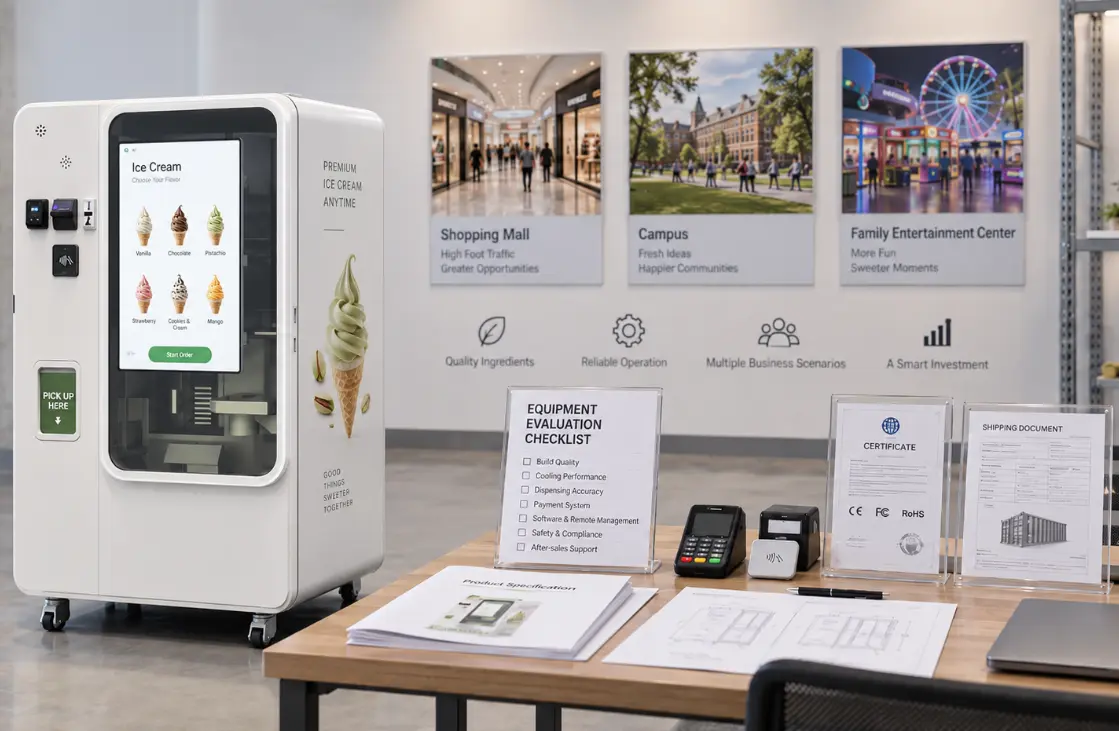
Buying an automatic dessert machine is easy. Buying the right machine for a real commercial location is much harder.
A useful ice cream vending machine buying guide therefore should not begin with touchscreen size, flavor count, or the lowest factory quotation. It should begin with the operating model: where the machine will be placed, what it must serve, how customers will pay, who will refill and clean it, and how the equipment will be supported after import.
Those questions determine the machine specification.
For a one-machine pilot, a regional rollout, or a distributor order, the purchasing process can be reduced to four decisions:
- Is the equipment suitable for the intended commercial environment?
- Can the supplier prove that it can deliver and support the required configuration?
- Are the machine, payment, hygiene and remote-management functions adequate for the operating model?
- Are the quotation, certification, shipping and service boundaries clear enough to compare suppliers fairly?
The fourth question is where many purchasing mistakes begin. Two machines described online as “fully automatic ice cream vending machines” may represent very different commercial packages.
Start With the Site, Not the Machine Catalogue
Before asking how to buy an ice cream vending machine, write a one-page operating brief.
At minimum, it should identify the country, location type, expected customer traffic, dessert concept, planned machine quantity, payment requirements and approximate peak demand.
A machine for an indoor university building does not face the same requirements as one operating in a tourist attraction, shopping centre or family entertainment venue.
The location changes what matters.
| Operating environment | What deserves extra attention | Why it matters |
|---|---|---|
| Shopping mall | Screen visibility, cashless payment, branding, peak serving capacity | Customers often discover the machine while passing |
| Campus or school-related location | Simple UI, menu control, cleaning procedures, payment policy | Access rules and menu requirements may be stricter |
| Family entertainment centre | Fast order flow, large cup capacity, easy pickup process | Demand can arrive in short peaks |
| Tourist location | Multilingual interface, remote monitoring, refill planning | Staff may not be continuously present |
| Hotel / controlled indoor site | Reliability, quieter operation, compact service routine | Traffic may be lower but service standards higher |
| Multi-site dealer rollout | Standardized specification, spare parts, remote tools, documentation | Repeatability matters more than a single attractive machine |
Menu concept also matters earlier than many buyers expect.
Soft serve, frozen yogurt, sorbet and Açaí-style frozen dessert may look similar from the customer's side, but recipe properties, temperature control, cleaning and product handling can differ.
For Huaxin's typical automatic system, one base mix is normally operated at a time. A buyer planning to sell several completely different base products simultaneously should clarify that concept before the quotation stage rather than assuming a topping menu automatically means several independent base-product systems.
This is why a catalogue-first buying process often creates confusion. The buyer starts comparing hardware before defining what the hardware has to do.
Supplier Evaluation Matters More Than the Product Page
A commercial machine supplier should be evaluated as an equipment partner, not simply as a seller with attractive product photography.
This becomes especially important for dealers.
An operator may need one reliable machine at one location. A dealer needs a configuration that can be reproduced across future orders, documentation that can survive customer scrutiny, spare-parts continuity and a clear escalation path when a machine needs technical support.
A practical supplier scorecard can look like this:
| Evaluation area | Suggested weight | Evidence worth requesting |
|---|---|---|
| Product and manufacturing capability | 20% | Factory information, production process, QC procedure, machine documentation |
| Commercial application fit | 15% | Relevant deployment experience and explanation of configuration logic |
| Certification and compliance | 15% | Certificate, report or listing details with model scope |
| Payment and software capability | 15% | Supported interfaces, provider requirements, remote-management demonstration |
| After-sales and spare parts | 20% | Warranty terms, spare-parts list, troubleshooting process, training method |
| Export and logistics capability | 10% | Packaging method, dimensions, loading plan, export documents |
| Communication quality | 5% | Technical accuracy, response quality and willingness to clarify limitations |
The exact percentages are not important. The discipline is.
A supplier that answers difficult technical questions clearly may be more valuable than one that replies instantly with a lower price.
Ask suppliers to demonstrate the remote-management system rather than merely saying that the machine is “IoT enabled.” Ask what data can actually be viewed, whether fault alerts are available, how software is updated and whether any ongoing connectivity or platform costs apply.
The same principle applies to service.
“24/7 support” tells a buyer very little unless the supplier can explain how diagnosis works, which problems can be handled remotely, how spare parts are identified, how replacement parts are shipped and what happens when local hands-on work is required.
Huaxin's own commercial equipment uses remote-management functions to monitor machine information such as status, sales, inventory and alerts. The commercial value is not the word “smart”; it is the ability to manage several machines without making unnecessary physical inspection trips.
The Machine Configuration Checklist That Actually Matters
A long specification sheet can create the illusion of technical diligence.
Commercial buyers usually need a shorter list of specifications connected directly to operating risk.
| Configuration area | What to verify before purchase | Commercial reason |
|---|---|---|
| Refrigeration / freezing | Product suitability, ambient conditions, recovery under repeated orders | Determines performance during peak periods |
| Serving speed | Real production cycle under normal operation | Helps estimate whether queues will develop |
| Product capacity | Mix capacity, cup capacity and refill access | Determines service frequency |
| Touchscreen | Size, language, menu editing, promotional content | Affects ordering and customer visibility |
| Payment | Card, NFC, QR, coin or local provider requirements | A machine cannot trade if the payment system is unsuitable |
| Remote management | Status, alerts, inventory, sales data, remote diagnosis | Critical for multi-site operation |
| Cleaning system | What is automated and what still requires manual work | Hygiene cannot be reduced to a marketing claim |
| Connectivity | Wi-Fi, cellular or other requirements | Determines whether remote functions remain available |
| Consumables | Cup specification, mix requirements, toppings and local sourcing | Affects replenishment and supply continuity |
| Spare parts | Recommended starter parts and replacement procedure | Reduces downtime risk |
Huaxin's typical full-size automatic machines provide a useful example of why specifications need commercial interpretation.
A serving cycle of roughly 15–20 seconds is useful because the operator can compare machine throughput with expected peak-hour demand. A cup-storage capacity around 160 cups is relevant because it affects how frequently the location needs to be serviced. Remote management becomes increasingly important when an operator moves from one machine to a route of several machines.
Automatic cleaning or pasteurization functions also require careful wording.
They can automate or standardize parts of the hygiene process. They do not mean that the operator never needs to inspect food-contact areas, clean components, manage ingredients or follow local food-safety procedures.
Payment deserves similar caution.
Support for MDB, NFC, card readers or QR payment does not automatically mean every payment terminal in every country can be connected. Payment compatibility depends on the country + payment provider + machine configuration.
Before purchasing, ask the supplier to confirm the exact provider or interface expected for your market.
That single confirmation can prevent a technically functional machine from arriving without a commercially usable payment setup.
Certification: Verify the Model, Not Just the Logo
Certification is one of the easiest areas for buyers to misunderstand.
A logo shown on a supplier website is not enough.
For the European market, CE marking indicates that the manufacturer declares the product complies with applicable EU requirements. The European Commission specifically notes that there is no central EU organization that simply issues a universal “CE certificate”; the manufacturer must identify applicable legislation, perform the appropriate conformity assessment, maintain technical documentation and issue the Declaration of Conformity where required.
For North America, the ETL Listed Mark is issued through Intertek. Intertek is recognized by the U.S. Occupational Safety and Health Administration as a Nationally Recognized Testing Laboratory, and the mark indicates that a product has been evaluated to applicable product safety standards within the certification scope.
NSF requirements relate primarily to sanitation and public-health aspects of food equipment. Of particular relevance to vending equipment, NSF/ANSI 25 covers food and beverage vending machines and establishes sanitation-related requirements for materials, design, construction and performance.
That still does not mean every country, site or authority will request the same documents.
A better procurement question is:
“Please provide the applicable certificate or conformity document and confirm that my exact model/configuration falls within its scope.”
Huaxin states that its vending machine development has included CE, ETL and NSF certification milestones. Buyers should nevertheless verify the certificate scope for the exact unit being purchased, especially where payment devices, electrical configuration or other market-specific components differ.
For large projects, discuss the requirements with the importer, local authority, testing body or other qualified compliance professional before manufacturing begins.
Changing the specification after production is far more expensive than clarifying the requirement during procurement.
Compare Quotations at the Same Commercial Boundary
One supplier quotes USD X.
Another quotes USD X minus 15%.
That does not yet mean the second machine is cheaper.
The first question is: What is included?
A purchase-ready quotation may need to identify:
- Exact machine model and configuration
- Voltage and electrical specification
- Touchscreen and UI
- Payment interface or payment hardware
- Remote-management software
- Branding or exterior customization
- Export packaging
- Recommended spare parts
- Warranty
- Technical training
- Production lead time
- Incoterm
- Freight, if requested
- Certification or documentation included
- Items specifically excluded
International buyers should also compare the Incoterm and named location.
Incoterms® 2020, published by the International Chamber of Commerce, defines standard trade terms including EXW, FCA, FOB, CIF and DDP and clarifies how transport tasks, costs and risks are divided between seller and buyer.
For example, an EXW factory quotation and a CIF destination-port quotation are not directly comparable.
Neither represents the same logistics responsibility.
For deeper budgeting, it is better to separate this purchasing decision from the full financial analysis. The dedicated Ice Cream Vending Machine Cost Breakdown for Commercial Buyers explains the wider cost structure, while the Ice Cream Vending Machine Shipping Cost and Total Import Expenses guide focuses specifically on freight and landed import expenses.
The buying guide should answer which equipment and supplier to select. It does not need to rebuild the entire investment model.
Why the Lowest Machine Price Can Become an Expensive Purchase
Low price is not automatically a warning sign.
An unnecessarily expensive machine is not automatically a better machine either.
The problem appears when the buyer compares prices before making specifications equivalent.
Suppose Supplier A includes remote software, a compatible payment interface, export packaging, spare parts and technical training.
Supplier B quotes only the base machine.
The second quotation may look significantly cheaper while still producing a higher launch cost later.
There are several less visible risks worth checking:
Weak refrigeration under real peak load.
A machine may perform correctly during a short demonstration but struggle with repeated orders in a warmer commercial environment.
Unverified payment compatibility.
“Supports credit card” is not enough. Ask which terminal, provider or protocol will actually be used.
Poor spare-parts planning.
A low-cost machine loses its price advantage quickly if a small component failure creates weeks of downtime.
Limited remote diagnosis.
Multi-location operators cannot efficiently manage every technical issue through site visits.
Certification mismatch.
A certificate belonging to a different model or configuration may not solve the buyer's local compliance problem.
Undefined after-sales responsibility.
If neither the supplier nor buyer has decided who handles physical service, the problem only becomes visible after a fault occurs.
For commercial equipment, purchase price should therefore be treated as one line in the evaluation—not as the evaluation itself.
A Practical Purchase Decision Checklist
Before issuing a purchase order, an operator or dealer should be able to answer these questions:
- Is the target location already defined?
- Is the dessert concept confirmed?
- Has expected peak demand been estimated?
- Is the proposed machine configuration matched to that demand?
- Has the exact payment solution been confirmed?
- Are voltage and electrical requirements correct?
- Are required languages and UI functions defined?
- Has remote-management functionality been demonstrated?
- Is the cleaning procedure understood?
- Are mix, cups and other consumables locally obtainable?
- Has the supplier provided a recommended spare-parts plan?
- Are warranty and technical-support responsibilities written down?
- Have applicable certification requirements been checked?
- Does the certificate or report cover the proposed model?
- Are packed dimensions and weight confirmed?
- Is the shipping Incoterm clearly stated?
- Are production lead time and shipment timing written into the quotation?
- Are all quotation exclusions visible?
- Has the buyer compared suppliers using equivalent specifications?
If several answers are still “unknown,” price negotiation is premature.
Quote Request Template for Commercial Buyers
A good RFQ does not need to be long.
It needs to contain enough information for the supplier to recommend a realistic configuration.
Project Location
Country:
City / Destination Port:
Location Type:
Deployment
Initial Quantity:
Possible Future Quantity:
Expected Launch Time:
Product Concept
Soft Serve / Frozen Yogurt / Sorbet / Açaí-Style:
Expected Daily Cups:
Expected Peak-Hour Demand:
Customer Interface
Required Language:
Branding Requirements:
Preferred Screen / UI Requirements:
Payment
Card / NFC / QR / Coin:
Preferred Local Payment Provider, if known:
Compliance
Required Certification or Local Inspection Requirement:
Commercial Request
Required Incoterm:
Destination Port or Delivery Location:
Starter Spare Parts Required: Yes / No
Remote Management Required: Yes / No
This information allows a supplier to quote the project rather than sending the same generic specification to every buyer.
For first-time operators still planning the overall project, the How to Start an Ice Cream Vending Machine Business guide covers location, startup preparation and pilot planning in more detail.
Dealers and Operators Should Not Buy With Exactly the Same Priorities
An operator buys a machine to make one or several locations work.
A dealer buys a product platform that other customers must be able to buy, install, understand and support.
That distinction changes the evaluation.
An operator should give more weight to:
- Site fit
- Local payment
- Service frequency
- Consumables
- Remote management
- Downtime response
A dealer should additionally examine:
- Configuration standardization
- Repeat-order consistency
- Documentation quality
- Certification scope
- Spare-parts availability
- Training materials
- Branding flexibility
- Software scalability
- Supplier production capability
- Territory and commercial cooperation terms
The best ice cream vending machine for commercial use is therefore not necessarily the machine with the longest feature list.
For an operator, it is the configuration that fits the site and can be maintained economically.
For a dealer, it also has to be repeatable.
FAQ
How do I choose a reliable ice cream vending machine supplier?
Evaluate manufacturing capability, relevant product experience, certification documentation, payment compatibility, remote-management functions, spare-parts support and after-sales procedures. Ask for evidence rather than relying only on marketing statements.
The supplier should also be willing to explain limitations. A technically credible “this depends on your payment provider” is more useful than claiming universal compatibility.
What are the most important specifications to check?
Start with refrigeration performance, serving speed, ingredient and cup capacity, payment, screen and UI, remote management, cleaning functions, connectivity and spare-parts support.
Specifications only matter when connected to the intended location and operating routine.
What are the main risks of buying a very cheap machine?
The price itself is not the risk. Missing configuration is.
A cheaper quotation may exclude payment hardware, export packaging, software, spare parts, certification support or technical service. Reliability and component availability also deserve verification before comparing purchase prices.
What should an ice cream vending machine quotation include?
The quotation should identify the exact model, specification, electrical configuration, payment setup, software, branding, packaging, spare parts, warranty, production lead time, Incoterm and all inclusions and exclusions.
For international projects, the named port or destination should also be explicit.
Do operators and dealers need different machines?
Not necessarily.
They often need different procurement criteria. Operators focus primarily on site performance and operating workload, while dealers must also evaluate repeatability, documentation, after-sales scalability, spare-parts supply and future batch orders.
Is CE certification enough for every European project?
No single document should be assumed to solve every project requirement.
CE marking relates to applicable EU product legislation, but buyers still need to confirm the exact product scope, technical documentation and any additional national, site, food-safety or importer requirements.
Buy the Operating System, Not Just the Hardware
A good ice cream vending machine buying guide ultimately leads to a simple conclusion:
The machine should be selected as part of an operating system.
That system includes the location, product, customer interface, payment provider, refill routine, hygiene process, remote management, spare parts, certification, shipping and technical support.
Once these conditions are defined, comparing suppliers becomes much easier.
For operators, this reduces the risk of buying a machine that looks impressive but does not fit the actual point of sale.
For dealers, it creates something even more important: a specification that can be repeated when the first machine becomes ten or fifty.
For a project-specific machine recommendation and quotation, prepare the following information before contacting Huaxin:
Country / Location Type / Planned Quantity / Product Type / Payment Requirements / Target Daily Cups / Expected Start Time
That information gives the supplier enough context to recommend a suitable commercial configuration instead of simply quoting the lowest available machine.
References
-
European Commission, CE Marking – EU Product Requirements and Compliance.
-
Intertek, ETL Listed Mark – Product Certification.
-
U.S. Occupational Safety and Health Administration, Nationally Recognized Testing Laboratory Program – Intertek Testing Services.
-
NSF, Food Equipment Standards, including NSF/ANSI 25 for food and beverage vending machines.
-
International Chamber of Commerce, Incoterms® 2020.
-
Huaxin, company certification and product-development information.
References / Sources