Soft Serve Ice Cream Vending Machine Ingredients and ROI Guide
Compare soft serve mix formats, control storage and per-cup cost, and use actual saleable yield to assess vending machine ROI without relying on generic returns.
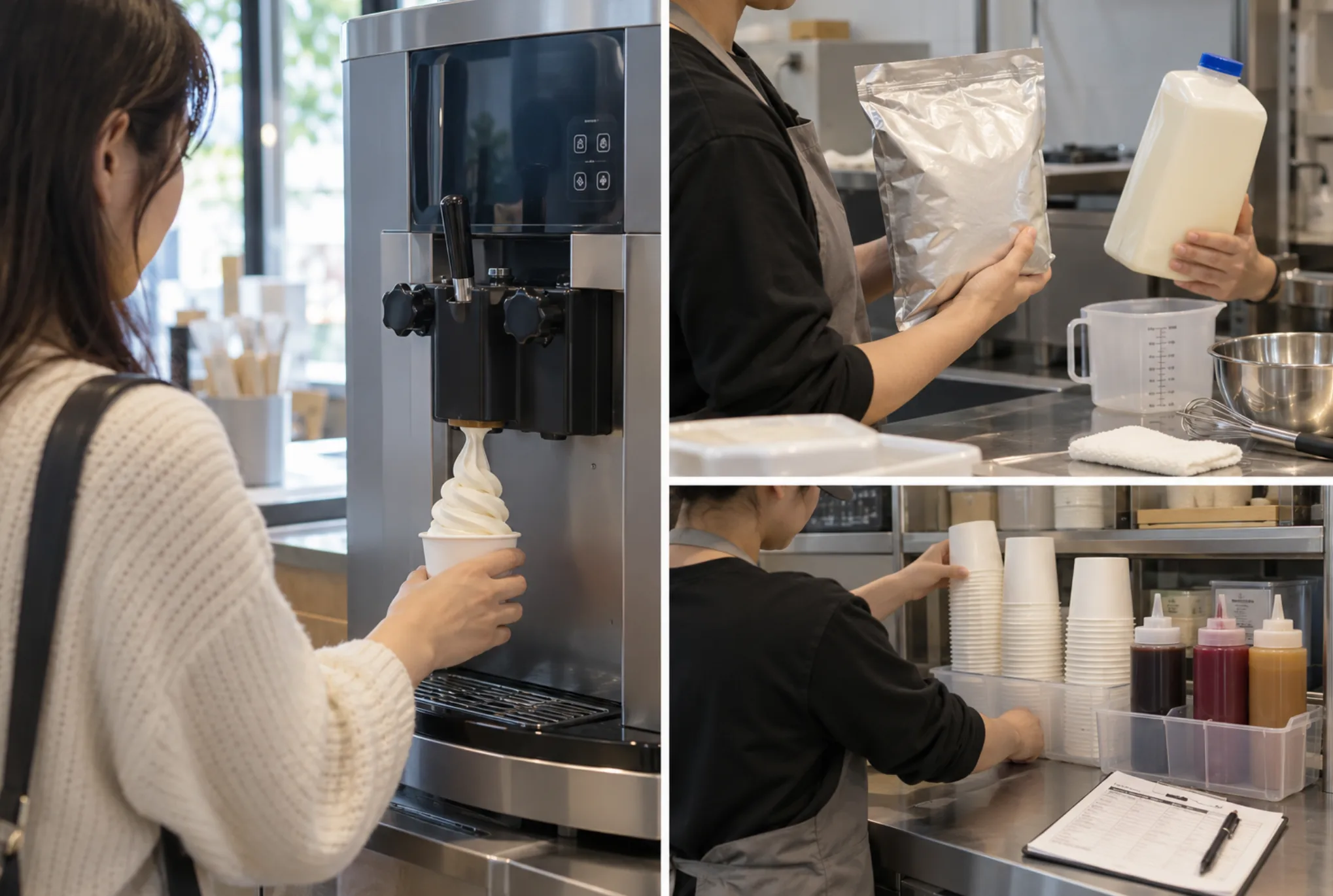
Soft serve vending machine ingredients determine more than flavor. The base mix affects preparation, chilled storage, cleaning work, serving consistency, and the number of cups that can actually be sold from a purchased case. Those differences flow into the cost per paid cup and, eventually, the return from a location. An operator should compare mixes after they are dispensed in the intended machine and portion size, rather than choosing by case price alone.
This guide is for commercial operators and dealers choosing a soft serve menu for an automatic vending site. It focuses on ingredient selection and its financial consequences. Huaxin's operating and ingredient cost guide covers the full recurring budget, including labor, electricity, and maintenance.
1. Choose a mix format that fits the service route
Most procurement discussions begin with two practical formats: a ready-to-use liquid mix and a dry mix prepared with water or another liquid as directed by its manufacturer. Some ready-to-use liquid products are delivered chilled, some frozen, and some are shelf-stable before opening. The label and supplier specification decide storage and handling; the words “liquid” and “powder” do not decide them on their own.
Mix format | Work before loading | Storage and cost question to resolve |
Ready-to-use liquid | Usually shake or mix as the supplier directs; a frozen product may need controlled thawing. | Check unopened and opened storage, cold-chain freight, package size, and whether slow sales will leave unused mix. |
Dry mix | Measure the specified liquid, blend until fully dispersed, and follow any rest or chilling instructions on the product sheet. | Check dry storage, potable-water supply, preparation labor, sanitation of mixing tools, and the prepared mix's holding limit. |
Shelf-stable ready-to-use liquid, where offered | Confirm handling before and after opening; “shelf-stable” describes the sealed product under stated conditions. | Compare freight and unopened storage savings with purchase price, pack size, and opened-product refrigeration requirements. |
A manufacturer example shows why yield needs qualification. Frostline's published dry-mix product sheet states a serving yield at a specified portion weight and overrun assumption. A different cup size or air incorporation changes how many cups that case can fill. Arizona Foods Group publishes ready-to-use soft serve products with frozen and refrigerated handling instructions that differ from a dry mix. Neither supplier's storage life or yield should be copied onto a different formula.
The ingredient list is a separate choice from format. A dry mix may contain milk-derived ingredients; a liquid mix may be dairy-based or plant-based. Review the exact allergen statement and any nutrition or dietary claim before writing the menu. Changing from dairy to a plant-based recipe also calls for recipe testing, revised cleaning and allergen controls, and a check of the machine's permitted mix range.
2. Judge taste and texture in the intended machine
Ice cream texture comes from the relationship among fat, milk or other solids, sweeteners, stabilizers, the unfrozen portion of the mix, and incorporated air. Overrun is the increase in product volume as air enters during freezing; it affects serving weight and apparent yield. Tetra Pak's Dairy Processing Handbook describes how fat and solids affect structure and melting, while the freezing process changes the finished texture. For a vending buyer, an attractive sample from a shop counter is only a starting point. Evaluate the product at the intended machine settings, serving size, and ambient conditions.
Request a practical trial with the exact candidate mix. Dispense several cups after startup and again during the expected busy period. Record portion weight, visible shape, melt behavior, taste, and any inconsistent or failed dispense. Repeat after a normal refill and cleaning cycle. If the supplier's “servings per case” assumes a particular volume, overrun, or cup size, measure the delivered serving rather than treating the headline yield as guaranteed.
Preparation errors can make an otherwise suitable formula look unreliable. Too much or too little dilution changes solids and sweetness; incomplete powder dispersion can change mouthfeel and flow. For liquid mix, the supplier's shaking, thawing, or chilling instructions still matter. Do not adjust a recipe beyond the supplier's guidance to force compatibility. Ask the mix supplier and machine supplier to agree on a tested method before committing to purchase volume.
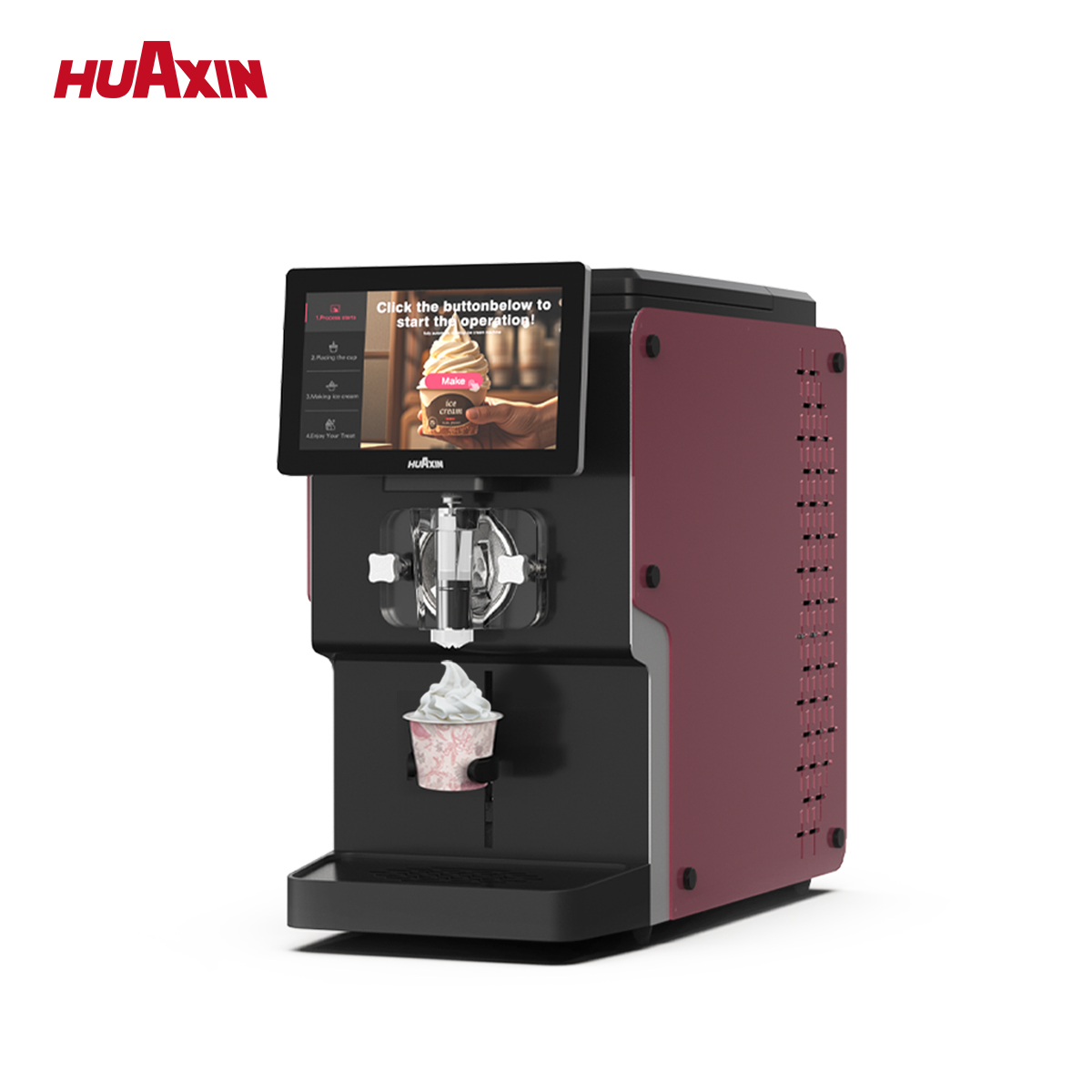
Huaxin's B Series is designed to dispense one base mix at a time. Suitable sauces and toppings can create menu variation when the ordered configuration and ingredients are compatible. The unit continues to run one base, however many compatible additions are offered. This matters when a dealer promises a flavor count or when an operator plans inventory: changing the base requires a controlled changeover and a new product validation.
3. Treat storage and waste as ingredient costs
An ingredient is useful only while it can be handled and sold within its documented limits. Before placing an order, obtain the supplier's instructions for sealed storage, transport, preparation, opened or reconstituted holding, and disposal. Apply the local authority's rules at the actual site. In the United States, the FDA Food Code 2026 is a model for retail-food jurisdictions, including vending; state and local requirements govern the installation. A universal “safe for X days” statement would ignore both the formula and the jurisdiction.
For each refill, record how much mix was loaded, how many paid cups were dispensed, and how much was discarded after testing, cleaning, overfilling, or reaching a use-by limit. Separate avoidable waste from normal process loss. This record reveals whether a slow site needs smaller preparation batches or a different supplier pack size. It also prevents a low purchase price from hiding a high cost per sold cup.
Cleaning is part of that record. Huaxin B Series machines have a one-touch cleaning program, but the operator still follows the equipment manual, supplier instructions, and local hygiene requirements for food-contact parts and routine manual work. Selected configurations may include pasteurization; this is a configuration to verify, not a reason to extend a mix's labeled life on your own. If a menu includes dairy, soy, or other declared allergens, cleaning and customer information need to match the actual ingredients and site process.
4. Calculate contribution before discussing ROI
There is no reliable universal ingredient percentage, ROI ratio, or payback period for soft serve vending. The first useful calculation is cost per paid cup. Use a supplier quote and the trial's measured saleable yield, then update both after the first operating period. The worksheet below keeps purchase cost and operating loss visible.
Worksheet line | Operator input | How it affects the decision |
Prepared base cost | Mix invoice + delivered freight + required water or milk + preparation supplies, divided by paid cups from that batch. | Changes with dilution, portion size, test cups, cleaning loss, and unsold mix. |
Extras and packaging | Sauce or topping portion + cup + spoon or lid, using actual purchase prices. | A menu upgrade helps only if its additional selling price covers its added cost and waste. |
Transaction cost | Local payment provider's per-sale and percentage charges. | Small ticket sizes can make fixed transaction fees material. |
Site and route cost | Written fixed rent + electricity + connectivity + refill and cleaning labor + travel + maintenance reserve; record any revenue share separately per sale. | These costs determine the sales volume needed to cover the location. |
Base cost per paid cup equals total prepared-batch cost divided by saleable cups. Add extras, packaging, transaction fees, and any variable venue charge to obtain variable cost per cup. Contribution per cup equals selling price minus that variable cost. Monthly operating break-even volume equals monthly fixed site and route costs divided by positive contribution per cup. The U.S. Small Business Administration uses the same fixed-cost and contribution logic in its break-even guidance.
ROI requires another boundary: the full initial cash investment and the operating cash left after all relevant costs. For a simple project model over a stated period, ROI = (cumulative operating cash after all variable, site, and route costs − initial project cash outlay) ÷ initial cash outlay. State whether financing, taxes, and any equipment resale value are included. A positive contribution per cup can coexist with a losing site if sales are too low to cover rent and service work. A base mix with a higher invoice price could produce a lower cost per paid cup if its usable yield and product acceptance are better; test this rather than assuming it. For the broader treatment of capital, break-even, and ROI, see Huaxin's profitability and ROI calculation guide.
Run a downside case before committing: fewer paid cups, a larger discard rate, a higher site charge, or more service visits. Keep each input tied to a quote, supplier sheet, observed trial, or site agreement. Financial scenarios are illustrative until actual operating records replace assumptions. No ingredient choice can guarantee a return.
5. Confirm the ingredient system before ordering machines
The operator and dealer need the same written specification. Before ordering soft serve vending machine ingredients at scale, ask for the candidate mix's ingredient and allergen statement, preparation instructions, sealed and opened storage conditions, pack size, and local supply route. Confirm the intended portion and acceptable sauces or toppings with the machine supplier. A trial should establish whether the product dispenses consistently in the exact ordered configuration and what cleaning work follows a changeover.
For an international order, check whether the chosen mix is available in the destination country at the planned purchase volume. Freight, import permissions, local cold storage, and backup supply can change the viable format. A dealer planning several sites should validate one mix and service routine before standardizing it across customers; differences in water quality, delivery access, and customer taste may require separate local trials.
Use this purchasing check before signing a recurring ingredient contract:
· Supplier: written product specification, allergens, batch and shelf-life details, and a dependable local replenishment route.
· Machine: compatibility confirmed for the exact B Series configuration, portion, preparation method, and any sauce or topping hardware.
· Site: storage space, clean preparation area if needed, service access, approved food-handling plan, and local payment setup.
· Economics: delivered batch cost, measured paid-cup yield, discarded mix, visit time, site terms, and a downside sales case.
6. Keep the first menu small enough to learn from
One reliable base with a short set of compatible add-ons gives a pilot clearer evidence than an extensive menu. Customers can still choose different finished cups, while the operator can see which sauce or topping earns enough additional revenue to justify its purchasing, cleaning, and refill work. Remove an option if it creates repeated stockouts or spoilage without enough paid orders.
Keep records by finished menu item rather than averaging all cups together. Compare the incremental selling price with the extra ingredient, packaging, and waste cost; then check whether the option changes service time or product consistency. If the market asks for another base flavor, test its demand and changeover workload as a separate proposal. With one base mix at a time, a second base is an operating decision, not a menu button.
Send Huaxin your country, proposed location and exact position, expected purchase quantity, and target daily cup volume to obtain a configuration and quotation recommendation. Include the mix format and supplier information you intend to use, plus your planned portion and payment provider if known. These inputs let Huaxin review product and machine fit; local paid demand and measured operating costs remain the operator's basis for any ROI forecast.
Relevant FAQs (5)
Is powder or ready-to-use liquid mix better for an unattended vending location?
Choose from the site and route conditions. Dry mix can reduce unopened cold-storage needs but adds measuring, water, and preparation work. Ready-to-use liquid reduces mixing steps but its freight, unopened and opened storage, and pack size may raise cost or waste. Trial both in the intended machine if both suppliers can support the site.
How do I calculate soft serve ingredient cost per cup?
Divide the delivered cost of a prepared batch by the number of paid cups it actually yields. Then add the measured topping or sauce amount and packaging. Record test cups, overfilling, cleaning loss, and discarded mix; a label's theoretical serving count may use a different portion or overrun assumption.
Can one Huaxin machine offer vanilla and chocolate at the same time?
A B Series machine uses one base mix at a time. Compatible toppings and sauces can change the finished cup, but two independent base mixes cannot be dispensed simultaneously from the same single-base system. A base change requires a controlled changeover and validation.
Does a more expensive soft serve mix produce a better ROI?
Possibly, but price alone cannot answer. Compare paid-cup yield, product acceptance, waste, refill work, and the selling price customers will actually pay. Include site and route costs before calculating a return; no mix has a universal ROI advantage.
How long can prepared mix stay in the vending machine?
Follow the exact mix supplier's opened or reconstituted holding instructions, the machine manual, and the local food authority's rules. The permitted period depends on the formula and handling process. A machine cleaning or optional pasteurization function does not create a universal holding period.
References / Sources
1. Tetra Pak, Dairy Processing Handbook, “Ice Cream.” Ice cream structure, fat, solids, overrun, and texture.
2. Frostline Frozen Treats, “Frostline Chocolate Soft Serve Mix.” Dry-mix preparation, storage, and yield assumptions.
3. Arizona Foods Group, “Soft Serve”; Lactalis Foodservice Australia, “Pauls Professional Soft Serve Vanilla.” Liquid-mix handling and a shelf-stable example.
4. U.S. Food and Drug Administration, “Food Code 2026.” Model code for retail-food and vending jurisdictions.
5. U.S. Small Business Administration, “Break-even Point.” Fixed-cost and contribution formula.

NEXT ARTICLE