Most Profitable Vending Machine Business: How Fresh Soft Serve Compares with Snacks, Drinks and Coffee
There is no single most profitable vending machine. Compare snacks, drinks, coffee and fresh soft serve on margin, setup cost, service work and site fit
There is no single most profitable vending machine. Which vending machine is most profitable for you depends on four things: how much of each sale you keep after product costs, how much it costs to get the machine selling, how often someone has to visit it, and how much its sales depend on one particular spot. Snack and drink machines keep little from each sale, but they are cheaper to place and simple to run. Coffee and fresh soft serve keep more from each sale, yet they cost more and need more attention, so they come out ahead at sites with enough buyers.
This guide compares five common categories on those four points, works through an example of why the margin on a single sale can mislead, and sets out when a fresh soft serve machine is likely to pay its way and when a simpler machine is the better buy. Huaxin manufactures soft serve vending machines, so the soft serve sections draw on our own machines and customer projects. The comparison itself applies whichever equipment you choose.
1 Four things that decide which vending machines make the most money
Most answers to "what vending machines make the most money" quote a margin percentage for each category. Margin matters, but it is one of four numbers, and the other three often decide the result.
What you keep from each sale
Snack, drink and packaged ice cream machines resell finished products. What you keep is the gap between the wholesale price and the price on the machine, and other people largely set both ends: suppliers set the cost, and nearby shops cap what customers will pay. Coffee and soft serve machines make the product to order from ingredients that cost little relative to the selling price, so each sale leaves more behind. For soft serve, the variable cost per serving covers the mix, cup and spoon, toppings and sauces, payment fees, and mix lost to cleaning and expiry, not the mix alone.
What it costs to get the machine selling
The outlay covers more than the machine: freight and import charges, installation, payment setup, any site deposit and the stock needed to open. A made-to-order machine carries refrigeration, freezing and dispensing systems that a snack machine does not, so it costs more to buy and takes longer to pay back if sales disappoint. Machine prices vary too much by market and specification to be useful here. Get quotes for the configuration you would actually order.
How often someone has to visit
Service labor is the cost operators most often underestimate. Depending on sales, a snack or drink machine may need a visit every few days or once a week, and the visit is mostly restocking. A machine handling fresh dairy needs its mix and cups refilled more often, its food-contact parts cleaned on a fixed routine and its temperatures checked. Every visit costs travel time as well as working time, so the same machine can be profitable on a dense route and unprofitable on a scattered one.
How much depends on one site
Snacks and drinks sell at almost any site with routine traffic, such as offices, factories, schools and waiting rooms, though they rarely sell exceptionally anywhere. Fresh desserts are a treat purchase. They sell best where people have time to stop and are in the mood to spend, and sales drop away quickly where that is missing. The higher a machine's fixed costs, the more one site decides its result. An Italian customer of ours bought two soft serve machines: one went into service at its site, while the other had to stop when the mall it stood in closed.
2 How snacks, drinks, coffee and frozen desserts compare
The table compares how each category makes and spends money rather than quoting margins, because margins depend on local prices and supplier terms.
Category | Where the margin comes from | Outlay to start selling | Service work and stock | Dependence on the site |
|---|---|---|---|---|
Packaged snacks | Resale gap between wholesale and machine price; suppliers and nearby shops set both ends | Low | Restocking on a route and little cleaning; shelf-stable stock, with losses mainly from expiry dates and slow sellers | Sells at most sites with routine traffic; rarely exceptional anywhere |
Canned and bottled drinks | Resale gap, as with snacks | Low; a refrigerated cabinet adds power cost | Restocking on a route, with heavy stock to carry; long shelf life | Sells at most sites with routine traffic; demand rises in hot weather |
Fresh-brewed coffee | Made to order; ingredients are a small share of the selling price | Higher | Regular cleaning and descaling, a water supply, and fresh milk handling where milk is used | Peaks at mornings and breaks; strongest at offices, transit and campuses |
Packaged frozen desserts | Resale gap on packaged ice cream | Medium; a freezer cabinet | Restocking from a frozen supply chain; little cleaning | Leisure and warm-weather sites; seasonal outdoors |
Fresh soft serve | Made to order from liquid mix; toppings and sauces raise the ticket | Higher | Frequent mix and cup refills, a fixed cleaning routine and temperature checks; chilled dairy mix with a limited holding window | Needs sites where people linger and buy treats; one spot can make or break it |
Structural comparison only. Margins, costs and service frequency depend on local prices, supplier terms, site agreements and the machines you choose.
Read down the table and a pattern appears: the more of each sale a category keeps, the more it costs to install and the more work it needs. Packaged categories trade a thin margin for simple, predictable operation. Made-to-order categories accept higher cost and labor in return for a wider margin and a product customers cannot buy at the shop next door. Neither side is more profitable in general. What matters is which trade-off your sites and your service capacity can carry.
Food rules widen the gap. In the United States, the FDA Food Code, a model code that state and local agencies adopt into their own food rules[2], classes heat-treated animal foods such as dairy mix as time/temperature control for safety (TCS) food. A machine vending TCS food must have an automatic control that stops it selling if it cannot hold safe temperatures, and equipment surfaces in contact with TCS food must be cleaned at frequencies the code sets out[1]. Shelf-stable snacks and canned drinks fall outside those two requirements. In the EU, food vending operators are food businesses under Regulation (EC) No 852/2004; Ireland's food safety authority, for example, requires them to register with their local environmental health office[3]. Check the rules with the authority that will inspect your site before you settle on a category.
3 Why the margin on one sale can mislead
A high margin per sale makes a machine more profitable only once it sells enough to cover its fixed costs. Two simple formulas show where that point lies:
Contribution per sale = selling price − variable cost per sale
Break-even sales per month = monthly fixed costs ÷ contribution per sale
The example below puts a packaged snack machine and a fresh soft serve machine at the same spot. A floor-standing soft serve machine takes up about as much floor space as a snack machine, so both pay the same site fee. The soft serve price and per-serving costs follow our robot ice cream vending machine business and ROI evaluation; the monthly costs are scaled to a smaller site than the busy mall kiosk modeled there. The snack figures were made up for this comparison. None of these numbers are typical market rates.
Illustrative assumptions (USD, 30-day month) | Packaged snack machine | Fresh soft serve machine |
|---|---|---|
Selling price per sale | 2.00 | 5.00 |
Variable cost per sale | 1.10 | 2.00 |
Contribution per sale | 0.90 | 3.00 |
Site fee (same spot) | 150 | 150 |
Refill, cleaning and route labor | 100 | 600 |
Utilities and connectivity | 50 | 200 |
Maintenance, software and insurance | 100 | 250 |
Total monthly fixed costs | 400 | 1,200 |
Break-even sales per day | 15 | 14 |
Monthly result at 20 sales a day | 140 | 600 |
Monthly result at 40 sales a day | 680 | 2,400 |
Monthly result at 60 sales a day | 1,220 | 4,200 |
Illustrative assumptions only. The monthly result is operating cash before the machine outlay, depreciation and tax. Replace every input with your own quotes and site terms.
The soft serve machine costs three times as much to keep running each month, yet it breaks even at about 14 paid servings a day, against about 15 sales for the snack machine. From that point it earns more than the snack machine at every sales level, because each extra serving adds USD 3.00 against USD 0.90 for an extra snack. At 40 sales a day it clears about USD 2,400 a month under these assumptions, more than three times the snack machine's USD 680.
The gap grows at the sites where soft serve sells best, because malls, cinemas and attractions rarely charge a token fee. Raise the site fee for both machines to a mall rent of USD 1,800 a month and keep everything else the same: the snack machine would then need about 76 sales a day to break even, the soft serve machine about 32. That is why snack and drink machines tend to sit at low-fee or commission-based sites, while fresh soft serve can pay its way at busier, higher-rent locations, and why it can be the most profitable vending machine business where the traffic is there.
Two adjustments belong in your own version. The example assumes both machines make the same number of sales, which real sites rarely do, so estimate demand for each category separately. And if the venue takes a percentage of sales instead of a fixed fee, break-even falls but you keep less from every extra sale. The machine outlay comes on top of all this: a soft serve machine has a larger investment to recover, so work out payback separately, as the robot ROI evaluation does.
One buyer in Chile worked through operating costs and expected returns in detail before placing an order, which is the right order of work. If you are not sure how many servings your site can sell, send us the site type and your estimate of daily footfall through our inquiry form, and we will suggest the machine that fits the spot.
4 When fresh soft serve is the more profitable choice
Sites where it tends to fit
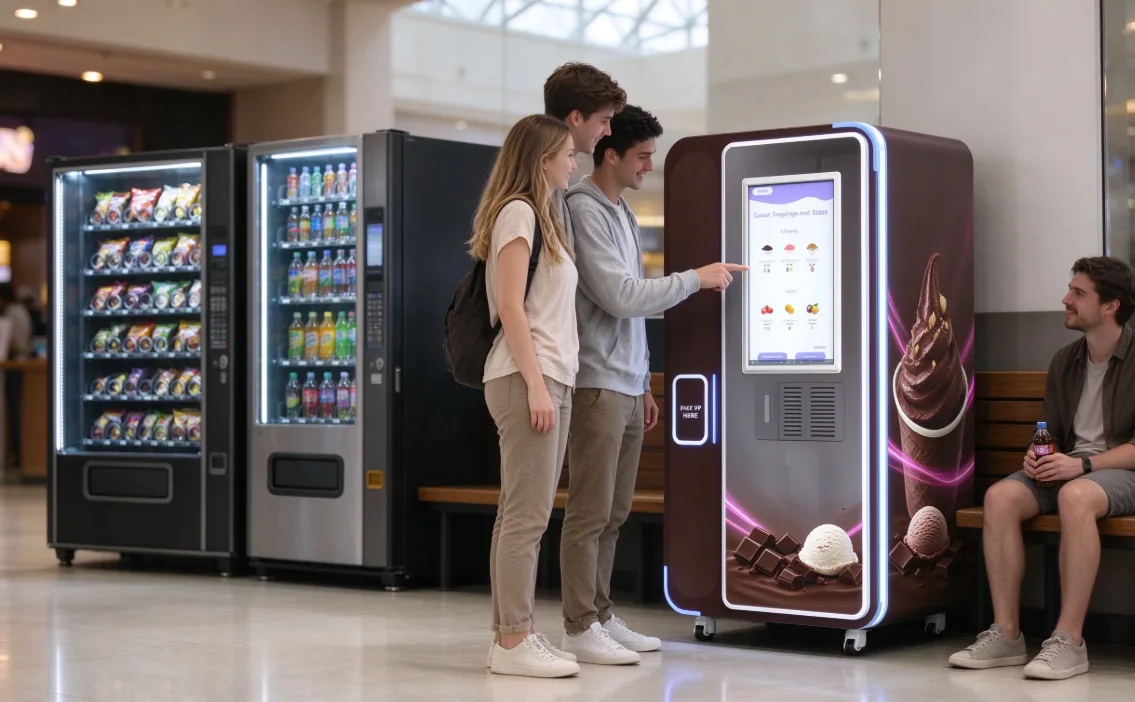
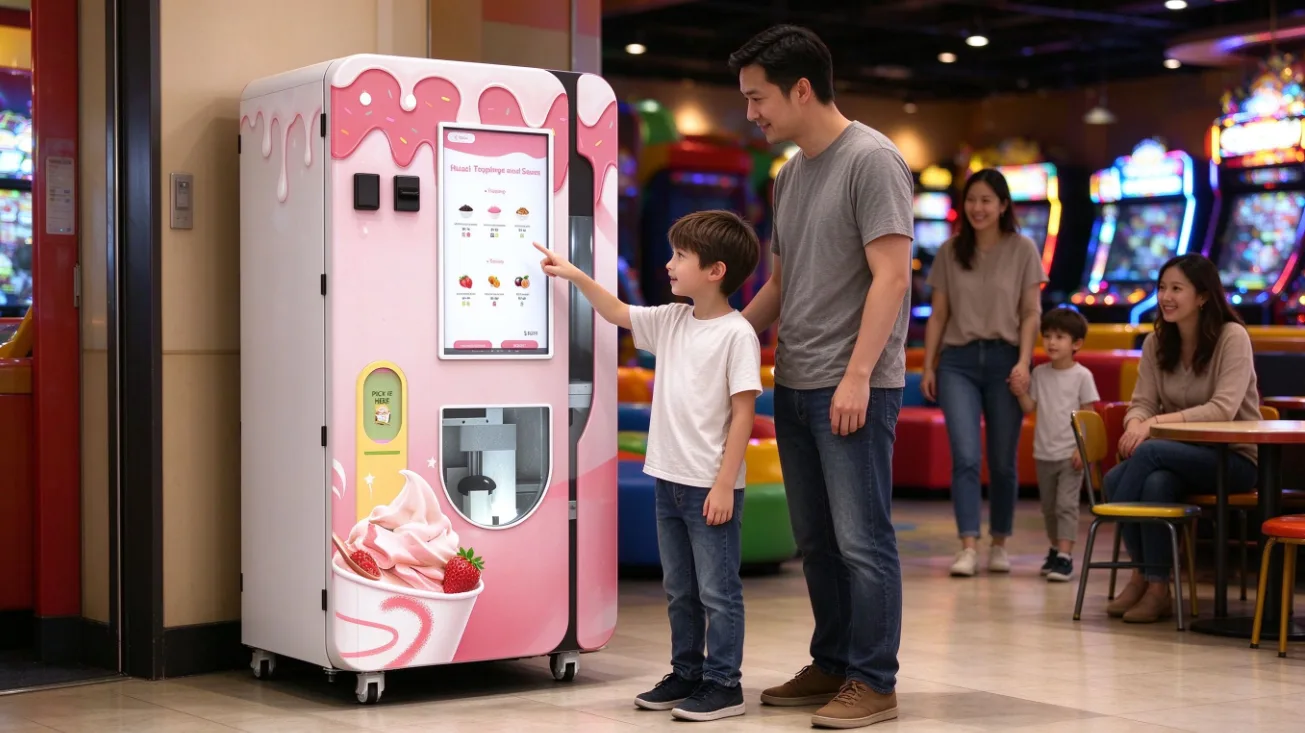
Soft serve sells where people stay long enough to want a treat and have a reason to spend: shopping malls, cinemas and family entertainment centers, tourist attractions and visitor areas, and schools and campuses with space for students to sit and relax. At many of these sites the snack and drink slots are already taken. A fresh dessert machine adds something the venue does not yet offer, which can make a placement easier to agree and keeps direct competition low, at least until a similar machine or dessert counter opens nearby.
Seasons and menu
Demand for frozen desserts follows the weather. In 2025, US plants produced about 18.3 million gallons of low-fat soft ice cream in June, the peak month, against about 10.2 million in December, roughly 79 percent more[4]. Plant output is not vending sales, but the swing is a warning for exposed sites. Indoor, climate-controlled venues smooth out much of it. Outdoor and semi-outdoor spots see the full swing, and a floor-standing soft serve machine placed outdoors needs shelter and an assessment of heat, rain, sun, dust and power at the site.
The menu can soften the quiet months but not remove them. Huaxin B Series machines run one base mix at a time and build variety from toppings and sauces, so a seasonal topping, or a switch of base mix to a suitable frozen yogurt or sorbet formulation, refreshes the offer without new equipment. Toppings priced as add-ons also lift the average ticket.
When a simpler machine is the better choice
A snack, drink or coffee machine is usually the safer choice when:
People pass through quickly with no reason to stop, as in station corridors or car parks.
Your route is serviced weekly or less, and nobody can reach the site for refills and cleaning at short notice.
The spot is exposed outdoors, or the off-season lasts several months.
The venue or local authority will not allow fresh dairy vending, or permits would take longer than the trial you have in mind.
Your best estimate of sales is below about 15 servings a day. At that level the lower fixed costs of a packaged machine leave more room for error.
5 Where robotic soft serve vending machines fit
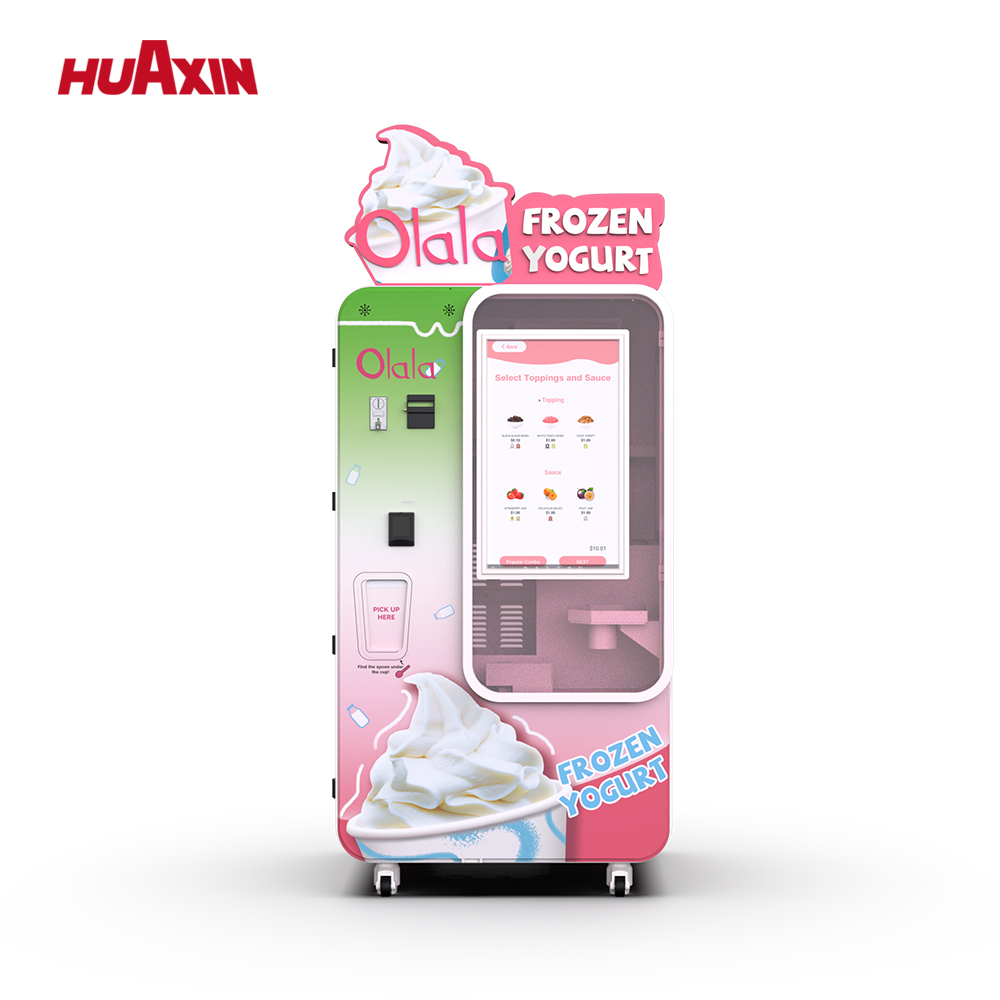
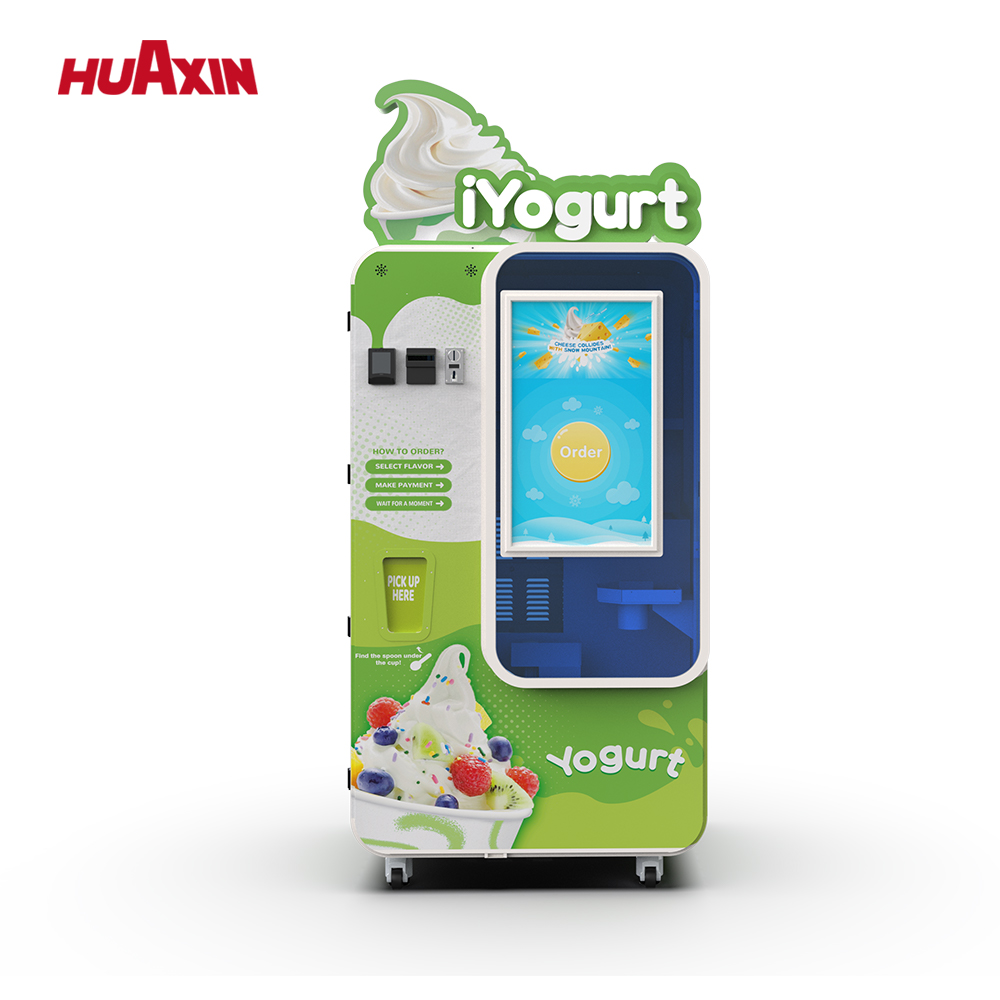
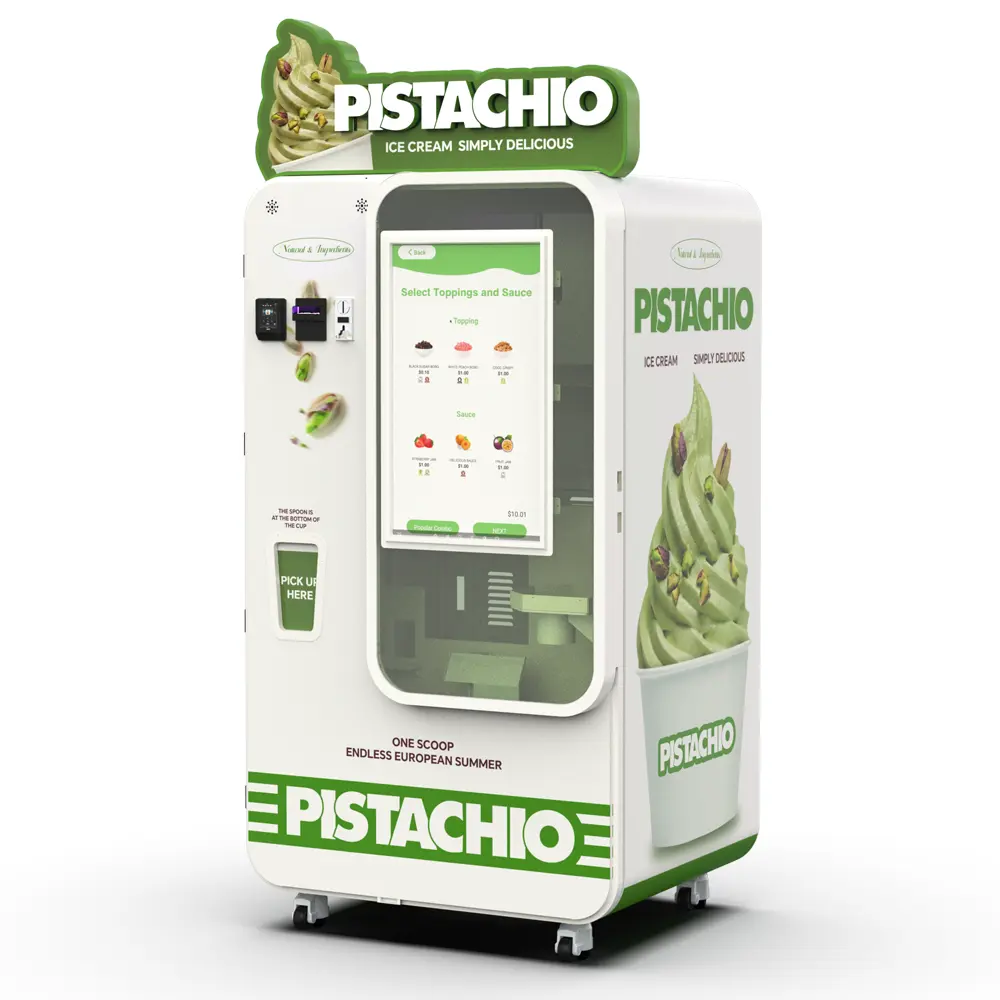
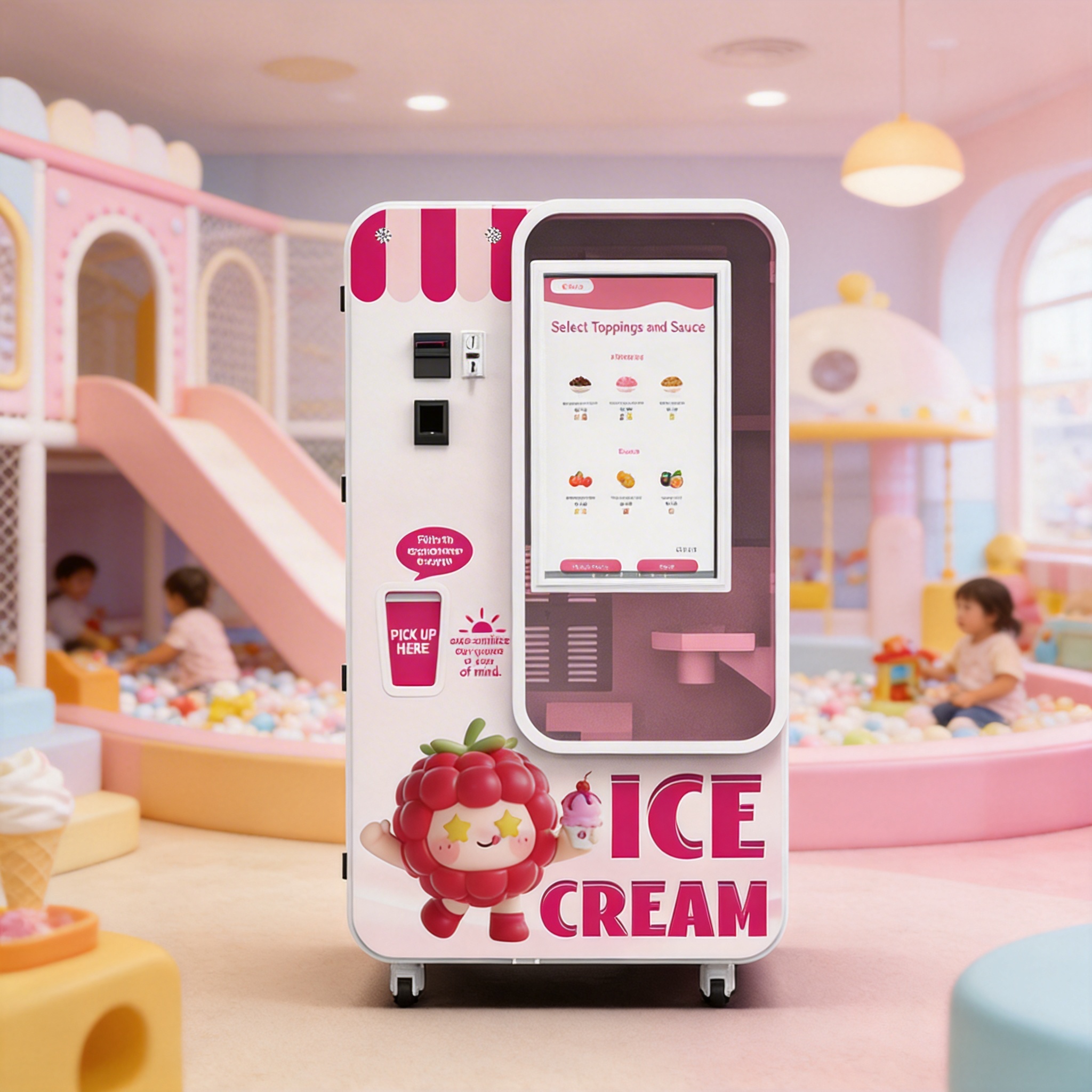
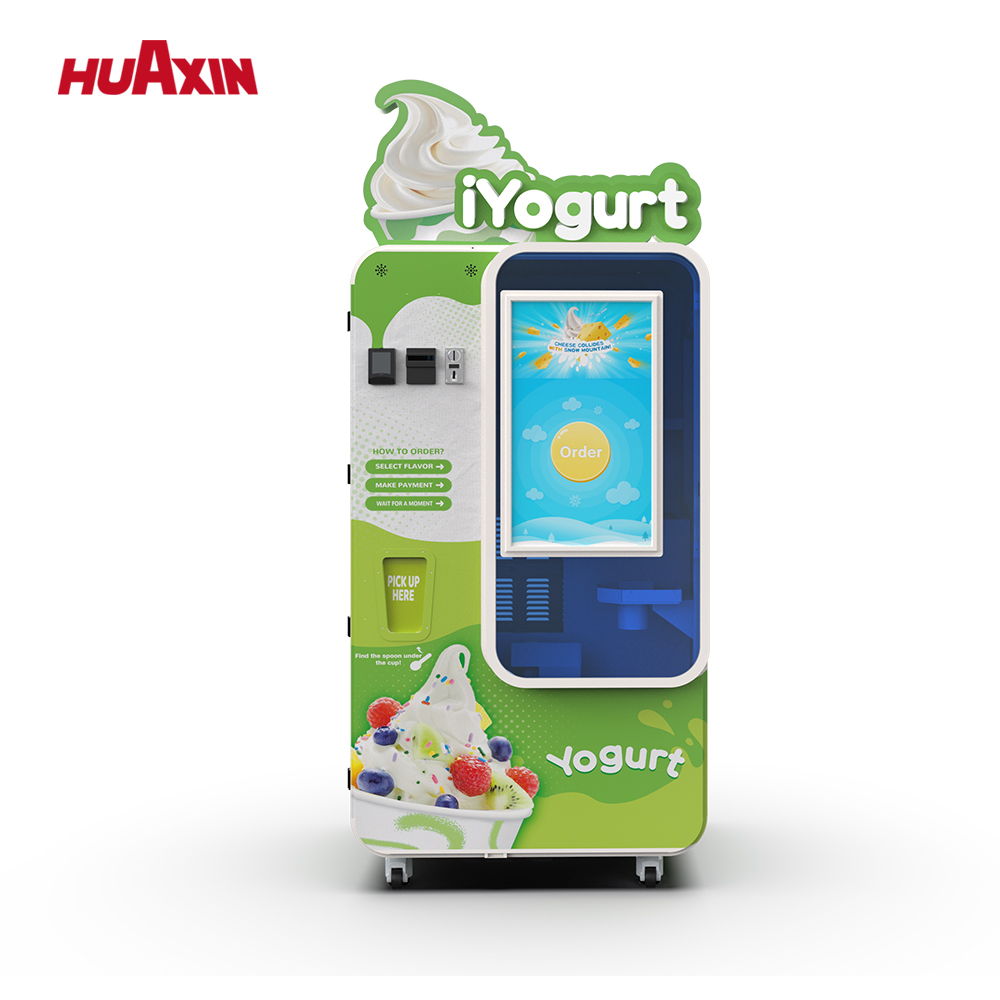
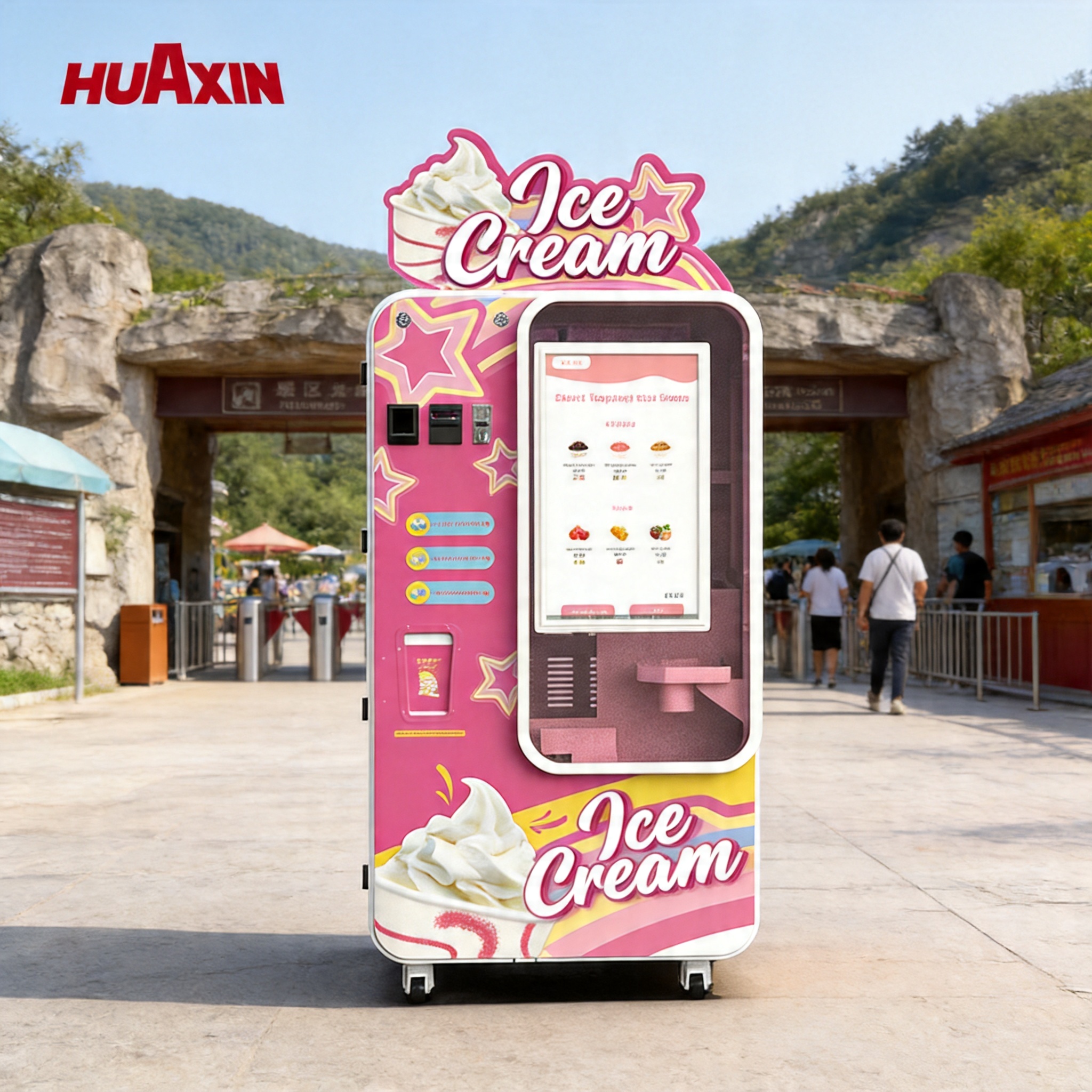
Fully automatic soft serve machines, often called robot ice cream vending machines, change one part of the picture: nobody needs to be at the machine for it to sell. On Huaxin's floor-standing B Series, the customer orders and pays on a 32-inch touchscreen, and the machine dispenses a cup, makes the soft serve, adds toppings and sauces on compatible configurations and delivers the cup to the pickup port. Accepted payment methods depend on the country, the payment provider and the terminal configured for each project.
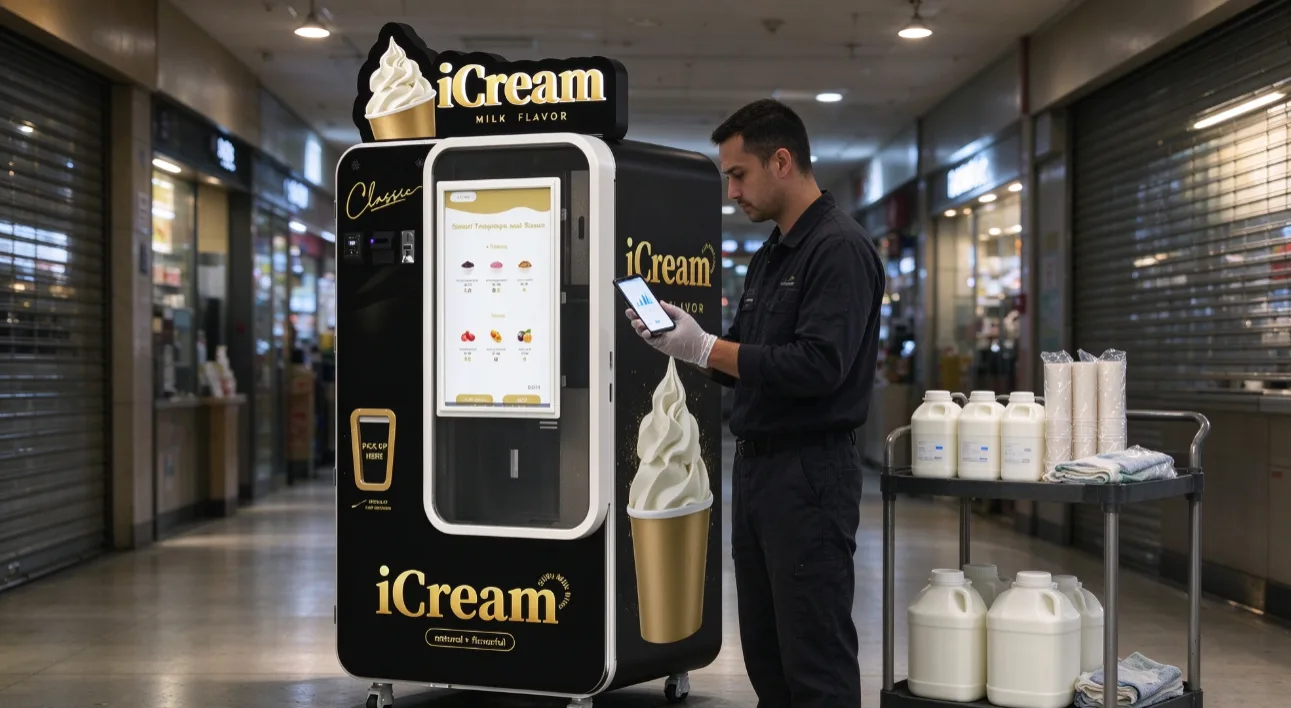
Automation does not remove the service work. B83 Max, B84, B85, B86 and B86 Max hold approx. 20 L of mix and approx. 160 cups, which sets how long a machine can sell between visits. A one-touch cleaning program simplifies routine cleaning, but hygiene routines and manual maintenance remain the operator's job. On networked machines, remote monitoring of status, alerts and sales data helps you plan visits rather than replace them, and selected software configurations support revenue-sharing functions for commission-based site agreements.
Experienced operators weigh the cleaning workload heavily. One Swiss operator who already ran automated machines started looking for a new supplier because the cleaning routine on their existing equipment was not working for them, and cleaning was the first thing they compared.
For a full model of a robotic kiosk, including the machine budget, payback and how the result moves with daily sales, see the robot ice cream vending machine business and ROI evaluation. If staff are already on site, as in a convenience store or café, a countertop machine may suit better than a floor-standing one; our guide to countertop vs floor-standing ice cream machines compares the options.
6 Test the choice at your own site
A calculation narrows the choice; paid sales at a real site settle it. If your estimate sits close to break-even, start with one machine at your strongest site, record paid sales, refills, cleaning time and any stoppages, and write down before it goes in what result would justify expanding. Our guide to planning a single-unit pilot or a 10-unit rollout covers how to set that up. If you already have several signed sites with clear demand, ordering a batch makes freight, installation and service planning simpler.
For a model recommendation, send us:
Site type and country, for example a cinema lobby in Lisbon or a mall corridor in Dubai.
Your estimate of daily footfall at the spot, and the opening hours.
Whether the spot is indoors, sheltered or outdoors.
Who will refill and clean the machine, and how often they can visit.
Send these details through our inquiry form and we will suggest the machine type and configuration that fit the site. We use your footfall estimate to size the machine, not to forecast your sales.
References / Sources
1. U.S. Food and Drug Administration. Food Code 2022: § 4-204.111 Vending Machines, Automatic Shutoff; § 4-602.11 Equipment Food-Contact Surfaces and Utensils; § 1-201.10 definition of time/temperature control for safety food.
2. U.S. Food and Drug Administration. Adoption of the FDA Food Code by State and Territorial Agencies Responsible for the Oversight of Restaurants and Retail Food Stores. Status report published December 2025.
3. Food Safety Authority of Ireland. Vending Machines.
4. U.S. Department of Agriculture, National Agricultural Statistics Service. Dairy Products 2025 Summary, April 2026. Table: Ice Cream Production by Product and Month, United States: 2025.