Robot Ice Cream Vending Machine Business and ROI Evaluation
Compare B86 and B85 robotic vending options, assess busy locations, and calculate cost per cup, break-even sales, ROI, and payback with a hypothetical example.
A robot ice cream vending machine business needs enough paid dessert orders to cover its location and service costs. The robotic presentation can attract attention, but the investment decision comes down to the cup you sell, the rent you pay, and how reliably you keep the machine available during busy periods.
For a concrete starting point, Huaxin's B86 product page lists USD 7,500 as of October 12, 2026. In the hypothetical project below, a USD 15,000 total investment and 45 paid cups per day produce a 22.4% annual after-tax ROI and a simple cash payback period of about 31.3 months. Those calculated results belong to the stated assumptions; they are neither customer results nor a promised return.
We recommend starting with one position that can be serviced easily, then testing demand before ordering for several locations.
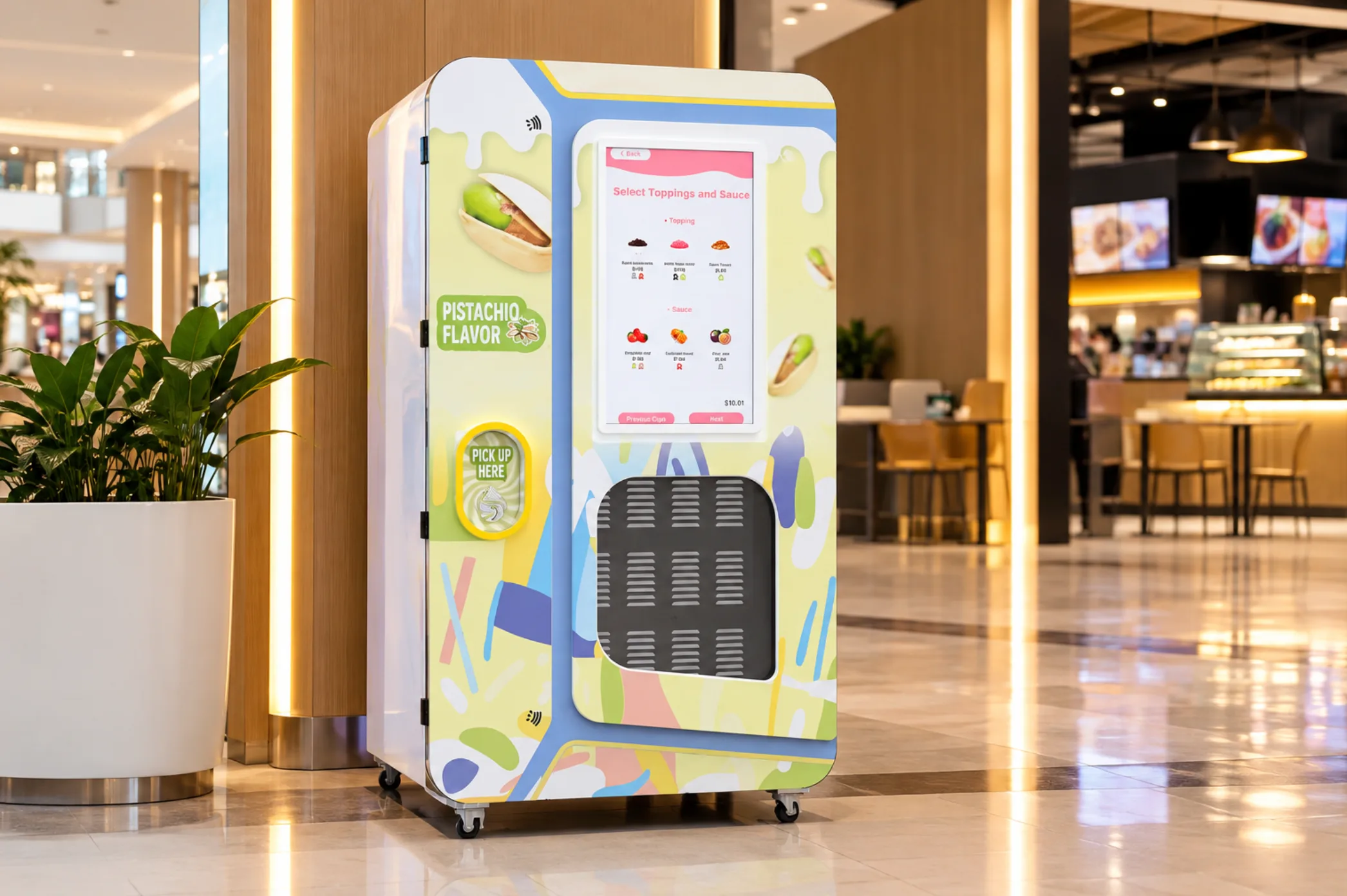
1 Choose the robotic format and budget the installed machine
Use B86 as the main robotic retail option; consider B85 when its exterior better fits the venue's design.
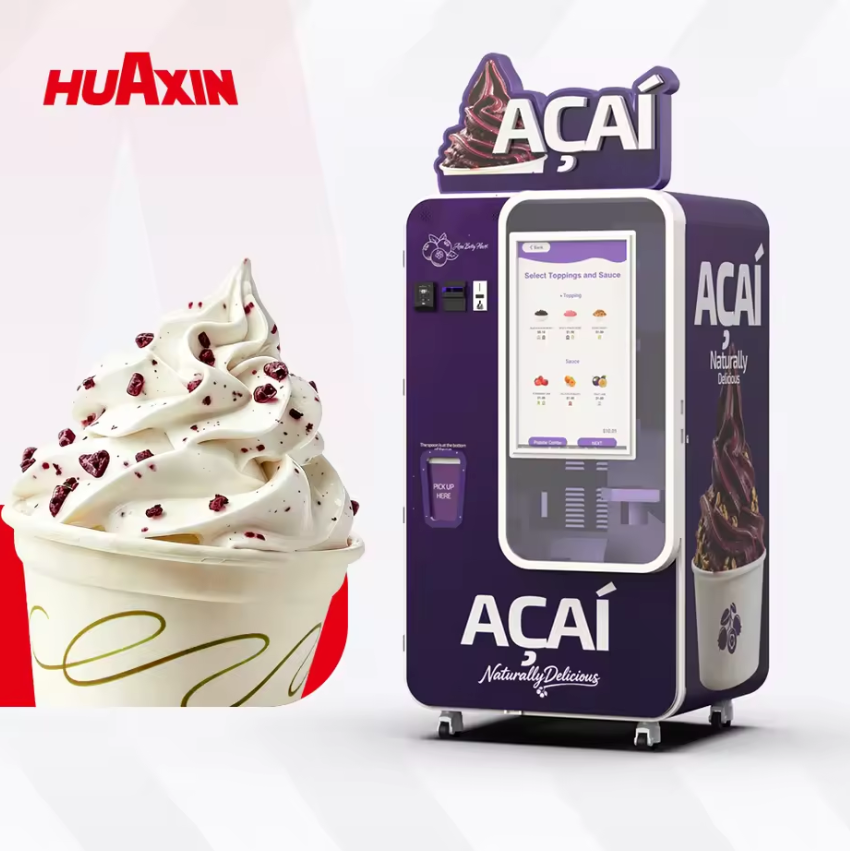
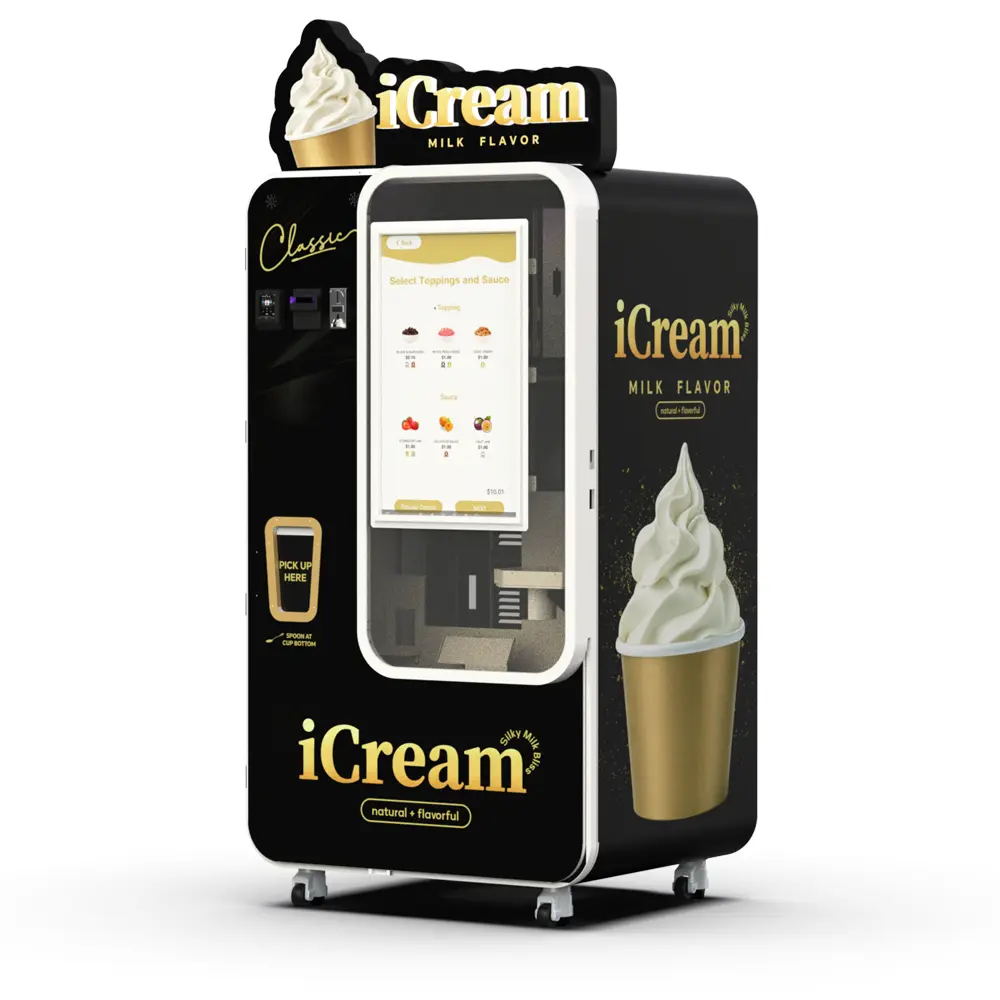
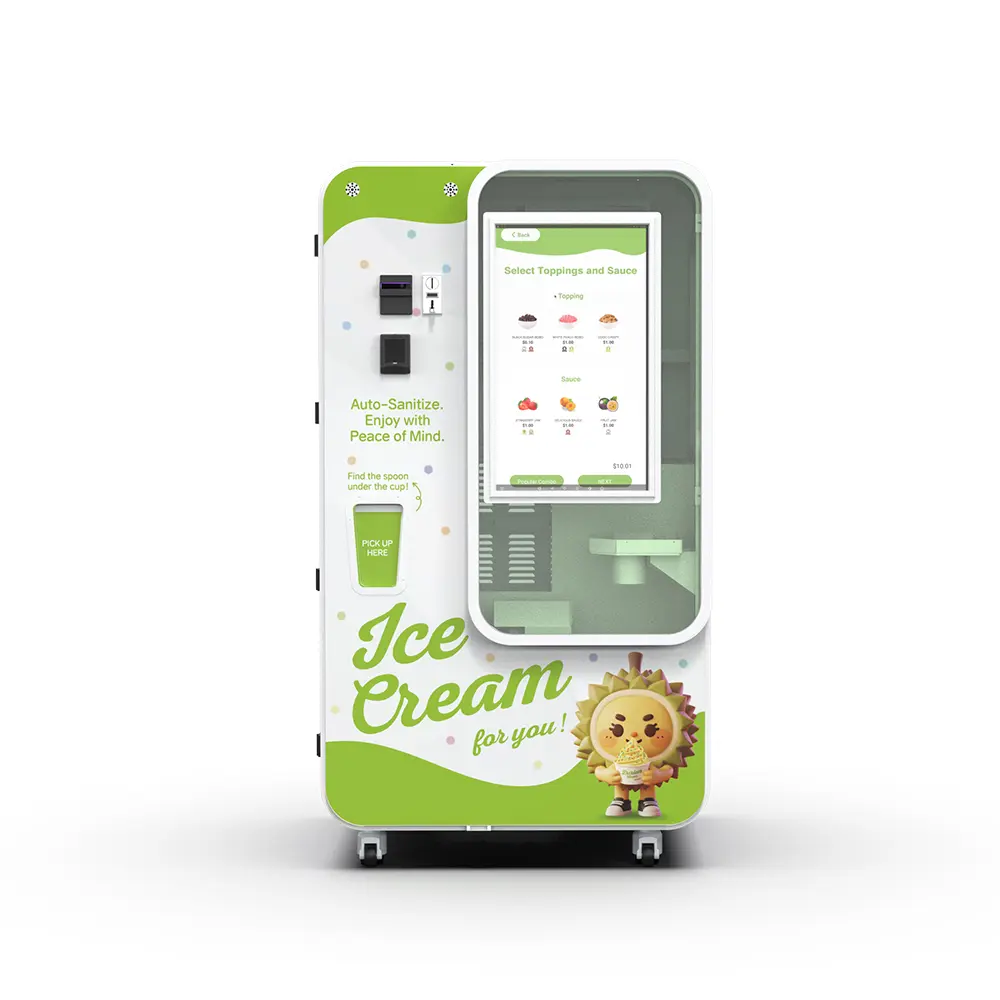
Both are B Series alternatives on the same vending platform. The customer orders and pays through the configured interface, the machine prepares the cup, and the finished dessert moves to the pickup position. Customers can watch preparation through a separate viewing window. Compare the actual exterior and quoted configuration, without assuming that B85 is a slower or lower-capacity version.
The platform runs one base mix at a time. Compatible sauces and dry toppings create menu choices according to the ordered configuration. Start with a menu customers can understand quickly, then test which additions earn enough extra revenue to justify their ingredient cost and handling.
Review the B86 robotic retail configuration and the B85 commercial soft serve alternative with the same menu, payment requirements, and installation conditions.
Parameter for B86 and B85 | Manufacturer specification | What the buyer should measure |
|---|---|---|
Cup storage | Approximately 160 cups, depending on cup type and configuration | How long cups last during the actual rush; mix and toppings have separate limits |
Single serving preparation | Approximately 15–20 seconds in current parameter material; | Preparation time with the selected recipe, portion, and toppings |
Hourly production | Rated up to 120 cups per hour under standard conditions | Completed orders during a continuous run with the intended ingredients and environment |
These are manufacturer parameters, not a measured end-to-end customer cycle. Menu selection, payment, pickup, and readiness for the next order also take time. A short preparation cycle alone cannot establish daily sales or peak queue capacity.
Selected public Huaxin equipment listings show USD 7,500–8,000, checked October 12, 2026; both linked B86 and B85 pages list USD 7,500. This is a limited listing reference, not a global market range or a delivered quotation. Request configuration, trade terms, freight, import charges, payment hardware, and commissioning as separate quotation items. Our startup cost and investment planning guide covers the wider launch budget.
To compare B86 with B85, request a configuration comparison with your country, proposed location, expected purchase quantity, and target daily cup sales. Add a site photo and payment requirements if available.
2 Find customers who have time to stop and buy
A busy dessert area with practical service access is a useful first pilot. Count people passing the exact position, then record purchases, waiting customers, and abandoned orders.
Location | Where to look | Main commercial question |
|---|---|---|
Shopping mall | A visible position near leisure activities or food seating | Will dessert sales cover the written rent, minimum guarantee, and any sales share? |
Cinema or family entertainment center | Waiting space before a session or after an activity | Can orders be completed before visitors leave for the next activity? |
Theme park or attraction | An approved food area with rest space and refill access | Can the operation handle event peaks and quiet or closed periods? |
Airport or transport hub | A waiting area with genuine dwell time | Do concession costs and restricted service access leave a workable margin? |
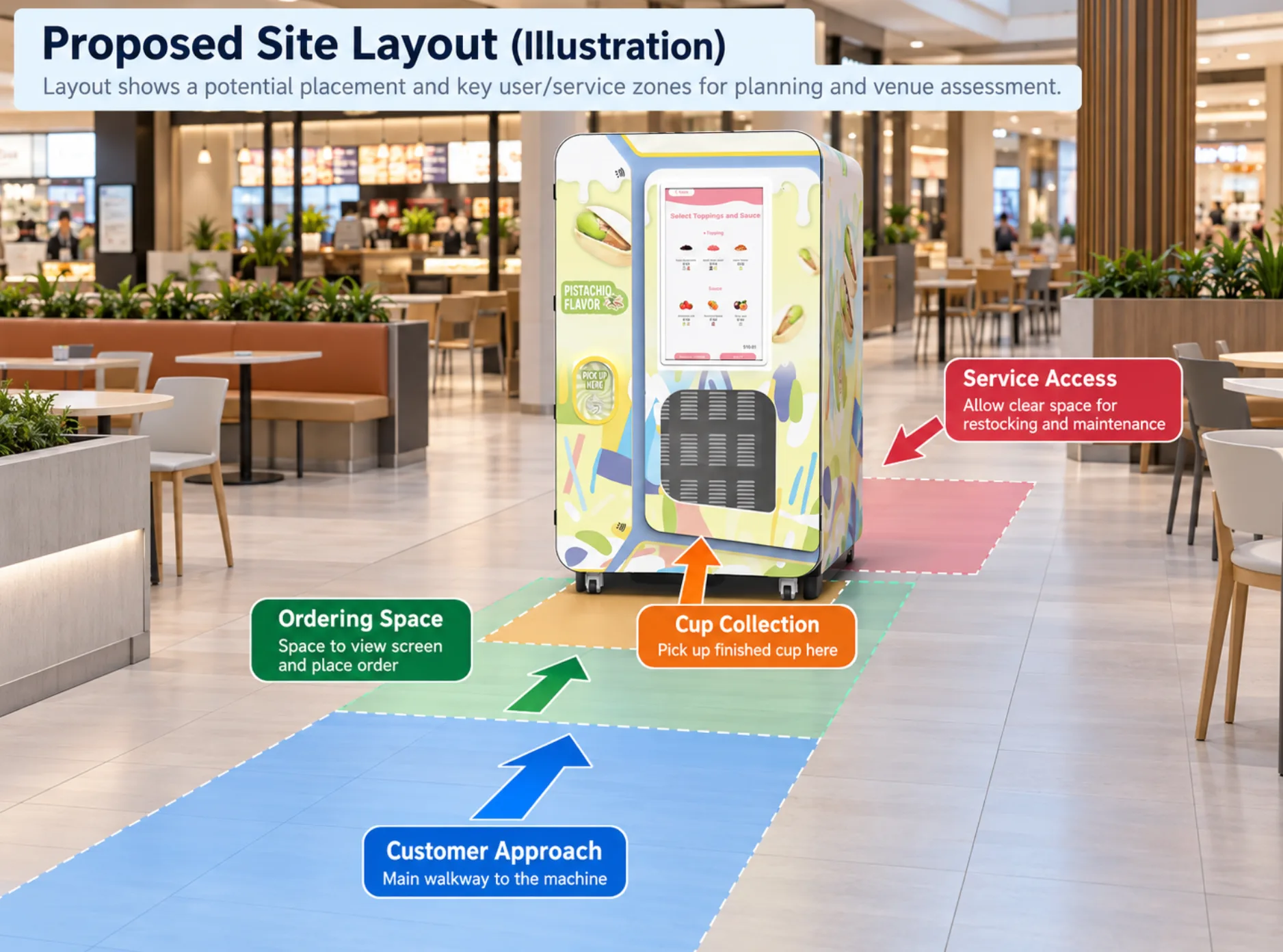
Treat these as candidates. A mall entrance may attract more passersby than a seating area, yet the seating area may offer more time to choose, pay, and collect. Observe both before accepting the landlord's preferred position.
Ask for the full agreement: fixed rent, percentage share, minimums, utilities, promotional fees, access hours, and relocation or exit terms. A rent-plus-share contract needs both charges in the forecast; a minimum-or-share contract uses whichever charge the agreement requires. Venue-wide footfall is a poor substitute for paid orders at the proposed kiosk.
A German buyer tested before expanding
According to our sales team's written project account, a German buyer returned to Huaxin's exhibition booth over several days to observe the machine while it was busy. The buyer brought a technical colleague into discussions about construction, software, wiring, and refrigeration, then ordered one sample. After more than three months of testing in Germany, the buyer placed a container order and later became a dealer.
This is a procurement and testing record, with no recorded model or sales results. It supports a useful sequence: observe the equipment, involve the person who will service it, test locally, then expand. For the broader launch sequence, use the business plan and opportunity evaluation guide.
3 Calculate profit per cup break-even sales and ROI
Build robot ice cream vending machine ROI from paid orders and the complete cost of operating the position. There is no reliable universal ROI percentage or payback period.
Use one currency and consistent periods. Net selling price excludes sales tax or VAT collected for the authority. Variable cost includes mix, toppings, packaging, payment charges, and sale-linked venue fees. With several menu items, use their expected sales mix to calculate average contribution.
Operating break-even divides fixed costs by positive contribution per cup. [1] The ROI measure here uses net profit after tax divided by initial project investment, adapting BDC's net-income and invested-capital approach. [2] Calculate payback separately from cash retained.
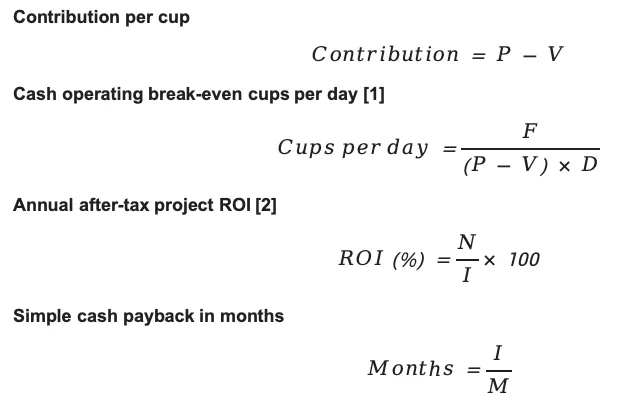
P is net selling price per cup; V is variable cost per cup; F is monthly fixed cash operating cost; D is trading days per month. N is annual net profit after tax; I is initial project investment; M is monthly cash retained after tax. The break-even formula covers cash operating costs. Include depreciation in F for accounting break-even. Payback requires positive monthly cash retained; a loss-making scenario has no positive payback result under these assumptions.
Hypothetical example for one installed kiosk
All amounts below are illustrative USD assumptions for an unfinanced, steady operating period. They are not a Huaxin quotation, local cost survey, or customer performance record. Assume 30 trading days per month, 45 fulfilled paid cups per day, and no percentage venue share.
Hypothetical launch budget | USD |
|---|---|
Machine budget allowance | 7,500 |
Freight, nonrecoverable import charges, installation, payment setup, and commissioning allowance | 4,500 |
Working capital and refundable site deposit held in the project | 3,000 |
Total initial project investment | 15,000 |
The example treats USD 12,000 as depreciable installed equipment over 60 months with zero residual value: USD 200 per month. The remaining USD 3,000 stays committed as cash and deposit. Actual accounting treatment and taxes require local advice.
Hypothetical variable cost per paid cup | USD |
|---|---|
Base mix | 1.05 |
Average sauces and toppings | 0.30 |
Cup and spoon | 0.25 |
Payment processing | 0.25 |
Allocated ingredient and cleaning loss | 0.15 |
Total variable cost | 2.00 |
At a hypothetical net selling price of USD 5.00, each cup contributes USD 3.00 toward fixed costs and profit. That contribution is not net profit per cup.
Monthly fixed cash operating costs are assumed to be USD 3,500: site rent USD 1,800; refill, cleaning, and route labor USD 900; utilities and connectivity USD 350; maintenance, software, and insurance USD 450. Labor includes the owner's service time. These are example inputs, not typical venue rates.
Hypothetical monthly calculation | Calculation | USD or result |
|---|---|---|
Fulfilled paid cups | 45 × 30 | 1,350 cups |
Net sales | 1,350 × 5.00 | 6,750 |
Variable costs | 1,350 × 2.00 | 2,700 |
Operating cash before income tax | 6,750 − 2,700 − 3,500 | 550 |
Profit before income tax | 550 − 200 depreciation | 350 |
Income tax expense and cash payment | Assumed 20% of positive profit | 70 |
Net profit after tax | 350 − 70 | 280 |
Operating cash retained after tax | 550 − 70 | 480 |
For this hypothetical example, cash operating break-even is USD 3,500 ÷ USD 3.00 = 1,166.7 cups per month, or 38.9 per trading day. Round up to 39 cups per day. Including USD 200 monthly depreciation raises accounting break-even to 42 cups per day when rounded up.
Hypothetical annual net profit is USD 280 × 12 = USD 3,360. Annual after-tax project ROI is USD 3,360 ÷ USD 15,000 × 100 = 22.4%. Net profit per paid cup is about USD 0.21 at this volume, after the stated fixed costs, depreciation, and assumed tax.
Simple hypothetical cash payback is USD 15,000 ÷ USD 480 = 31.25 months, rounded to 31.3 months. This uses constant cash retained, no borrowing, no additional capital spending, and unchanged working capital. It ignores discounting and eventual deposit recovery. A real project needs a monthly forecast with seasonality, downtime, payment settlement delays, and actual tax timing.
Change the sales assumption before trusting the result
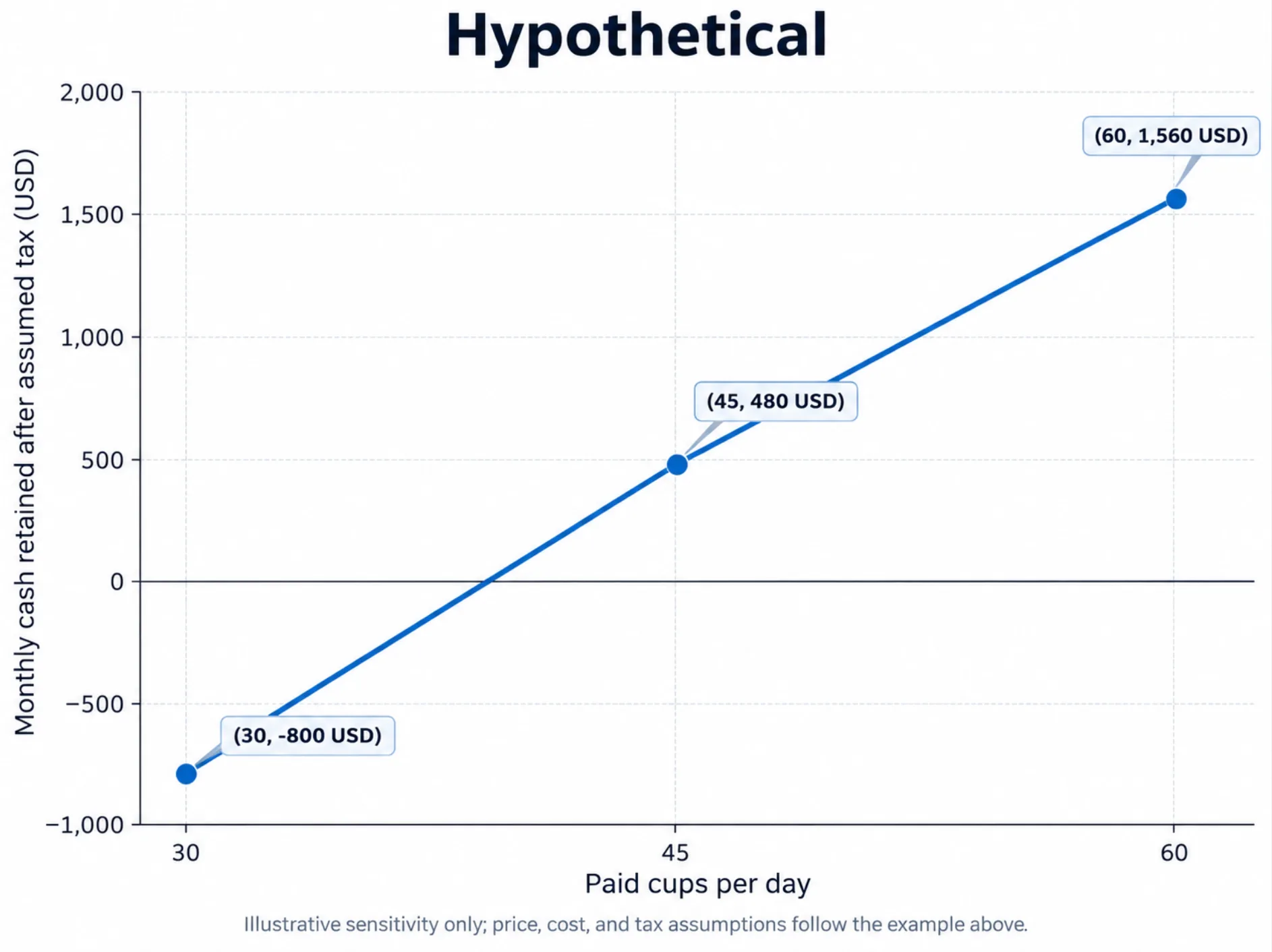
Hypothetical paid cups per day | Cups per 30-day month | Monthly cash retained after assumed tax |
|---|---|---|
30 | 900 | −USD 800 |
45 | 1,350 | USD 480 |
60 | 1,800 | USD 1,560 |
All scenarios retain the same price, costs, depreciation, and tax assumptions. Tax is zero when calculated profit is negative; no tax-loss benefit is assumed. Extra visits or higher rent at stronger sales would reduce the result.
At 30 cups per day, the machine needs more funding to keep trading. Even at 45 cups, a small change in rent or service cost can consume the cash surplus. Use observed demand to choose the sales input, and count lost peak orders as well as quiet days.
To replace the machine and installation allowances with project-specific inputs, send the details for a configuration and quotation review: country, location, expected purchase quantity, and target daily cup sales. Include your proposed selling price and site terms. Our profitability calculation guide provides the wider financial planning method.
4 Make automated serving work during the rush
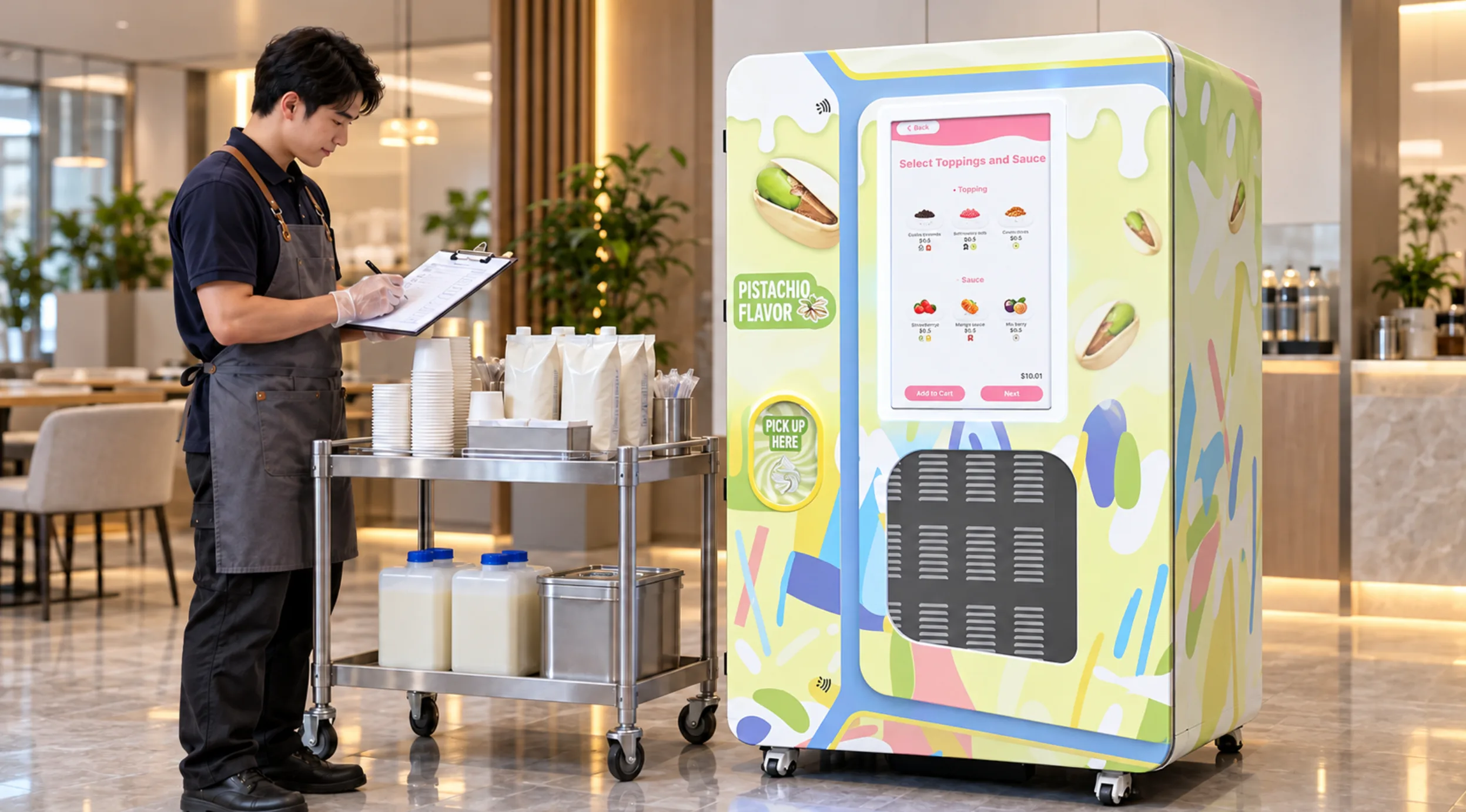
Automation reduces the need to prepare each cup by hand. Its value depends on keeping ingredients, consumables, and the payment system ready when people want to buy.
With approximately 160 stored cups, B86 and B85 still need separate checks for mix, sauces, and toppings. Refill before the first required item runs out. Set the visit schedule from actual consumption and permitted access; a universal refill frequency would be misleading.
Network-enabled B Series configurations can provide operating status, sales information, and selected alerts through configured software and permissions. Assign someone to act on them. A cup alert needs a physical refill, and a payment fault may need coordination with the local terminal provider.
A Netherlands installation separated product quality from payment readiness
A customer's August 13, 2026 message reported that the machine worked well and the ice cream tasted good, while the payment terminal was not working. On September 3, the customer reported good machine operation and positive feedback. The record provides no sales total or confirmed terminal repair time.
Accept production and payment separately. Test a paid order, a failed transaction, refund handling, and settlement before opening the ice cream robot kiosk. A successful dessert demonstration does not complete payment acceptance.
Keep a daily record of completed orders, discarded mix, cleaning work, stockouts, alerts, and service visits. For a fault, record when sales stopped, who responded, what restored service, and when normal trading resumed. These records give an operator usable maintenance costs and interruption losses for the next site.
5 Check the operating conditions before expanding
Expand after the pilot can reproduce paid demand and service performance through ordinary busy and quiet periods.
B Series one-touch cleaning assists the cleaning workflow; manual hygiene and maintenance still follow the machine instructions. Optional pasteurization is configuration-specific. Follow ingredient storage instructions and the local authority's requirements. For U.S. projects, FDA's Food Code 2026 is a model for adoption by jurisdictions, so applicable local rules must be checked. [3]
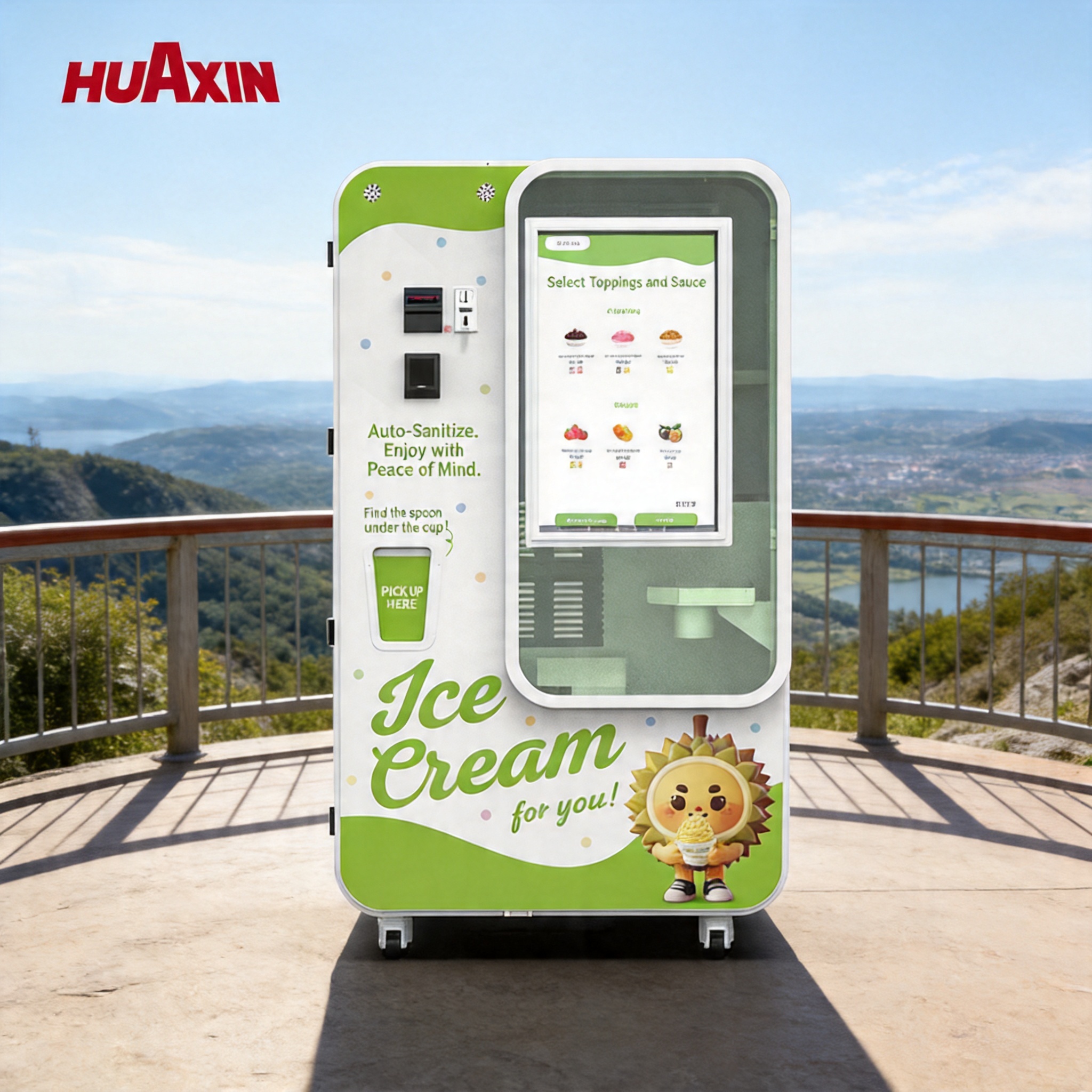
Before shipment, confirm electricity, network coverage, ventilation, delivery access, service space, and the approved environment. An exposed location needs a model-specific assessment of weather, temperature, and protection.
Use this purchase checklist:
Can the proposed cup sell repeatedly at the planned price in the exact position?
Has the quoted configuration completed a continuous peak test using the intended recipe, portion, payment terminal, and pickup flow?
Can the team refill, clean, and respond within the venue's access hours, with responsibilities agreed in writing?
Does the budget survive weaker sales, ingredient loss, extra visits, and all site charges?
For a second machine, compare simplifying the menu, improving the position, adding local service help, and adding equipment. Match the purchase to the observed bottleneck. Keep each site's agreement and results separate when building a route.
If the pilot needs a flexible procurement route, compare new, used, and rental equipment commitments. Rental availability and support terms need a local agreement; they are not a standard option in every market.
Frequently asked questions
How much does a robot ice cream vending machine cost?
The linked Huaxin B86 and B85 pages each list USD 7,500, checked October 12, 2026. Budget separately for shipping, import charges, installation, payment setup, site deposits, and working capital. Obtain a project quotation before committing funds.
What is the payback period?
There is no reliable universal payback period. The hypothetical example gives about 31.3 months by dividing USD 15,000 of investment by USD 480 of monthly cash retained after the assumed tax. Lower sales, interruptions, or higher site costs can extend recovery or prevent it.
Is a robot ice cream vending machine profitable?
It can generate profit when completed sales cover variable costs, site charges, service labor, depreciation, and applicable taxes. In the hypothetical example, USD 3.00 contribution per cup becomes about USD 0.21 net profit per paid cup at 45 cups per day. Validate the volume and costs locally.
Does robotic presentation justify a higher site rent?
Only if additional completed sales or a documented operating benefit pays for it. Compare the premium position with a less expensive workable position using the same menu and full cost model. Crowd attention and photographs alone do not establish that benefit.
Request a configuration and quotation for your site
Submit your project details to Huaxin: country, proposed location, expected purchase quantity, and target daily cup sales. State the daily target as your planning assumption. Share the intended menu and busiest expected trading period so the B86 proposal, B85 alternative, and quotation can be reviewed against the actual project.
References / Sources
1. U.S. Small Business Administration. Break-even Point. Updated October 3, 2024.
2. Business Development Bank of Canada. Return on Investment (ROI).
3. U.S. Food and Drug Administration. Food Code 2026.

PREVIOUS ARTICLE
Soft Serve Ice Cream Vending Machine Ingredients and ROI Guide
NEXT ARTICLE