Gravity Fed vs Pump Soft Serve Machine: Texture, Cleaning and Cost
Gravity fed vs pump soft serve machines: overrun, texture, cleaning and cost per cup, which suits staffed stores or vending, and why Huaxin uses gravity
In June, a Dutch buyer with 20 years in soft serve asked us about our vending machines. His first technical question was what pump we use. We told him our machines are gravity fed, with no pump. He replied in four words: "Less overrun on product."
He was right. Lower overrun means less air whipped into the mix, so the same cup holds more mix and eats denser. A gravity fed soft serve machine lets the mix flow in under its own weight, with no pump. It has fewer parts, costs less to buy, and is easier to clean and maintain [1].
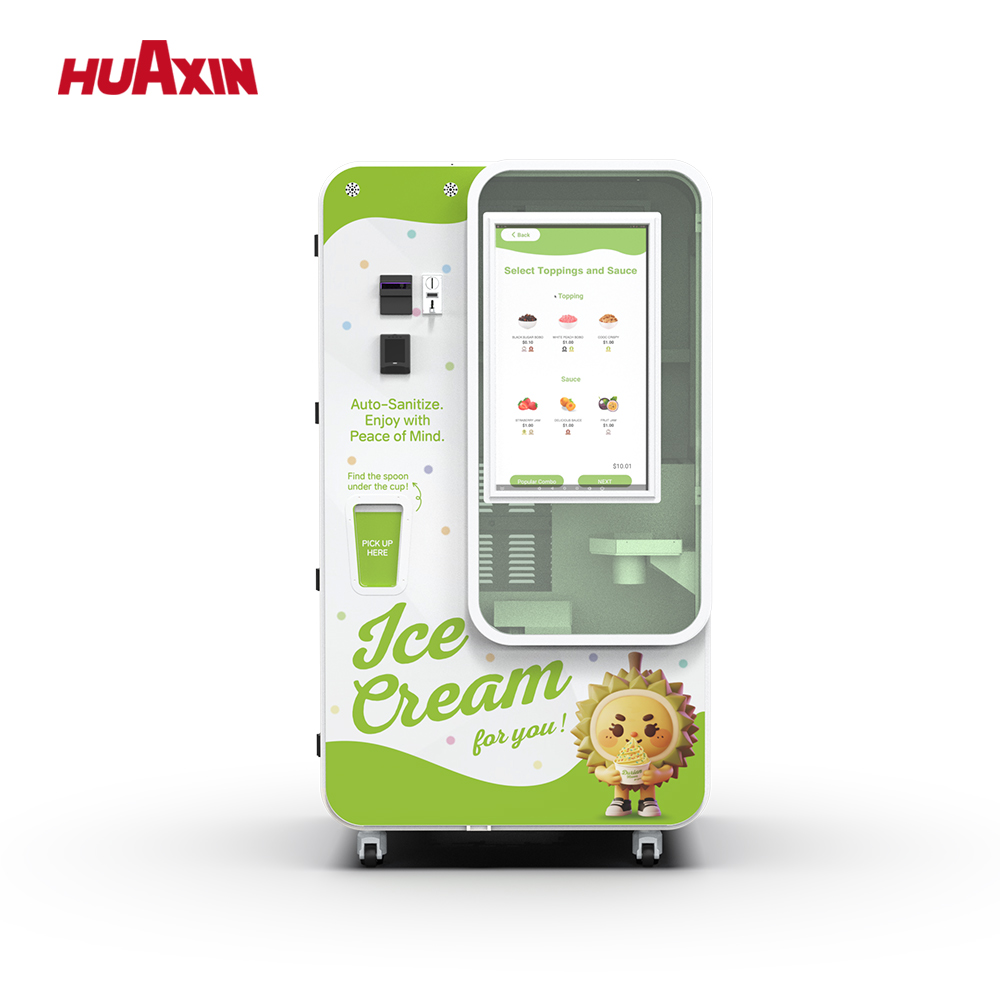
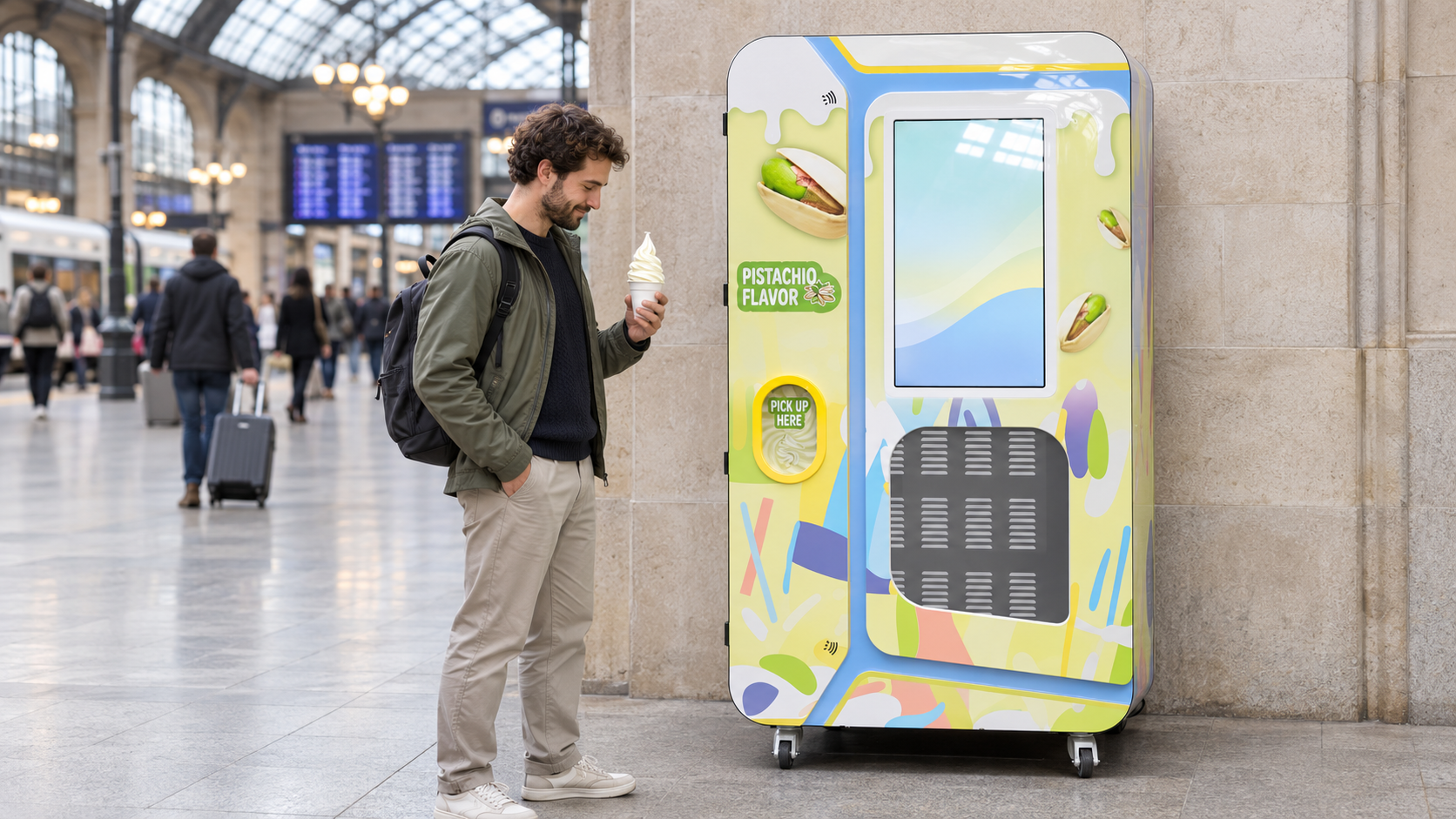
A pump soft serve machine whips in more air, and its overrun can be adjusted. On a traditional counter machine where staff pull each serving, it also keeps up better in a rush [1]. The cost is an extra pump assembly that has to come out at cleaning time, be washed part by part and go back together exactly as before. With staff at the machine every day, that trade-off can work. A vending machine has nobody beside it. Cleaning happens on scheduled visits, and the fewer parts there are, the easier each visit is. All Huaxin vending machines use gravity feed.
What “Gravity Fed” and “Pump Fed” Mean in a Soft Serve Machine
In any soft serve machine, mix is held in a refrigerated hopper and then enters the freezing cylinder. There it is frozen and whipped with air at the same time until it becomes soft serve. Both designs do the same work inside the cylinder. Where they differ is in how the mix and air get in.
Gravity fed: the hopper sits above or beside the freezing cylinder. Mix runs down a feed tube into the cylinder under its own weight, and air is drawn in through an air tube at the same time [1]. There is no pump, so the design is simple.
Pump fed: in a pump fed soft serve machine, a pump sends mix and air into the freezing cylinder together. Because the pump controls how much air goes in, overrun can run higher, and on some models the operator can adjust it [1]. When buyers talk about an air pump soft serve machine or a soft serve machine air pump, this is the design they mean.
When we say a machine has no pump, we mean the mix feed. The sauce pumps that add sauce to each cup on a vending machine are a separate system and have nothing to do with how the mix is fed.
Gravity fed | Pump fed | |
|---|---|---|
How mix and air enter the cylinder | Mix flows in by gravity; air enters through an air tube | A pump feeds the mix and controls the air |
Typical overrun | About 25%–40% | About 35%–80% |
Overrun control | Narrow range, little room to adjust | Wider range; adjustable on some models; more consistent day to day |
Mix in the same cup | More | Less |
Texture | Denser and fuller | Lighter and fluffier |
Back-to-back serving in a rush (traditional counter machines) | Slower than pump fed | Serves more in the same time |
Parts to take apart for cleaning | Fewer | An extra pump assembly |
Purchase price | Lower | Higher |
Table: Gravity fed vs pump fed soft serve machines, main differences. Industry sources mostly describe traditional counter machines operated by staff [1]; check the specific model with its supplier.
How the Feed System Changes Overrun, Texture and Cost per Cup
Overrun is the extra volume a mix gains as air is whipped in during freezing. Our guide to soft serve overrun explains how to calculate it and how to measure it on site.
Foodservice Equipment Reports (FER), an industry publication, puts typical overrun at 35%–80% for pump fed machines and about 25%–40% for gravity fed machines [1]. In the same cup, gravity fed soft serve holds less air and more mix.
Texture
Lower overrun gives a denser, fuller product; higher overrun gives a lighter, fluffier one. Both ends have limits. With too little air, soft serve turns compact and hard. With too much, it has a weak body, feels foamy in the mouth and melts fast [2].
FER reported a taste test described by one equipment maker: with the same mix, at times half the tasters preferred the pump fed product and the other half the gravity fed one [1]. The recipe changes the result as well, and a different mix at the same overrun can eat quite differently. Before you choose a feed system, run your own mix on the machine and taste it.
Mix Cost per Cup
A vending machine dispenses for a set time, so each cup is about the same size. With the cup size fixed, lower overrun puts more mix in each cup. Using the same illustrative assumptions as our overrun guide (150 ml of soft serve per cup, ready-to-use liquid mix at 3.00 per liter in any currency, no start-up, leftover or cleaning losses):
At 40% overrun, the top of the usual gravity fed range: about 107 ml of mix per cup, costing about 0.32
At 60% overrun, a typical level for pump fed machines: about 94 ml of mix per cup, costing about 0.28
That is 0.04 per cup, or about one-eighth of the mix. In a cup of the same size, the gravity fed serving holds that much more mix and tastes fuller for it. Whatever mix a pump saves has to be weighed against the other costs: the purchase price, which is lower for gravity feed [1]; the labor of taking the pump assembly apart at every cleaning; and its routine maintenance. Higher overrun is not always better, either. Push it past what the mix can hold, and the product turns foamy and melts fast [2]. Customers can taste the difference.
Cleaning, Parts and Maintenance: Where the Two Designs Differ
Both designs need every part that touches the mix cleaned and sanitized at regular intervals. How often depends on your local health rules and on whether the machine has heat treatment. For what each service visit involves, see how much work an ice cream vending machine takes.
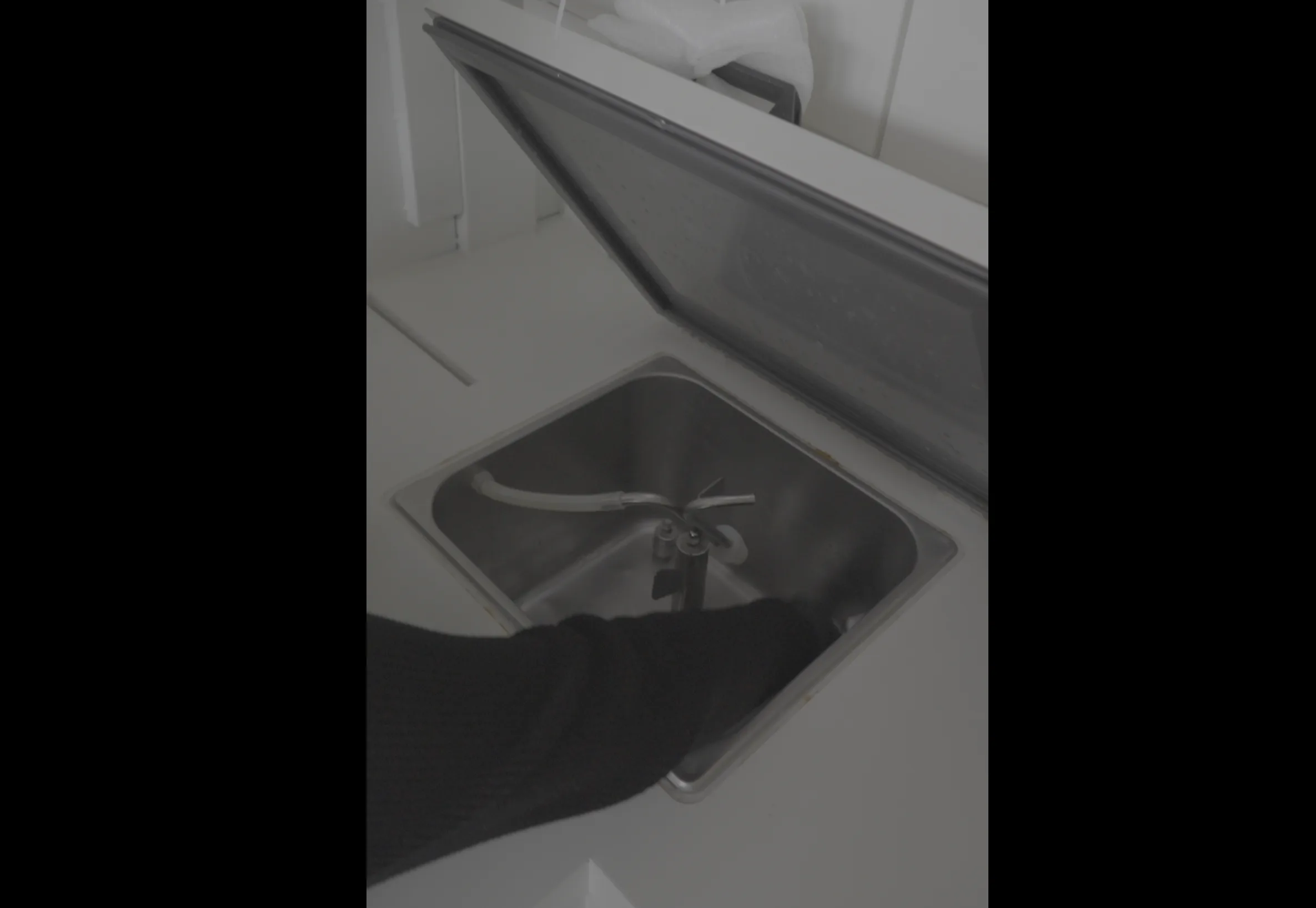
The difference is how much has to come apart each time. A pump fed machine has an extra pump assembly that is removed at cleaning time, washed part by part and reassembled exactly as before. A gravity fed machine has fewer parts and is easier to clean and maintain [1].
In May 2026, an operator in Switzerland got in touch with us. Since 2024 he had been running a soft serve machine at a mall entrance, a covered spot open to the public, selling 50 to 100 cups a day. He was not happy with his machine, and the first thing he told us was that cleaning mattered most in choosing a new supplier.
His old machine was pump fed. By his account, each cleaning meant washing about 20 parts, and it took trained staff to do it. Later he sent us a photo of the pump: 25 parts, every one to be washed and then put back together exactly as before. "It's a lot of work," he wrote. His first technical question was how our machine handles the pump at cleaning time. On our current machines, there is no pump in the mix feed.
He ordered one machine with the pasteurization option. Half his payments came in cash and half by card, so he kept both. He planned to switch to paper cups with wooden spoons, printed with his own logo, so we asked his cup supplier for samples and tested them on the machine. They passed in early July.
Pump fed machines are improving too, and some makers have simplified their designs so the pump assembly is easier to take apart and clean [1]. Where staff are on site every day, stripping it by the book can be part of the routine.
A vending machine is different. Nobody is on site, and the operator does the cleaning on scheduled visits. On a Huaxin B Series machine with the pasteurization option, cleaning comes every 5 days. You defrost, drain the soft serve left in the freezing cylinder, add water and run the cleaning program four times (cold water, warm water at about 55°C, sanitizer solution, then cold water again), and refill with mix to go back on sale. The cleaning program runs the wash; adding and draining the water is done by hand. The dispensing nozzle and mixing shaft come out at the intervals set in the user manual for brushing and a seal check. There is no pump assembly in the mix feed to take apart.
Two daily habits matter: keep debris out of the hopper so it cannot block the feed tube, and do not leave mix sitting in the hopper too long.
Which Feed System Fits Which Operation
Two questions settle the gravity vs pump soft serve machine choice: who is at the machine while it sells, and how sales are spread across the day.
On a traditional counter machine where staff pull each serving, pump feed pays off when:
Staff can strip and clean the pump assembly by the book every day, as at a dessert shop or fast-food counter.
Demand comes in rushes and staff pull many servings back to back. A pump fed machine serves more in the same time [1].
The brand standard is a lighter, fluffier product, or you want to set the overrun yourself.
A chain needs every store to serve the same product every day. Pump feed holds overrun more consistently from day to day [1].
For an unattended vending machine, gravity feed fits better when:
The operator visits on a schedule to clean and refill, and every visit is easier with fewer parts to take apart.
Each cup is made after the customer orders, one customer at a time, with sales spread across the day.
You want to give customers a denser, more substantial cup.
The budget is tight and you want a machine that is simple and easy to maintain [1].
A vending machine and a staffed counter machine are two different ways to run the business. To see which suits your location, read ice cream vending machine vs traditional soft serve machine.
On peak demand: our B Series makes one serving in about 15–20 seconds, with a nominal capacity of 120 cups per hour under standard conditions. If a site's peak is more than one machine can make, we recommend a machine count based on peak-hour demand.
Why Huaxin Machines Use Gravity Feed
All our current models use gravity-fed side feeding: the B83 Max, B84, B85, B86 and B86 Max floor-standing vending machines and the Easy7 and Power7 countertop machines. There is no pump fed version. You can see every model in our full range of ice cream vending machines. On the B Series, mix is held in a refrigerated hopper, about 20 liters on the B83 Max to B86 Max, and flows by its own weight from the side into the 2-liter freezing cylinder.
Our earlier models came in both pump fed and gravity fed versions. Our current models are gravity fed only.
In day-to-day use, this means:
Overrun results from the feed design, the freezing settings and the mix. It is not a number you enter on the parameter screen. What you set is the hardness and the dispense time, and the dispense time decides the size of each cup.
Cleaning uses the One-Touch Cleaning Program, and the mix feed has no pump assembly to take apart. The B Series offers a pasteurization option (not available on Easy7 or Power7), and pasteurization does not replace cleaning.
When you switch to a new mix or recipe, we test it on the machine first and then recommend settings.
For how the machine handles each step from order to pickup, see how an ice cream vending machine works from ordering to pickup.
If you have used pump fed machines and are used to a lighter product, run your own mix on our machine before you order, and taste the result.
Questions to Ask a Supplier About the Feed System
Before you order, ask your supplier:
Is this machine gravity fed or pump fed? The feed system decides the texture you get and how much comes apart at every cleaning, so weigh it alongside the price.
What overrun will my mix give, and can you test it on the machine first? Once you have a sample cup, you can weigh a cup to check overrun and compare the result with what the supplier told you.
Can overrun be adjusted, and how? Some pump fed machines let you adjust it directly [1]. On a gravity fed machine it depends mainly on the mix and the machine settings. If overrun goes up, check the texture and the melt on the machine.
Which parts come apart at each cleaning, how often, and who on site has to do it? With a pump fed vending machine, ask specifically whether the pump assembly comes out at every cleaning and who will take it apart and put it back. Ask for a complete cleaning video of the same model, from defrosting and draining to reassembly and refilling.
What does the cleaning program do automatically, and what is manual? Does the pasteurization option change the cleaning interval? Compare the answers with your local health department's rules and follow whichever is stricter.
What are the wear parts in the feed system and freezing cylinder, and how are spare parts supplied? For how we handle this, see our guide to ice cream vending machine after-sales support, warranty and spare parts.
To find out how your mix turns out on a gravity fed machine, send us the details below. We will arrange a machine test and recommend a model.
Your mix type: liquid or powder, dairy or plant-based, with the product sheet or ingredient list
The feed system of the machine you use now, and the texture you are used to
Your target country, location type and planned cups per day (an estimate is fine)
Who will do the cleaning: you, an employee or the venue's staff
References / Sources
[1] Panitz, B. "How Sweet It Is: The Scoop on Soft Serve Machines." Foodservice Equipment Reports, 3 June 2022. https://www.fermag.com/articles/how-sweet-it-is-sizing-up-soft-serve-machines/
[2] Virtual Labs, IIT Kanpur, Dairy Technology Lab. "Determination of Overrun in Icecream – Theory."
https://dt-iitk.vlabs.ac.in/exp/overrun-icecream/theory.html

PREVIOUS ARTICLE
How Much Work Does an Ice Cream Vending Machine Take? Daily, Weekly and Monthly Tasks
NEXT ARTICLE