How to Choose an Ice Cream Vending Machine Supplier for Overseas Projects
Learn how to evaluate an ice cream vending machine supplier by factory capability, certifications, after-sales support, payment integration, export delivery, contracts, spare parts, and long-term project support.
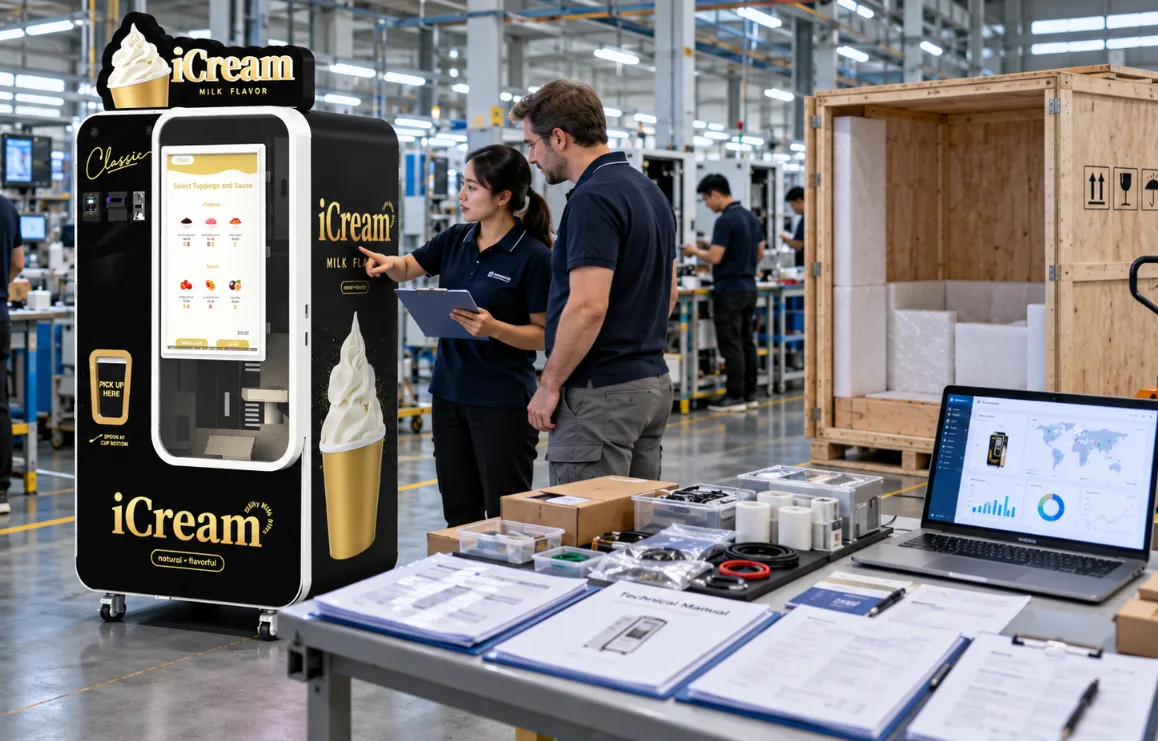
If you are researching how to choose an ice cream vending machine supplier for an overseas project, the difficult part is rarely finding a factory that can send a quotation. The difficult part is deciding which supplier can still support the project after the deposit is paid, the machine is shipped, and the first technical problem appears thousands of kilometers away.
International procurement adds layers that a domestic purchase may not have: market-specific electrical requirements, food-equipment compliance, payment integration, export packaging, customs documentation, remote troubleshooting, spare-parts logistics, language, time zones, and the practical question of who will put hands on the machine when remote support is not enough.
That changes the supplier-selection process. A buyer needs evidence that the manufacturer can build the right configuration, document it, ship it safely, and support it in the destination market. This guide provides a framework for doing that without turning supplier selection into a simple price comparison.
Begin With a Defined Project, Not a Supplier Catalog
A supplier can only be evaluated against a real operating requirement. Before comparing factories, define the destination country and city or port, location type, quantity, dessert category, payment method, electrical supply, target daily volume, indoor or outdoor placement, branding needs and planned launch date.
The gaps usually appear when the discussion becomes specific. Can the machine match local voltage and frequency? Which payment terminal has been evaluated? Which certification documents apply to the exact model? What happens if a sensor fails after installation, and how is the replacement part identified?
Compare every supplier against the same project brief. One quotation may include payment preparation, remote management, export packaging and spare parts while another covers only the machine. Similar prices can therefore represent very different commercial boundaries.
Evaluation area | Evidence worth requesting | What deserves closer review |
Manufacturing capability | Factory video/visit, QC steps, test records, batch capability | Generic factory photos unrelated to the quoted model |
Certification and market readiness | Model-specific scope, declarations/listings, electrical configuration | Logos that do not identify the relevant product/configuration |
International project support | Payment process, multilingual documentation, packaging method | “Global support” with no operating detail |
After-sales and spare parts | Diagnostic workflow, parts list, training, warranty boundaries | Support promises without a service process |
Software and remote management | Live demonstration, available data, alerts, connectivity | “IoT enabled” without showing operator functions |
Contract and delivery | Exact configuration, Incoterm, named place, lead-time basis | Undefined inclusions, exclusions or responsibilities |
Verify Factory Capability as a System
Automated frozen-dessert equipment combines refrigeration, food-contact systems, mechanical motion, electrical controls, software, payment peripherals and customer-facing hardware. Supplier evaluation therefore needs to go beyond the final assembly line.
Look at what the factory actually controls: machining or fabrication of critical parts, sheet-metal work, refrigeration assembly, electrical integration, software/controller access, incoming inspection, pressure or leak testing, high-temperature operation testing and final functional checks. The manufacturer does not need to make every component in-house, but it needs enough technical control to diagnose faults, maintain consistency and supply replacements.
For a larger order, a factory visit is useful. For a pilot, a live video walkthrough can still reveal the production line, refrigeration area, QC stations, finished units and parts warehouse. Ask an engineer to explain one real maintenance procedure on the quoted machine rather than staying with a company presentation.
Huaxin’s manufacturing profile describes a 15,000 m² production base in Dezhou with machining, sheet-metal, powder-coating, refrigeration, electrical and final-assembly capabilities, plus incoming inspection and final testing. Its current public site lists annual production capacity at 6,000+ units. For a buyer, the practical question behind those figures is whether the supplier can keep batches consistent, provide parts and meet the planned schedule.
Factory ownership alone is a weak shortcut. Direct access to the people who understand refrigeration, software, electrical systems and payment integration is more useful when an unusual problem appears.
Treat Certification as Model-Specific Evidence
Certification discussions need to reach the exact model and configuration being purchased.
For the European Economic Area, the European Commission states that manufacturers are responsible for identifying applicable legislation and standards, carrying out conformity assessment, preparing technical documentation, issuing the EU Declaration of Conformity and affixing CE marking where required. CE is not a blanket approval issued by a central EU authority. Importers also have duties to verify that the necessary steps and documentation are in place. [1]
For the United States and Canada, buyers may encounter ETL or another mark from an OSHA-recognized Nationally Recognized Testing Laboratory (NRTL). OSHA describes the NRTL program as independent testing and certification within a laboratory’s recognized scope. Intertek states that its ETL Listed Mark shows compliance with applicable North American safety standards, and listings can be checked by manufacturer, model or standard. [2]
Food sanitation can be a separate issue. NSF lists NSF/ANSI 25 for vending machines for food and beverages, covering sanitation requirements for materials, design, construction and performance. The applicable standard or local approval depends on the machine, installation and authority having jurisdiction. [3]
Request the document set tied to the quoted machine: certificate or listing, model/configuration, Declaration of Conformity where relevant, electrical rating, test references, food-contact documentation, manual and labeling. A certification logo without a clear link to the product being imported is not enough for procurement.
Overseas After-Sales Support Is a Supply-Chain Question
An overseas support promise is useful only when it explains how a failure moves from “machine stopped” to “machine operating again.”
Start with diagnosis. Ask what the supplier needs when a fault occurs: error code, photos, video, remote data, voltage readings or a short inspection procedure. Then ask who reviews that information and how the likely component is identified. This quickly shows whether service is a technical workflow or merely a messaging account.
Parts come next. Many modular items can be replaced locally when the manufacturer provides accurate part numbers, diagrams and instructions. Refrigeration work or complex electrical repair may require a qualified local technician. The overseas supplier still needs to make that local work possible.
For a multi-machine project, a small stock of selected spare parts may reduce avoidable downtime. Ask the manufacturer to recommend a model-specific starter list and explain the purpose of each item rather than accepting a generic parts box.
Huaxin’s current service framework includes remote diagnosis, spare-parts support and video/document guidance. Network-enabled B Series configurations can also provide remote operating-status data and selected alerts. Local on-site service depends on the market and project arrangement. Remote tools can shorten troubleshooting, but routine cleaning, refilling, inspection and hands-on repair still require people.
Support question | Evidence to ask for | Why it matters overseas |
How is a fault diagnosed? | Fault guide, remote process, sample workflow | Speeds up first-line troubleshooting |
How are parts identified? | Part number, photo, model/serial mapping | Reduces wrong-part shipments |
What should be held locally? | Model-specific recommended parts list | Helps shorten downtime |
What training is provided? | Operation, cleaning and maintenance material | Supports consistent local work |
What can the remote system do? | Live dashboard and feature list | Confirms the actual monitoring scope |
Is on-site service available? | Named partner/region or project arrangement | Avoids assumptions about local coverage |
Test the Supplier’s International Project Support Before Ordering
Export experience is useful, but market readiness is better tested through the supplier’s ability to adapt and coordinate the project.
Payment is a good example. MDB-compatible integration does not make every card reader, QR system or mobile wallet automatically compatible. The supplier needs the target country, provider or terminal model, interface and software requirements before confirming the solution. For card-based projects, involve the local payment provider early enough to resolve hardware, certification, merchant onboarding and network requirements.
Request a real remote-management demonstration as well. Check which data is visible, what alerts exist, which settings can be changed, what connection is required and whether platform or connectivity charges apply. Multi-site operators should also ask how machines, users and permissions are organized.
Training and documentation are part of project support: operation, cleaning, basic maintenance, packing documents and a clear handover process. Interface language and exterior branding should be frozen before production.
Huaxin’s B Series supports project-based market configuration such as voltage/frequency options, interface language, payment integration and exterior branding. Its public materials also show deployment across 50+ countries. That experience is useful context, but the exact market and configuration still need confirmation before purchase.
Put the Configuration and Delivery Boundary Into the Contract
A useful quotation should convert cleanly into the purchase agreement. Record the exact model/configuration, quantity, voltage and frequency, payment responsibility, software functions, language, branding, accessories, spare parts, compliance documents, packaging, warranty and any recurring software or connectivity fees.
Lead time needs a defined starting point. Production may begin after deposit, artwork approval, payment-terminal confirmation or a full configuration freeze. A simple milestone schedule covering configuration, production, testing, packing and shipment readiness prevents different interpretations later.
Incoterms® 2020 help define delivery obligations, costs and risk. ICC stresses that the selected rule needs a named place or port and that Incoterms do not replace the sales contract. [4] “FOB” without a named port or “DDP” without a precise destination leaves an important boundary unclear.
Include export packaging too. Ask how the machine is fixed inside the crate and protected from moisture and vibration. Photos before packing, during crating and after sealing create a useful condition record for higher-value shipments.
Compare Long-Term Operating Value on the Same Boundary
For buyers deciding how to choose an ice cream vending machine supplier, price is still part of the decision. It simply needs to be compared on equal terms.
A lower quotation can be the better choice when the machine configuration, certification scope, software, payment preparation, packaging, warranty, training and spare-parts support are genuinely equivalent. The problem comes when buyers compare a purchase-ready package with a stripped base quotation and discover the missing items after production has started.
For a pilot order, focus on whether the supplier can help you get one location running and collect reliable operating feedback. For a distributor or multi-site rollout, add batch consistency, software management, parts availability, documentation control and the ability to repeat the same configuration months later. A supplier relationship becomes more valuable as the cost of inconsistency increases.
Use the following checklist as a gate. A supplier does not need to look perfect in every category, but any unresolved item that can stop import, payment, installation or service needs an owner and a written answer before the order is released.
Supplier Evaluation Checklist
· Legal company identity and payment beneficiary verified
· Factory or production capability reviewed by visit, live video or credible documentation
· Exact machine model and commercial configuration frozen
· Certification or compliance documents matched to the model/configuration and destination market
· Voltage, frequency and installation requirements confirmed
· Local payment provider or terminal compatibility evaluated
· Remote-management functions demonstrated, including connectivity requirements
· Warranty scope, exclusions and parts-shipping responsibility documented
· Recommended spare-parts plan reviewed for the planned quantity
· Operation, cleaning and maintenance training materials available
· Export packaging method and shipping dimensions confirmed
· Incoterm, named place/port and logistics responsibilities written into the quotation/contract
· Production lead-time basis and project milestones agreed
· Software, platform or recurring connectivity charges disclosed
A checklist prevents obvious omissions, but it should not become a scoring exercise that hides serious risks. One missing compliance document can matter more than several minor strengths. A payment integration that is still untested can delay launch even when the factory itself is excellent. Resolve the project-stopping items first, then compare commercial value.
Give the Supplier Enough Information to Produce a Useful Quote
Many weak quotations begin with a weak request: “Please send your best price.” That question encourages the supplier to quote a standard machine before the project conditions are known.
A better RFQ gives the manufacturer enough context to select a model, flag market-specific work and state what is included. Keep it concise; the goal is not to write a business plan for the supplier.
Supplier Evaluation / Quote Request Template
Country / City or Destination Port:
Location Type: mall / campus / tourist site / entertainment venue / retail / other
Planned Quantity:
Product Type: soft serve / frozen yogurt / sorbet / other compatible frozen dessert
Indoor or Outdoor Placement:
Power Supply: voltage / frequency if known
Payment Requirement: card / NFC / QR / cash / local provider or terminal
Target Daily Cups:
Language / Branding Requirement:
Certification or Documentation Requirement:
Remote Management Requirement:
Expected Start Date:
Buyer Type: operator / distributor / project investor / venue procurement
Preferred Incoterm or Delivery Boundary (if known):
Destination for Freight Quote (if required):
When these fields are provided, the supplier can respond with a project-specific configuration instead of a generic catalog price. The quotation becomes easier to compare, and technical issues are more likely to surface before money and production time are committed.
FAQ: Choosing an Overseas Ice Cream Vending Machine Supplier
How can I tell whether an ice cream vending machine supplier is reliable?
Look for consistency between claims and evidence. A reliable supplier can connect the quoted model to production capability, compliance documents, payment options, software functions, export packaging, warranty terms and a workable after-sales process. Factory photos and fast replies are useful, but they are weaker evidence than a clear technical answer supported by documents or a live demonstration.
What matters most in after-sales support for an overseas project?
Remote diagnosis, accurate spare-part identification, practical training material and a clear escalation path matter most. Ask how the supplier handles a fault from first report through diagnosis, parts dispatch and local repair. If on-site service is important, confirm the specific country or partner rather than assuming “global support” means a local technician is available everywhere.
Are certifications and export cases important when evaluating a supplier?
Yes, but relevance matters more than the number of logos or countries on a brochure. Verify that certification evidence applies to the exact model and configuration you are buying. Export history shows that a supplier has handled international logistics, yet each new market still needs its own check for electrical requirements, payment, documentation and local compliance.
Which contract terms deserve the most attention?
Freeze the product configuration, inclusions and exclusions, certification documents, payment responsibilities, software functions, spare parts, warranty, lead-time basis, acceptance/testing method, packaging, Incoterm and named delivery point. Also record how changes are approved after the order is placed. Most disputes begin where the quotation leaves a boundary undefined.
Is long-term cooperation more important than getting the lowest price?
For a one-machine pilot, price can carry more weight because the exposure is smaller. As the project grows, repeatability and support become increasingly important. A distributor or multi-site operator depends on consistent batches, stable parts, software continuity, documentation and a supplier that can troubleshoot across time zones. Compare price after those operating requirements are visible.
Final Decision: Choose the Supplier You Can Operate With
The practical answer to how to choose an ice cream vending machine supplier is to evaluate the supplier across the life of the project: manufacturing, compliance, market configuration, shipment, commissioning and service. Price belongs in that decision, but it becomes meaningful only after the commercial boundaries are comparable.
If you are still choosing the equipment itself, use the Ice Cream Vending Machine Buying Guide for Commercial Operators and Dealers. For landed-cost planning, review Ice Cream Vending Machine Shipping Cost and Total Import Expenses and Ice Cream Vending Machine Cost Breakdown for Commercial Buyers. For an earlier-stage project, How to Start an Ice Cream Vending Machine Business covers the path from location research to pilot deployment.
For a configuration-based recommendation from Huaxin, provide your country, location type, planned quantity, product type, payment requirement, target daily cups and expected start time. That information allows the supplier to discuss the appropriate configuration, payment path, documentation, support plan and shipping boundary before the quotation is finalized.
References / Sources
1. European Commission — CE marking; Manufacturers; Importers and distributors.
2. U.S. Occupational Safety and Health Administration (OSHA) — Nationally Recognized Testing Laboratory (NRTL) Program; Intertek — ETL Listed Mark and certification directory.
3. NSF — Food Equipment Standards, including NSF/ANSI 25: Vending Machines for Food and Beverages.
4. International Chamber of Commerce (ICC) — Incoterms® 2020 rules and guidance.

NEXT ARTICLE