Ice Cream Vending Machines for Family Entertainment Centers and Indoor Playgrounds
Planning an ice cream vending machine for a family entertainment center? Choose the front door, payment route and venue terms, then check the launch list.
An ice cream vending machine for a family entertainment center sells to a different crowd from one in a mall corridor. The person paying is usually a parent, the person choosing is often a child, and many visitors are local families who come back for another play session, another bowling night or another birthday party. Sales bunch up around weekends, school holidays and party time slots, and in many venues parents are already spending from a play card rather than with coins.
This guide is for vending operators who place machines in indoor playgrounds, family entertainment centers (FECs), bowling alleys, mini golf, trampoline parks, children's museums and party venues, and for the venue owners who host them. Huaxin manufactures the machines discussed here, so model details refer to Huaxin configurations. Outdoor attractions, with their weather and seasonal visitors, are a different decision and are not covered.
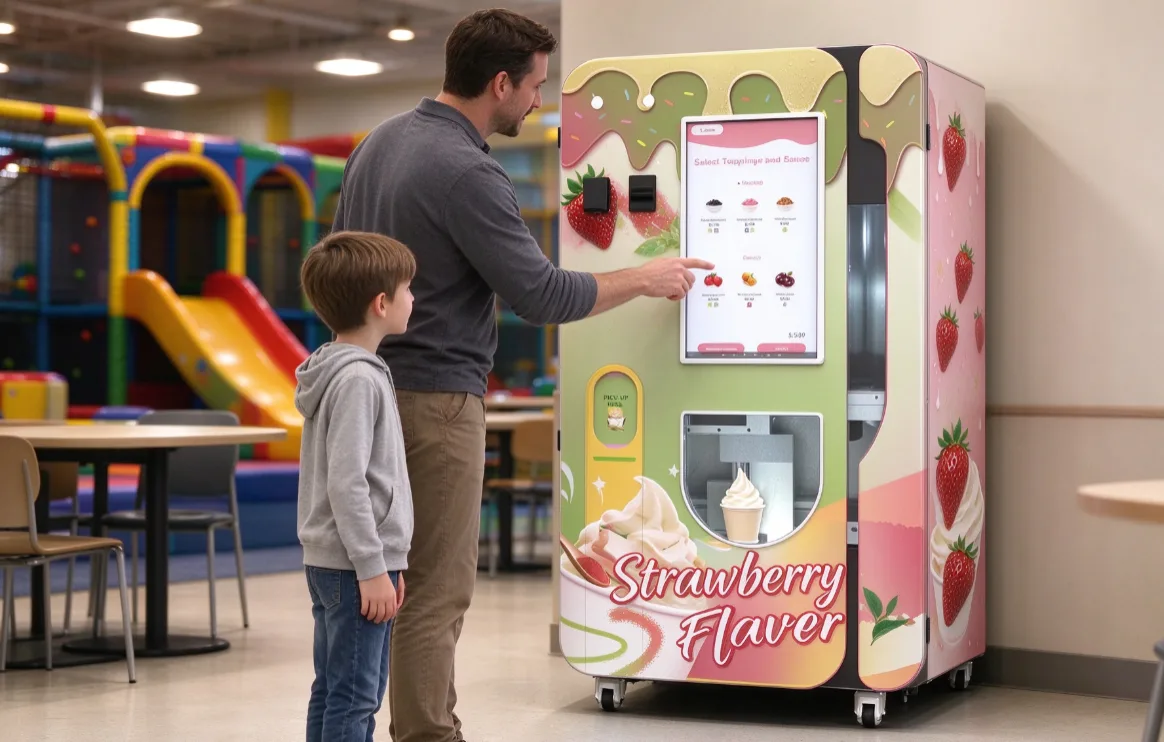
1 What changes at an entertainment venue
Families stay, and they come back
People arrive for a play session, a game or a party rather than passing through, so an indoor playground ice cream vending machine is seen on the way in, during a break and again on the way out. Children usually spot it first, and parents decide. Because many visitors are local, a menu that never changes gets ignored sooner than it would at a transit site. Rotating toppings and sauces is the practical lever. B Series machines run one base mix at a time and build variety from compatible toppings and sauces, so a seasonal topping or a party-only combination can be added with a menu change.
Peaks follow the calendar
A weekday morning may bring only a toddler session, while a Saturday afternoon or a school holiday can fill every party room at once. A party group also tends to want ice cream at the same moment, after the cake or just before going home. As an illustration, fifteen children ordering one after another need roughly four to five minutes of making time at the rated 15–20 seconds per serving for B83 Max, B84, B85, B86 and B86 Max under standard conditions, before ordering and payment time is added. A party host who knows that can stagger the group. If the machine is the only dessert for three parties ending at the same time, the queue becomes the complaint.
Not every family venue peaks in the holidays. Venues built around lessons can run the other way: an Australian buyer whose café serves a children's swim school told us trade was quieter during the school holidays, and chose regular ice cream over açaí for its first machine because its customers are children. Ask the venue for its own bookings or door counts by month and by hour before you plan stock and service visits.
On the busiest days, stored supplies matter as much as speed. A full B83 Max, B84, B85, B86 or B86 Max holds approx. 20 L of mix and approx. 160 cups; B83 holds 10 L and approx. 80 cups, which suits smaller venues where someone can refill more often. Base refill visits on the venue's party calendar, and use the sales data and status alerts from network-enabled machines to time them, as described in our guide to remote monitoring for ice cream vending machines.
Bowling alleys, mini golf and arcades
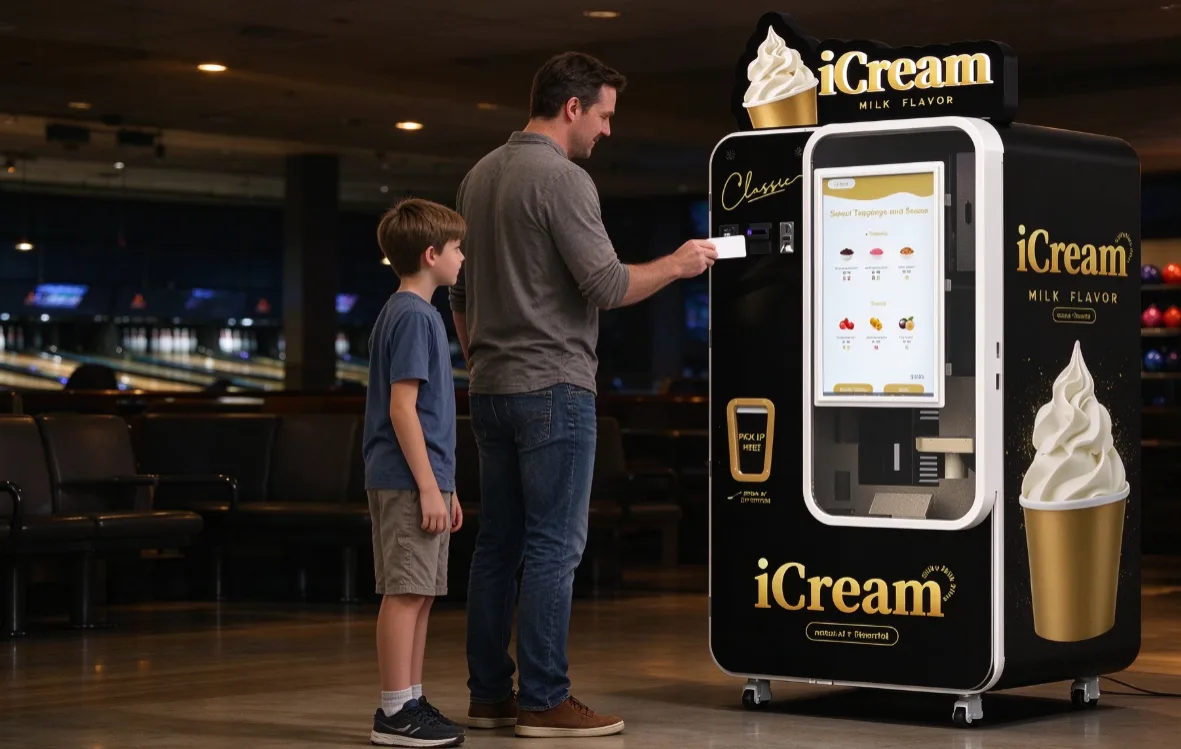
A bowling alley ice cream vending machine usually serves a wider age range than one in a toddler soft-play center, from children at weekend parties to teenagers and adult groups in the evening. Later opening hours also move the quiet window for refilling and cleaning. Mini golf and arcades sit in between: the planning questions stay the same, while the peak hours and the tone of the menu change.
The venue controls the floor
Inside an entertainment center you are the guest of a business that already sells food and drink, sets the hours and decides where everything goes. Put the machine where parents sit or pass, such as café seating, the exit route or the party-room corridor, and keep it out of the running lines from play zones and clear of emergency routes. It needs a suitable power supply at the spot and, for remote monitoring, a network connection. Expect the venue to ask whether the machine competes with its own café. Section 4 covers terms that make it a shared source of income instead.
2 Setting up the machine for children and the parents who pay
Choose a front door with a viewing window
What holds a child's attention is watching their own cup being made. On B83 Max, B84 and B86 Max, the production area sits behind glass on the front of the machine, so a child can watch the cup arrive, the soft serve fill it and the toppings go on. B86 Max has the largest glazed front of the three. The window is for watching only; the finished cup comes out of a separate pickup opening, as our walk-through of how an ice cream vending machine works from ordering to pickup shows.
The B Series models share the same internal configuration and differ mainly in their front doors and exterior design, so in a family venue the door is the main choice to make. A wrap can change colors and graphics but cannot add a window where the door has none. Compare the front views on the B84 and B86 and B86 Max pages before you decide.
When the spot is a counter, not the floor
Some venues would rather place the machine on their café counter or at a party-host station, where staff are nearby all day. Power7, a countertop model, takes orders and payment at the machine, lets customers watch through a window, and delivers the cup to an enclosed cup port. It holds approx. 32 cups and 6 L of mix, so someone has to reload it during busy days. Our comparison of countertop and floor-standing ice cream machines explains when each format fits.

The ordering screen
B Series machines take orders on a 32-inch touchscreen. On a machine about 1.95 m tall the screen is placed for someone standing in front of it, which in a family venue usually means the parent who pays. Children will tap it anyway. A serving is made only after payment is completed, so taps alone do not produce a cup, but a crowded first screen slows the queue. Keep the menu short with prices visible, and set the interface languages your visitors use. Languages are configured for each project and software version; a buyer in Kuwait, for example, specified Arabic and English screens.
In the United States, the 2010 ADA Standards require at least one of each type of vending machine provided at a site to have its operable parts within the specified reach ranges; for an unobstructed forward reach, that means 15 to 48 inches (380 to 1,220 mm) above the floor[1][2]. Ask for the heights above the floor of the touchscreen, the payment terminal and the pickup opening for the exact door design you are ordering, and review them with the venue's accessibility adviser before the machine is placed.
Allergen and ingredient information
Parents of young children read ingredient lists, and a vending machine has no member of staff beside it to answer questions. Rules differ by market. Under EU food information law, allergen information must also be provided for food that is not prepacked, and member states may set national rules on how it is made available[3]. In the United Kingdom, food businesses must inform consumers if they have used any of the 14 regulated allergens, and the Food Standards Agency's best practice is to make that information easily available in writing[4]. In the United States, operators with 20 or more vending machines should also check FDA's vending machine calorie labeling rule, whose definition of a vending machine includes one that dispenses food prepared by the machine[5]. Ask a local food-safety adviser how your market's rules apply to servings from a machine.
Operators normally buy base mix and toppings locally, so the allergen details come from those suppliers' specifications and change when a supplier changes. A fixed ingredient and allergen panel on the wrap next to the screen works on any configuration; ask whether your software version can also show ingredient text on the menu screens. Toppings carry most of the risk: nut pieces, biscuit crumbs and some sauces bring allergens the base may not contain, and they are dispensed inside the same machine, so the panel should say so. If the venue has a nut-free policy, the topping list follows it, and the list should be agreed before the wrap is printed.
Graphics for a young audience
A brightly wrapped machine pulls children across a room, and exterior graphics, logos and colors can be customized on every Huaxin model. Two checks come before the design. Cartoon characters you do not own need the rights holder's permission. And some countries restrict how sweet foods are marketed to children. In Chile, foods that must carry "high in" warning labels may not be advertised to children under 14 or sold using hooks aimed at children, such as gifts or games[6]. A Chilean buyer ruled out cups printed with cartoon characters for that reason, because his products would carry those labels. Check your market's rules before characters go on the wrap, the cups or the screen.
3 Payment: the venue's card, bank cards, or both
Cashless payment for entertainment centers often starts with the venue itself. Many FECs sell play credit on their own card, wristband or app, and parents carry that credit around the building. A vending machine on the floor either joins that system or takes payment on its own. Decide which before ordering, because the answer changes the payment hardware, the timeline and the route by which money reaches you.
Taking payment at the machine
The simpler route is for the machine to take bank cards, contactless payments and, where local wallets dominate, QR codes. On B Series machines each method is integrated according to the country, the payment provider and the terminal configured for the project, and cash and coin modules are set up for a specific currency. What parents carry differs by market. Electronic payments made up 79% of retail payments in Saudi Arabia in 2024[7], and debit and credit cards accounted for two-thirds of payments by US consumers in the Federal Reserve's 2026 payment diary[8]. In the euro area, cash was still used in 52% of point-of-sale transactions in 2024, and 62% of consumers said it was important to keep the option of paying in cash[9].
A venue that has replaced coins with cards may not want cash handled in the building at all, while in parts of Europe a card-only machine may lose sales from parents who prefer cash. Our guide to ice cream vending machine payment systems covers terminals, providers and transaction testing in detail.
Joining the venue's card system
If the machine is to accept the venue's card or wristband, the venue's card-system supplier must provide a reader that can work with a vending machine, and that reader has to be connected to the machine's payment interface. Treat this as a project item rather than a line on a price list. Huaxin evaluates the integration against the reader's interface, MDB compatibility, communication method and power requirements, and depending on the reader it can involve third-party hardware, joint testing and extra lead time. Ask the card-system supplier for the exact reader model and its interface documentation, and agree with the venue who settles the money and how often.
Leave time for testing either way. One buyer in the country of Georgia, whose machine was going into a children's entertainment area in a shopping mall, had it delivered to her home first because the lease was still being finalized, and ran it there with a test payment unit while waiting for the embedded payment terminal. By late July she reported that they had got the hang of operating it and that it was working very well, although she was still considering moving it to a different location.
4 Agreeing terms with the venue
No single rent or percentage fits every venue, so the useful work is picking a structure that both sides can check.
Arrangement | How it works | Often suits | Put in writing |
|---|---|---|---|
Fixed rent | The operator pays the venue a set monthly amount and keeps the sales | Venues with steady, predictable traffic | Review dates; what happens if the venue changes its hours or closes the area |
Revenue share | The venue receives an agreed percentage of sales | New placements where neither side knows the volume yet, and machines paid through the venue's card system | Which sales report the share is based on; how refunds and payment fees are treated; settlement dates |
Minimum plus share | A lower fixed amount plus a share of sales above an agreed level | Venues that want a guaranteed floor and a stake in busy months | The sales level, and whether school-holiday months are counted separately |
A revenue share only works if both sides trust the sales figure. On network-enabled B Series machines, the operator can review sales and machine data remotely, and selected software configurations can support revenue-sharing and coupon functions; confirm these for your project before they are written into the agreement. If parents pay through the venue's card system, the venue holds the money first, so the agreement must say when and how it pays the operator.
Service access and position
Refill and clean before opening or after closing, when no children are waiting. Agree who lets your staff in at those times, where mix and cups can be stored, and how quickly the venue reports a fault. The one-touch cleaning program on B Series machines simplifies routine cleaning, but hygiene procedures and regular manual maintenance still apply, so the cleaning slot belongs in the agreement.
Fix the position before delivery. A B Series machine weighs several hundred kilograms and stands about 1.95 m tall, so check doors, lifts and corners on the way in. After each move, Huaxin's after-sales team asks for the machine to stand unplugged for 24 hours before it is switched on again. A machine wheeled into a party room for events would lose a day of selling every time, so choose one spot and leave it there.
Party packages
Birthday parties are where venue and operator can both gain. For a birthday party venue, dessert vending works best when the ice cream is part of the package: the venue includes one serving per child and settles with the operator afterwards, either through its card system or with vouchers redeemed at the machine. Voucher redemption depends on the software configuration and the payment set-up, so test the mechanism before the venue prints it on its party menu. Brief the party hosts on timing as well, since a whole party ordering at once is the biggest queue the machine will see.
5 Pre-launch checklist
Work through these points with the venue before the machine is installed.
Opening hours, party schedule and weekday and weekend peaks noted.
Position agreed: visible to parents, outside the running lines from play zones, clear of emergency routes, with power and network at the spot.
Delivery route checked, and the 24-hour standing time planned before first use.
Front door chosen for its viewing window; in the US, screen, terminal and pickup heights checked against ADA reach ranges.
Wrap and cup artwork cleared for character rights and local rules on marketing to children.
Toppings and allergen panel agreed with the venue, including any nut-free policy.
Payment route confirmed in writing: at the machine, through the venue's card system, or both.
On-site transaction test passed, including a declined payment and a refund.
Terms signed: rent or share, the settlement report, service-access hours, and storage for mix and cups.
Party vouchers or package settlement tested with the party hosts.
Refill and cleaning visits scheduled around weekends and school holidays.
6 What to send for a configuration proposal
To recommend a model, front door and payment set-up for your venue, Huaxin needs four details: the venue type (indoor playground, bowling alley, mini golf, party venue or a mixed FEC), your own estimate of daily visitors on weekdays and at weekends, the opening hours, and how you want visitors to pay, whether by bank card, through the venue's card system, or both. A photo of the intended spot helps. Send them through our inquiry form.
References / Sources
1. U.S. Department of Justice. 2010 ADA Standards for Accessible Design, sections 228.1 (Depositories, Vending Machines, Change Machines, Mail Boxes, and Fuel Dispensers), 308 (Reach Ranges) and 309 (Operable Parts).
2. U.S. Access Board. Guide to the ADA Accessibility Standards, Chapter 3: Operable Parts.
3. Regulation (EU) No 1169/2011 on the provision of food information to consumers, Articles 9(1)(c) and 44.
4. Food Standards Agency. Allergen Information for Non-Prepacked Foods: Best Practice. Published 24 February 2025.
5. Electronic Code of Federal Regulations. 21 CFR 101.8: Vending machines.
6. Chile. Ley 20.606 sobre composición nutricional de los alimentos y su publicidad (2012), Articles 5–8. Text held in the World Health Organization's NCD document repository.
7. Saudi Central Bank (SAMA). E-Payments Account for 79% of Total Retail Payments in 2024. 15 April 2025.
8. Federal Reserve Financial Services. 2026 Findings from the Diary of Consumer Payment Choice. May 2026.
9. European Central Bank. Study on the payment attitudes of consumers in the euro area (SPACE) – 2024. 19 December 2024.

PREVIOUS ARTICLE
Countertop vs Floor-Standing Ice Cream Machines: Choosing Between B Series, Easy7 and Power7
NEXT ARTICLE