Packaged vs Soft Serve Ice Cream Vending Machine: Which to Choose
Packaged vs soft serve ice cream vending machine: margin per serving, cold chain, cleaning, permits and sites, plus when a packaged freezer fits better.
The difference between a packaged ice cream vending machine and a soft serve ice cream vending machine starts with what is inside. A packaged machine holds ice cream bars, cups and pints made in a factory and kept frozen the whole time; it stores them and hands them out. A soft serve machine holds chilled liquid mix, and when a customer orders, it freezes that mix into a cup of soft serve on the spot.
That difference decides where the money comes from, how restocking works, who does the cleaning and which permits you need. Where people stop and linger, and someone can visit the machine regularly, soft serve keeps more from each sale and is not priced against the supermarket freezer. Where foot traffic is thin, visits are weeks apart or the venue only wants established brands, packaged is simpler to run.
Huaxin manufactures soft serve vending machines; we do not make packaged freezer machines. Some locations really are better suited to packaged ice cream, and when we see one, we tell the customer so. Those situations are listed in the section on which sites suit each model.
Two Ways to Sell Ice Cream From a Machine
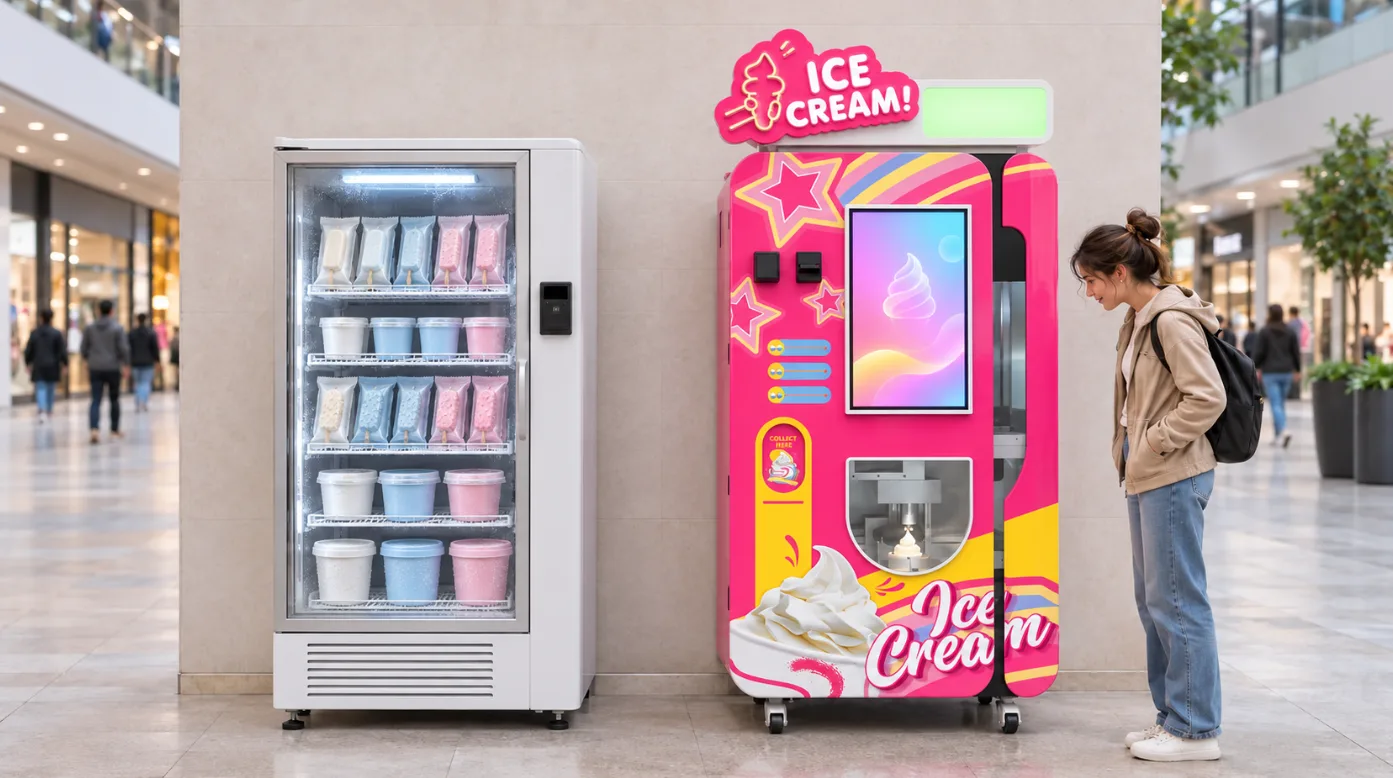
A packaged ice cream vending machine is essentially a freezer that takes payment. It sells finished frozen products, such as single bars, cups and pints, often alongside other frozen food. Depending on what it stocks, it may be called a frozen ice cream vending machine, an ice cream bar or ice cream pint vending machine, or a frozen food vending machine. Like a soft serve machine, it counts as a cold dessert vending machine.
Packaged machines dispense in one of two ways. Some move products along lanes or with a lift: the customer chooses and pays, and the machine delivers the item to a pickup door. Others are self serve ice cream freezers: a card tap unlocks the door, the customer takes what they want, and weight sensors, cameras or similar methods work out what was taken. Models with image recognition are often sold as an AI smart freezer vending machine. A refrigerated desserts vending machine with a card reader, selling cakes or puddings, works the same way, only chilled instead of frozen.
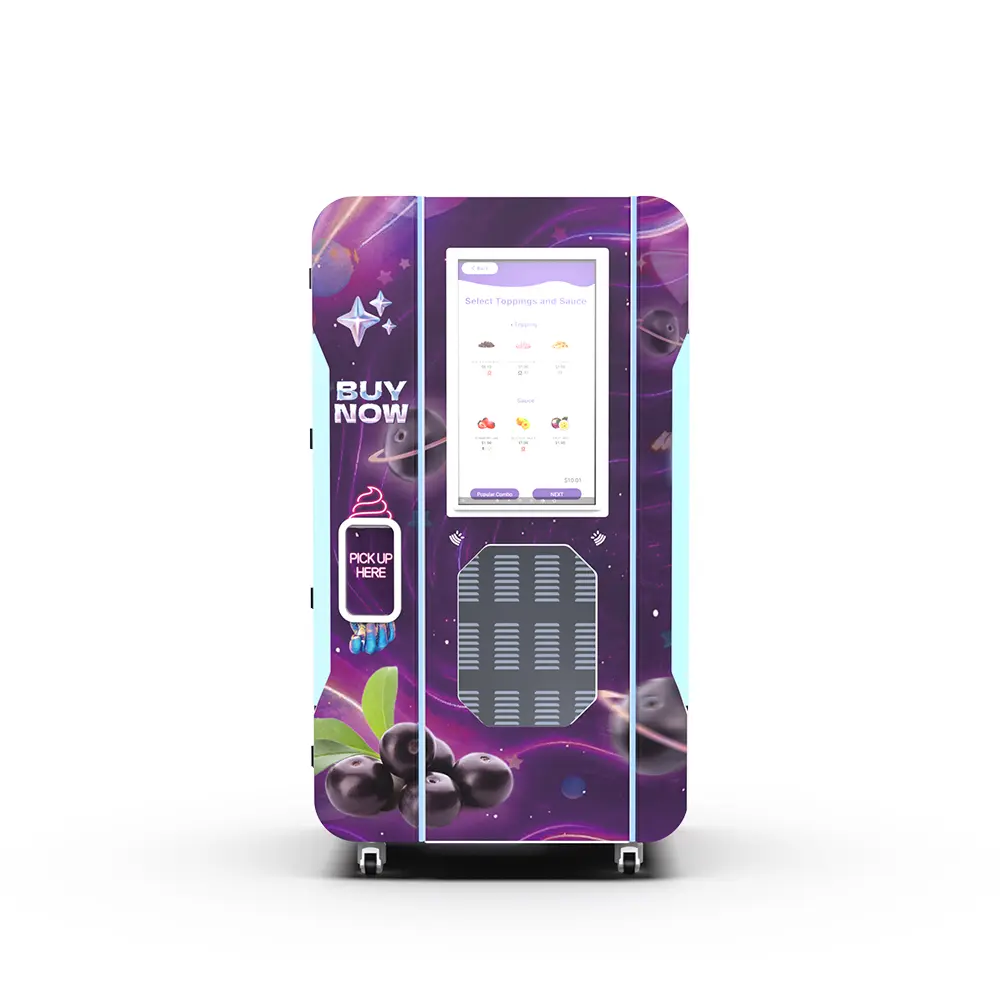
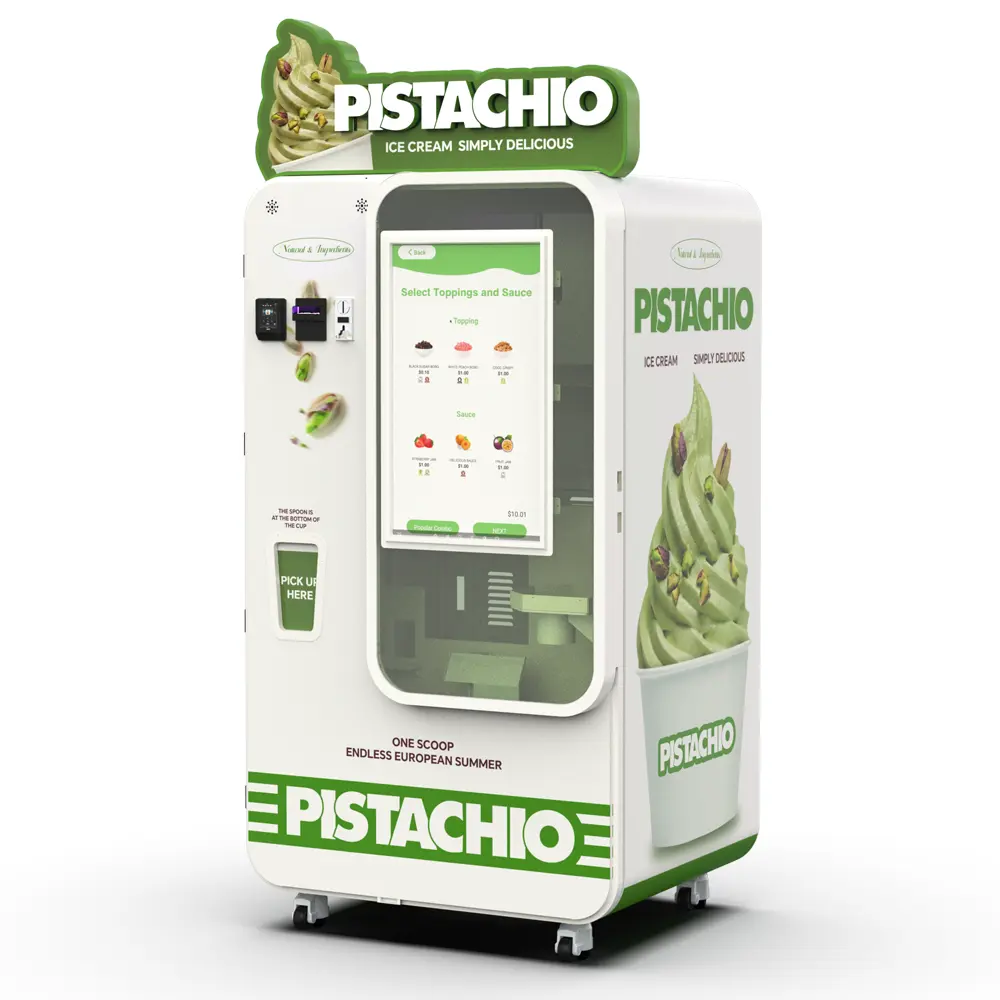
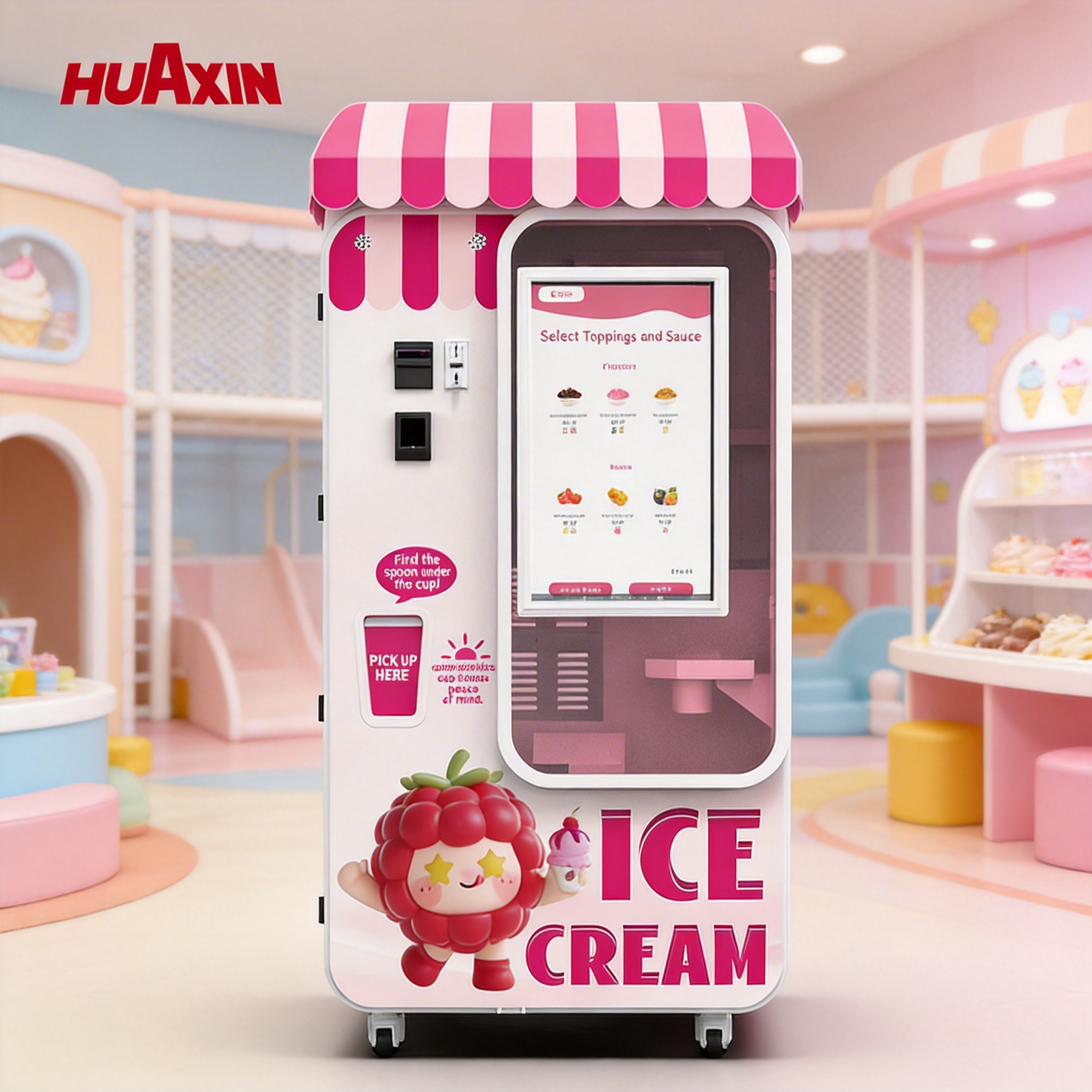
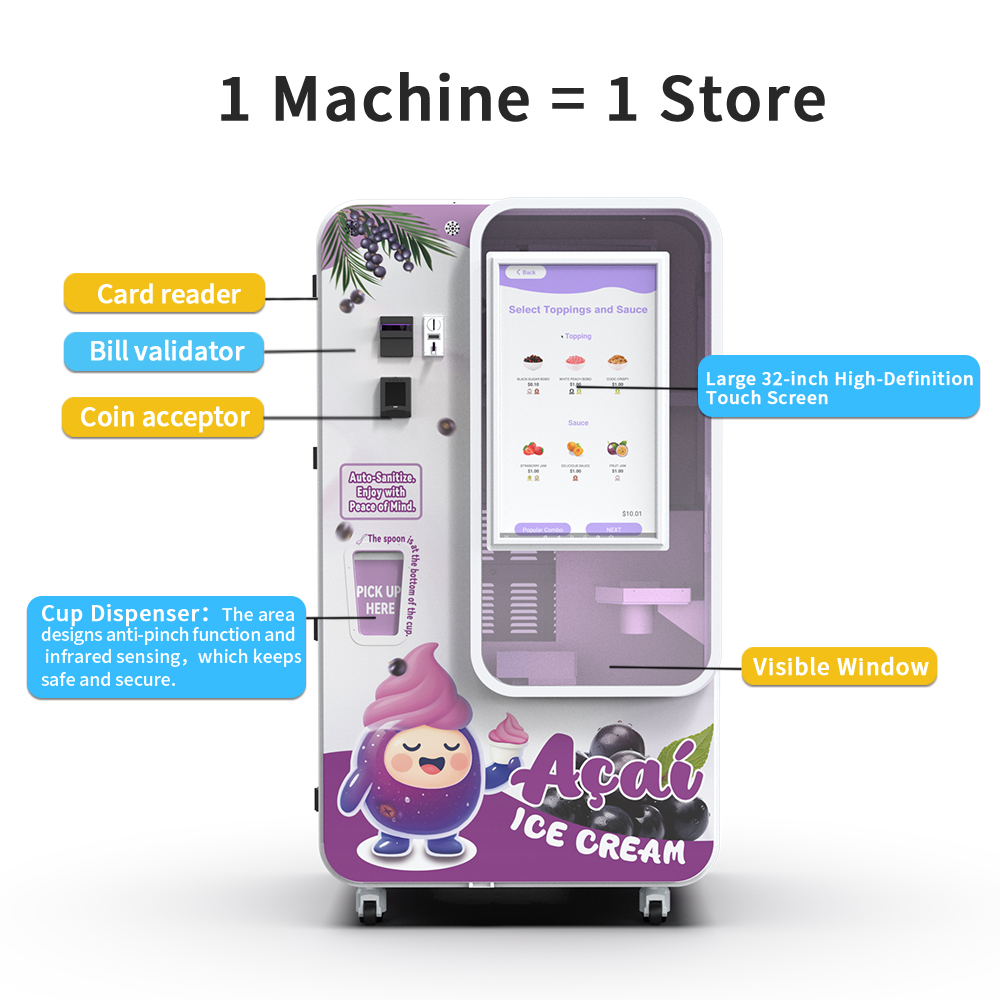
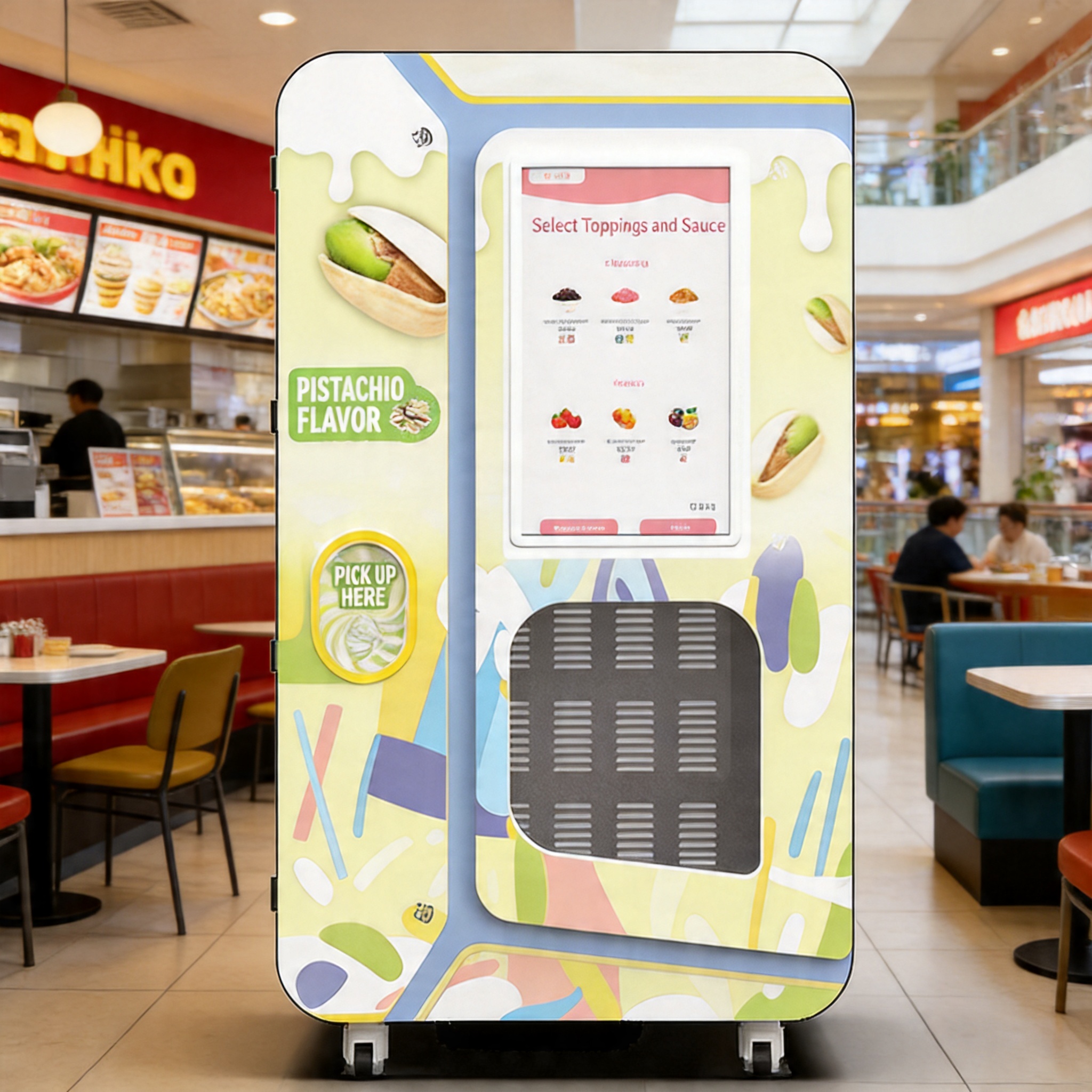
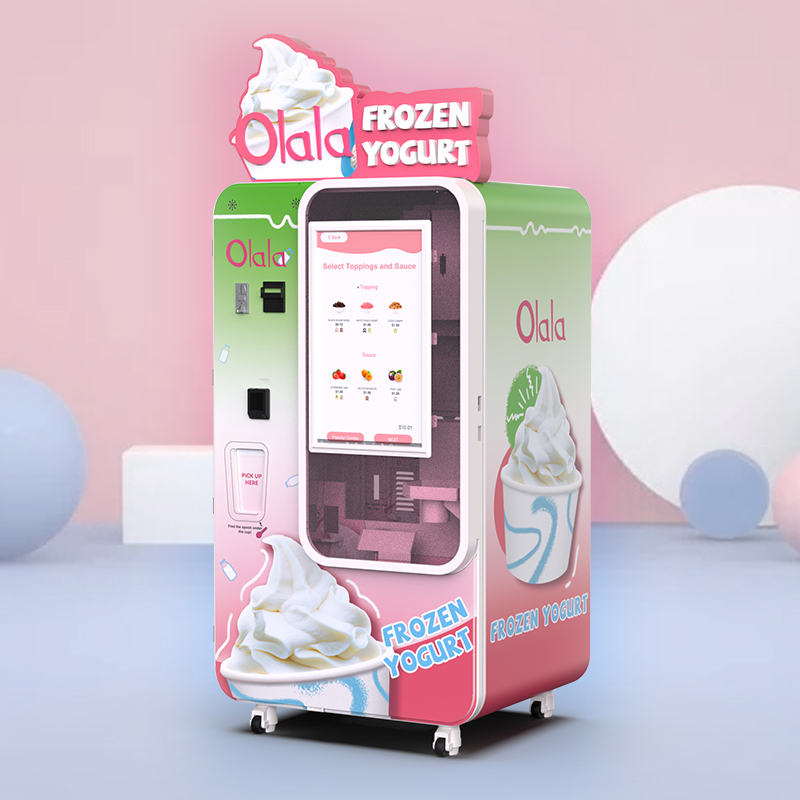
A soft serve ice cream vending machine holds no finished product. On our B Series, the mix hopper takes about 20 liters of mix and the cup storage holds about 160 cups. The customer chooses and pays on the touchscreen. The machine drops a cup, freezes the mix into soft serve in the freezing cylinder and fills the cup, adds the selected sauce and toppings, and delivers it to the pickup port. Each serving takes about 15–20 seconds, and the whole process can be watched through the viewing window. For each step in detail, see how an ice cream vending machine works from ordering to pickup.
Product and Customer Experience: Fresh Soft Serve vs Packaged Bars and Pints
Customers have seen everything in a packaged machine before, in supermarket and convenience store freezers. Familiar brands sell without explanation, one machine can carry several brands and a dozen or more flavors, and as long as the cold chain holds, quality stays consistent. The flip side is that customers also know what that bar costs at the supermarket.
Soft serve is a different product. It comes straight out of the freezing cylinder, softer than hard ice cream from a freezer and smooth in the mouth, and customers choose their own sauce and toppings. The making itself draws an audience. On the B Series, the viewing window faces the production area, and on the B86 Max a full-height window takes up about two-thirds of the front. The wrap, the screen and the cups carry the operator's own brand. The interface can show your logo, menu images and promotional videos, and there is no franchise fee or sales commission.
The limit on soft serve is the number of flavors. A B Series machine runs one base mix at a time, and the menu varies through combinations of sauces and toppings. If you need a dozen flavors and several brands at once, a packaged machine can do that and a soft serve machine cannot.
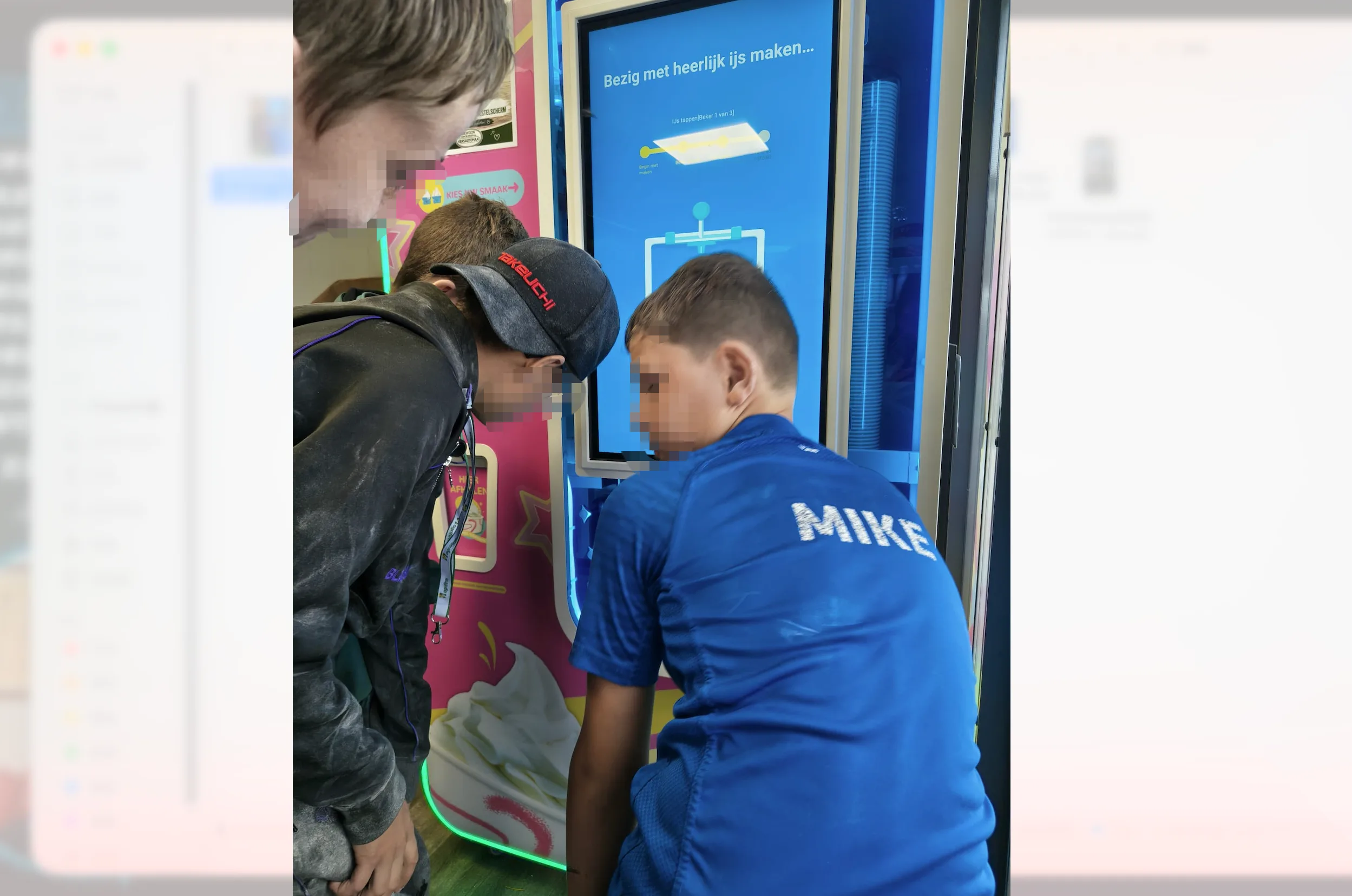
In August this year, a shop owner in the Netherlands took delivery of a B83 Max and placed it in front of his store, where he already ran several other vending machines. Ice cream was a new category for him. After the machine shipped, our sales manager had asked how many sales his other machines made each day and what foot traffic was like outside the store; the worry was whether a new category would sell at that spot. The evening the machine arrived, we reminded him to let it stand for 24 hours before switching it on and arranged for our after-sales team to take him through the pre-start checks in the support group chat. A few days later we emailed him the cleaning videos.
A week later he wrote: “People find it beautiful just to watch how the ice cream is made.” He added that they had not promoted it yet and already had good sales, though a rainy day had been slower. In early September he said the machine was running very well and they were receiving a lot of positive feedback. In mid-September the store held an open day, and he sent us photos and videos of customers gathered at the machine to watch it work and eating from their cups. A little over a week later, he told us he had a meeting lined up with a major supplier of soft serve mix.
Margin per Serving and Pricing Room
Each sale from a packaged machine leaves you the price on the machine minus what you paid for the item. You control neither end fully: the purchase price depends on your supplier and volume, and the selling price is held down by nearby supermarkets and convenience stores. Two kinds of loss belong in the calculation as well: flavors that do not sell and pass their date, and stock that partly thawed during a restock or a power cut and then refroze, which you can no longer sell with confidence.
With soft serve, you set the price, and the shop next door has nothing identical to compare it with. The variable cost per serving covers the mix (how much goes into each cup depends on cup size and overrun), the cup and spoon, sauces and toppings, payment fees, and mix lost to cleaning and expiry. Sauces and toppings can also be priced as add-ons, which raises the value of each order. For how to calculate each item and what to give a supplier when you ask for a quote, see our guide to ice cream vending machine cost per serving.
For a sense of scale, that guide uses publicly listed US prices as an illustration: about USD 0.16 of mix per serving, about USD 0.08 for a paper cup, USD 0.02–0.03 for a spoon and about USD 0.15 for a portion of topping. That comes to roughly USD 0.41–0.42 in direct materials per cup, before payment fees and losses from cleaning and expiry. The selling price minus these costs is the contribution from one cup. For packaged, work out the contribution per item from the purchase price you are quoted and the price you plan to charge, then put the two side by side.
Contribution first has to cover the site fee, labor and travel for visits, electricity and the monthly share of the equipment cost; what remains is profit. Both types of machine are priced by configuration, and a soft serve machine adds freezing, dispensing and topping systems. When you compare them, put the equipment price, the contribution per sale and the number you can sell each day together, and work out how long each would take to pay back. Ingredient prices, selling prices and site terms vary too much between markets for one margin figure to be useful, so we do not quote one; we can work through the numbers with you using your local prices.
Restocking, Cold Chain and Daily Work
A packaged machine depends on a frozen supply chain. Ice cream is held colder at the manufacturer: a study in the Journal of Dairy Science gives the industry storage standard as −28.9°C [1]. At retail, the UK Food Standards Agency advises keeping frozen food at −18°C or colder [2]. Between the cold store and the machine, stock travels in a freezer vehicle or insulated boxes, and the machine door should be open as briefly as possible while you load.
Melting is not the only risk. When the temperature rises and falls, small ice crystals melt and larger ones grow, and the texture turns coarse and icy. These temperature swings are the main cause of texture loss in ice cream. The refrigeration cycle and automatic defrost of a freezer create swings of their own, which is why low, steady storage temperatures work best [3]. Stock is also spread across many products, each rotated by its date. If you choose packaged, ask the supplier three things: how the cabinet temperature is monitored and whether it is logged; how far the temperature rises during restocking and automatic defrost; and whether there is an alarm for a power cut or over-temperature.
A soft serve machine needs no frozen deliveries. Mix comes as a liquid or as a powder made up with water, stored as the supplier specifies; cups, spoons and dry toppings keep at room temperature. You can buy mix from a local supplier, and once you have chosen a recipe, we can test it on the machine first.
A full load on the B Series is about 20 liters of mix and about 160 cups. On a networked machine with monitoring switched on, low-supply and fault alerts are sent to the back office. The routine comes down to two jobs: refilling mix, cups and toppings as sales require, and cleaning on a fixed schedule. A B Series machine with the pasteurization option is cleaned every 5 days. The One-Touch Cleaning Program runs the wash; adding and draining the water and taking certain parts apart for cleaning are done by hand. For what happens each day, week and month, see how much work an ice cream vending machine takes.
The work lands in different places. With packaged, the effort goes into frozen deliveries and stock control, and a site visit is mostly loading and checking temperatures. Soft serve adds scheduled cleaning visits on top of refilling, but there is no freezer vehicle to run and no long list of products to rotate by date.
Cleaning, Food Safety and Local Permits
The hygiene difference comes down to whether the food touches the machine. Packaged products are sealed, so looking after a packaged machine means keeping the cabinet clean, defrosting it and checking temperatures. In a soft serve machine, the mix runs from the hopper to the freezing cylinder to the outlet in contact with machine parts all the way, and those parts must be cleaned and sanitized on a schedule.
Our machines use a One-Touch Cleaning Program: the operator adds clean water, and the machine runs the rinse cycle automatically. The dispensing outlet, the drip area and other parts still need cleaning by hand, with scheduled disassembly cleaning as set out in the user manual. B Series machines can be ordered with a pasteurization option, and configurations that support it hold the mix at 2–6°C. Pasteurization does not replace cleaning. Where the local health authority sets a stricter cleaning schedule, follow the stricter one.
On permits, many places treat any vending operation as a food business. Ireland's food safety authority, for example, states that vending machine operators are food business operators and must register with their local environmental health office [4]. Where the two types of machine differ is in risk classification.
Take Victoria, Australia. Vending machines that sell unpackaged, potentially hazardous foods are class 2, with fresh orange juice given as the official example, and their operators must register with the council every year and have a food safety program and a food safety supervisor. Machines that sell low-risk foods, such as packaged chocolate, chips, or cans or bottles of soft drink, are class 4 and only need to notify the council, with no fee and no renewal [5].
Class 2 fees vary by council. For 2025–26, one council charges AUD 133 [6], while another charges AUD 862 a year for a principal registration [7]. Soft serve is an unpackaged dairy product, so by this definition it would most likely be class 2. The official pages do not say which class packaged ice cream falls into, so ask the council.
In the United States, the FDA Food Code is a model for state and local health departments to adopt. Under the code, food equipment certified or classified for sanitation by an ANSI-accredited certification program is deemed to meet its requirements for equipment materials, design and construction [8]. Our B83, B83 Max and B86 Max in the 110 V/60 Hz configuration are certified to NSF/ANSI 6, and Huaxin also holds an ETL certificate. For the certifications each market looks for, see ice cream vending machine certifications by market.
Whichever you choose, ask the health authority where the machine will stand before you order: which class it falls into, whether it has to be registered, what that costs and whether cleaning frequency is set by rule.
Space, Power and Placement Requirements
B Series floor-standing machines (B83 Max, B84, B85, B86 and B86 Max) stand about 1.95 m tall, take up about 0.91 m² of floor space and weigh more than 300 kg, so check the floor load and the delivery route, including door widths and elevators, before the machine goes in. The standard supply is 220 V, 50 Hz, with 110 V and 60 Hz available as options. Rated power is 1,700 W, and the machine is best on its own outlet. Leave about 50 cm between the machine and the wall for ventilation, and avoid direct sunlight and enclosed spaces. An outdoor location needs shelter and a separate review of temperature, rain, sunlight, dust and electrical conditions. A packaged freezer vending machine also needs power around the clock and ventilation clearance; check the specification of the cabinet you choose.
Remote monitoring and card payments both need a network connection, and depending on configuration, B Series machines connect by 4G, Wi-Fi or other methods. Payment is configured for the destination country. Card, contactless, QR code and mobile wallet payments can be set up, and bill validators and coin acceptors can be evaluated, depending on the local payment provider and terminal.
If a floor-standing machine will not fit, look at a countertop model. Power7 is a countertop self-service machine with a footprint of about 0.46 m², and card and QR payment are confirmed per configuration. Easy7 is made for a staffed bar or front counter and is not an unattended vending machine. For how to choose between them, see countertop vs floor-standing ice cream machines.
Which Sites Suit Each Model
Soft serve suits places where people stop: shopping malls, cinemas, family entertainment centers, tourist attractions, campuses and transit hubs with long waits. People there have the time, and the inclination, to pay for a dessert made in front of them. Many of these venues already have drink and snack machines, so a soft serve machine adds something the venue does not yet offer, which makes the placement easier to agree. A shop that already has vending machines outside is also worth trying; that is how the Dutch shop owner above started. The condition is that the site is not too far off your refill and cleaning route.
Packaged is the better choice when:
Foot traffic is thin, or sites are scattered and someone gets there once a week or less
Nobody can make regular cleaning visits
The venue requires specific brands, or you want many brands and flavors at once
People pass through and grab something on the way, as in staff break rooms, dormitory corridors or parking garages
Local registration and inspection rules for unpackaged food are too much for one or two machines
You already run a frozen delivery route, and a freezer machine is just one more stop
To score a specific location, use our site scoring checklist for ice cream vending machines.
How to Decide: A Side-by-Side Checklist
Packaged ice cream vending machine | Soft serve ice cream vending machine | |
|---|---|---|
What it sells | Factory-made bars, cups and pints; the manufacturer sets brand and size | Soft serve made after the customer orders, with optional sauces and toppings, under the operator's own brand |
Flavor range | Several brands and many flavors at once | One base mix at a time, varied with sauces and toppings |
What each sale leaves | Selling price minus purchase price; the supplier sets one, nearby stores cap the other | Selling price minus mix, cup and spoon, toppings, payment fees and losses; you set the price |
Restocking and cold chain | Frozen throughout, −18°C or colder at retail; stock rotated by flavor and date; temperature swings hurt texture | No frozen deliveries; mix, cups and toppings refilled as sales require |
Cleaning | Products are sealed; cabinet hygiene, defrosting and temperature checks | Parts in contact with the mix cleaned on schedule; every 5 days on a B Series with the pasteurization option, or more often if local rules require |
Local permits | Usually still a food business; fewer requirements for low-risk packaged food | Unpackaged dairy; placed in a higher-requirement class in some places |
Customer experience | The same as the supermarket freezer; grab and go | Made in view, softer, toppings chosen by the customer |
Best-fit sites | Thin traffic, infrequent visits, set brands, no one to clean regularly | People stay a while; your refill and cleaning route can cover the site |
Table: Main differences between packaged and soft serve ice cream vending machines. A structural comparison without prices; cold chain sources [1]–[3]. Check permits with your local authority.
Then answer these questions:
Do people stop at this location? At what times of day is it busiest?
Who will service the machine and how often, and can cleaning follow a fixed schedule?
What does the local authority require for each type of machine, and what does it cost?
What price do you want to charge, and what do nearby stores charge for similar products?
Are you selling your own brand or established brands?
Does the site have power, a network connection, ventilation space and shelter?
If the answer to the first two is yes, soft serve is worth working through in numbers. If both are no, packaged is the safer choice.
To find out whether your location suits soft serve, send us the following, and we will recommend a model and configuration for that site:
Country, city and type of location (shopping mall, tourist attraction, campus, transit hub and so on)
Expected foot traffic, or the number of cups you plan to sell per day (a planning figure is fine)
Who will refill and clean the machine, and how often
The payment methods you need and the number of machines you plan to order
If you have already chosen a local mix, its product sheet or ingredient list, so we can test it on the machine first
Send us your site details through our inquiry form. Current models are listed in our full range of ice cream vending machines.
References / Sources
[1] Buyck, J. R., Baer, R. J., & Choi, J. “Effect of storage temperature on quality of light and full-fat ice cream.” Journal of Dairy Science 94(5), 2011, 2213–2219.
[2] Food Standards Agency. Safer Food, Better Business for Retailers: “Frozen storage and display.”
[3] University of Guelph. Ice Cream Technology e-Book, “Ice Cream Shelf Life.”
[4] Food Safety Authority of Ireland. “Vending Machines.”
[5] Safe Food Victoria, State Government of Victoria. FoodTrader: “Vending machines.”
[6] Australian Business Licence and Information Service (ABLIS). “Registration / Notification of a Food Vending Machine – Banyule City Council – Victoria.” Fees for 2025–26.
[7] Australian Business Licence and Information Service (ABLIS). “Registration / Notification of a Food Vending Machine – City of Greater Dandenong – Victoria.” Fees for 2025–26.
[8] U.S. Food and Drug Administration. Food Code 2022, § 4-205.10 Food Equipment, Certification and Classification.

PREVIOUS ARTICLE
Gravity Fed vs Pump Soft Serve Machine: Texture, Cleaning and Cost
NEXT ARTICLE